The short version
- Focus
- Hardware, physics & control.
- Best for
- Physics & EE backgrounds.
- Estimated timeline
- 2-4 years (often a degree).
- First step
- Master the maths and quantum mechanics.
- Last step
- Apply for quantum engineering roles.
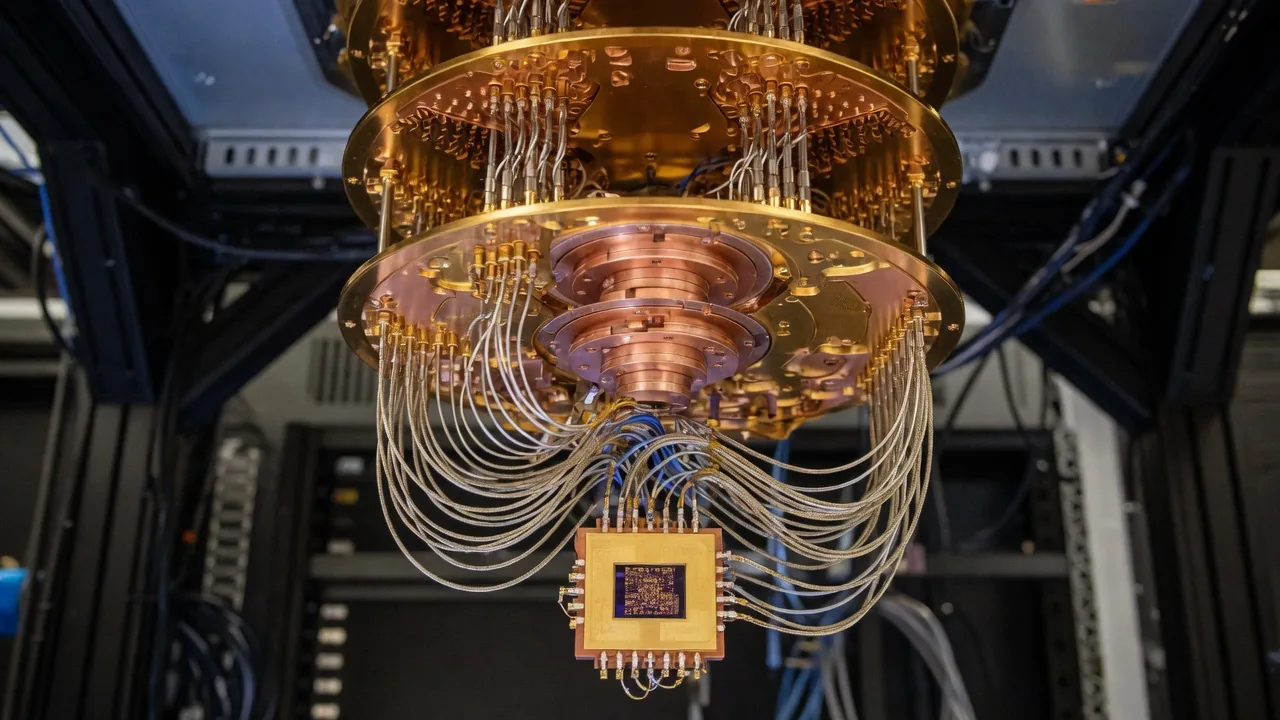
It is a physics- and hardware-focused path that sits at the intersection of quantum mechanics, electrical engineering, and materials science.
A quantum engineer works close to the physics, qubit hardware, cryogenics, control electronics, and error correction. A quantum developer works at the software layer: circuits, SDKs, and algorithms in Python. If writing code appeals to you more than lab work and physics, see the quantum developer guide instead.
Key skills you will build
Step 01 · Foundations Master the maths and quantum mechanics
Quantum engineering is physics-heavy. Build a solid base in linear algebra, complex numbers, and the formalism of quantum mechanics: state vectors, operators, the Dirac notation, and how measurement collapses a state. Unlike the software path, you should also be comfortable with the density-matrix description of mixed states, since real qubits are never perfectly pure.
Where to learn it
Step 02 · Core concepts Understand qubits, gates, and measurement physically
Learn what a qubit is, how gates rotate a state, and what measurement does, but with a physical lens. A quantum engineer cares not just that an H gate exists, but how it is physically realized as a pulse, and why a qubit only holds its state for a finite coherence time. Use the Bloch sphere as your mental model for single-qubit dynamics.
Where to learn it
Step 03 · Qubit modalities Study the physical qubit platforms
The defining knowledge of a quantum engineer is how qubits are actually built. Study the major modalities (superconducting circuits, trapped ions, neutral atoms, photonics, and topological approaches) and understand the trade-offs in coherence, connectivity, gate speed, and scalability. Know why a transmon needs millikelvin temperatures while a trapped ion uses lasers in a vacuum chamber.
Where to learn it
Step 04 · Noise & decoherence Learn how real qubits fail
Real hardware is noisy. Understand decoherence, relaxation (T1) and dephasing (T2), and how the environment corrupts quantum information. Learn to describe noise rigorously with quantum channels and Kraus operators, and how to benchmark a device with metrics like quantum volume. This is the language used to characterize and improve hardware.
Where to learn it
Step 05 · Control Get hands-on with control and characterization
Engineers control qubits with precisely shaped electromagnetic pulses and read out the results. Learn pulse-level programming, how gates are calibrated, and how to characterize a device experimentally. Simulating superconducting systems and modeling device noise in code bridges the gap between theory and the lab bench.
Where to learn it
Step 06 · Error correction Learn quantum error correction and fault tolerance
Useful quantum computers will be built on logical qubits protected by error-correcting codes. Study the repetition code, then the surface code, and understand what fault tolerance requires of the underlying hardware. Quantum error correction is one of the most in-demand specializations in the field and sits squarely at the hardware-theory boundary.
Where to learn it
Step 07 · Specialize Pick a hardware specialization and go deep
Quantum hardware spans many disciplines: cryogenic and microwave engineering for superconducting systems, laser and vacuum systems for trapped ions and neutral atoms, photonics, materials science and fabrication, and FPGA-based control electronics. Choose a modality and a layer of the stack, then build deep expertise through formal courses. Hardware roles reward specialists.
Where to learn it
Step 08 · Projects Build experimental and simulation projects
Demonstrate ability through projects: simulate a noise model and propose a mitigation, reproduce a published characterization experiment, implement an error-correcting code in a simulator, or run a hardware benchmark on a real device over the cloud. Document your methodology clearly. Engineering employers value rigorous, reproducible work over flashy demos.
Where to learn it
Step 09 · Get hired Apply for quantum engineering roles
Target quantum hardware engineer, quantum error correction researcher, and experimental physicist roles at hardware companies and national labs. Many positions favor or require a physics or electrical engineering graduate degree, so weigh further study against industry experience. Prepare for interviews that probe physics depth and lab intuition, and review compensation before negotiating.
Where to learn it