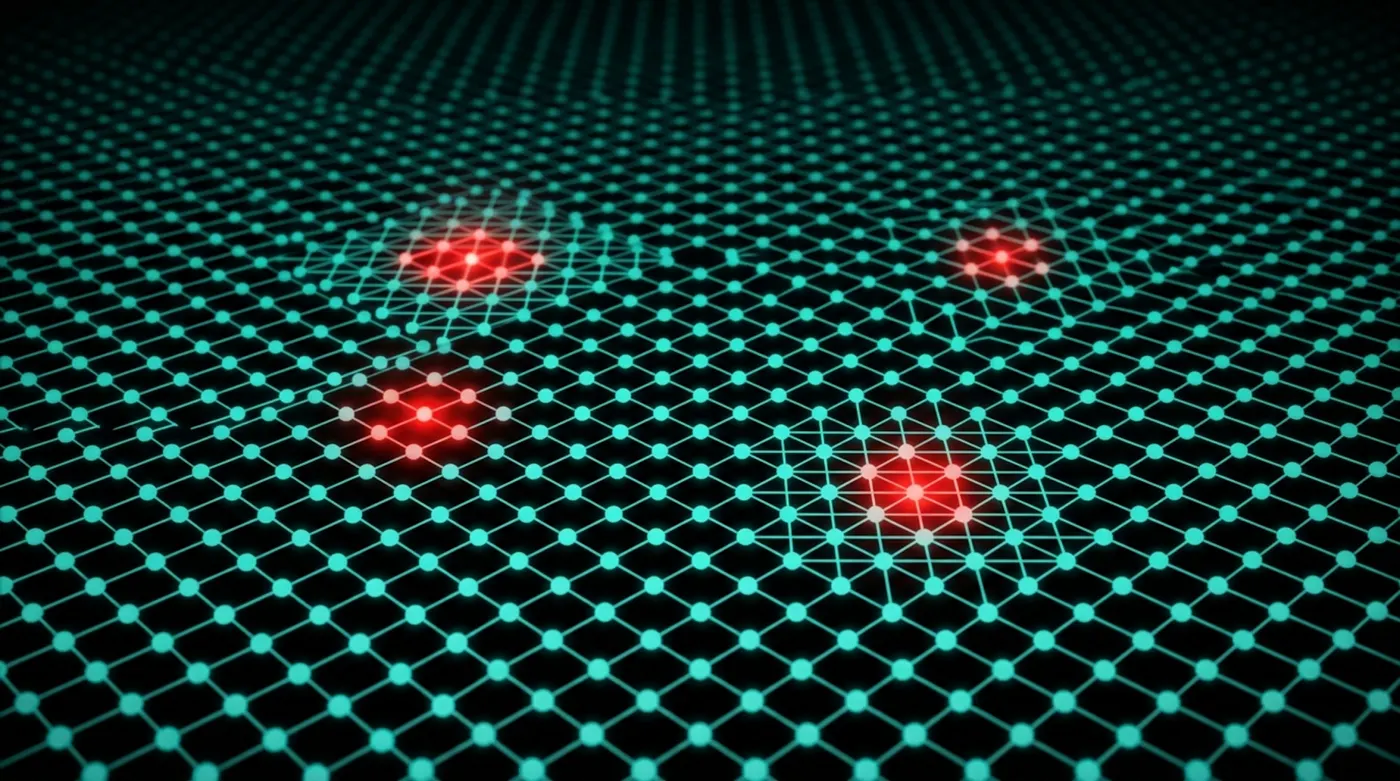
When headlines say a quantum computer has “1,000 qubits,” they mean physical qubits: the actual hardware components that store quantum information. Physical qubits are noisy. They suffer gate error rates of and lose their quantum state within microseconds to milliseconds. These numbers are far too bad to run complex algorithms.
A logical qubit is different. It is one well-protected qubit of information, encoded redundantly across many physical qubits using quantum error correction. Errors in individual physical qubits are detected and corrected continuously, so the logical qubit remains intact throughout long computations. The logical qubit is the unit of computation in a fault-tolerant machine.
The details
The encoding works by spreading the quantum information across an entangled state of many physical qubits, no single one of which carries the full logical state. Syndrome measurements reveal whether any physical qubit has suffered a bit-flip or phase-flip error, without collapsing the logical information. A classical decoder processes these syndromes and applies corrections.
The physical overhead is the key number. Using the surface code, which is the leading practical error correction code, rough estimates at current error rates require:
- Physical gate error rate : roughly physical qubits per logical qubit
- Physical gate error rate : roughly physical qubits per logical qubit
This ratio improves as physical qubit quality improves. The threshold theorem says that below roughly physical error rate, adding more physical qubits per logical qubit always helps. Current best superconducting devices achieve two-qubit gate error, placing them just inside the threshold.
To run Shor’s algorithm against RSA-2048 requires approximately logical qubits. At current surface code overhead, that implies roughly million physical qubits. IBM’s largest processor as of 2025 has around physical qubits with no error correction active. The gap is large.
Logical error rates achievable in principle: with sufficient physical qubit overhead, logical error rates can be suppressed to per gate or better, compared to for the physical qubits underneath.
The unit that headlines usually skip
The physical/logical qubit distinction is the most important clarifying concept when reading quantum computing news. A claim that a computer has qubits should prompt the question: are these physical or logical?
No current machine operates with fully active error correction producing true logical qubits in the fault-tolerant sense. Experiments have demonstrated small logical qubits (Google demonstrated a logical qubit using 49 physical qubits in 2023 and showed improved logical error rates with more physical qubits), but a production-scale fault-tolerant machine with thousands of logical qubits does not yet exist.
This distinction also explains why building quantum computers is so resource-intensive. The hardware challenge is not just making qubits; it is making enough high-quality physical qubits per logical qubit while maintaining the control electronics, cryogenic cooling, and classical processing infrastructure to support the whole error correction stack.
Common misconceptions
Misconception 1: Logical qubits are just better physical qubits. Logical qubits are not a hardware component; they are a software/architecture construct built on top of physical hardware through error correction. The same physical qubit hardware becomes a logical qubit through the addition of encoding circuits, syndrome measurements, and a classical decoder.
Misconception 2: Having logical qubits means the computer is fault-tolerant. A machine demonstrating a single logical qubit with lower error than the underlying physical qubits is not yet a fault-tolerant computer. Full fault tolerance requires also that the error correction operations themselves (gate operations on logical qubits) are implemented fault-tolerantly, so that errors do not propagate catastrophically during correction.
Misconception 3: The physical-to-logical qubit ratio is fixed. The overhead ratio depends on the physical error rate, the code distance chosen, and the specific error correction code used. Lower physical error rates allow using smaller code distances, reducing overhead dramatically. Research into more efficient codes and better decoders is continuously improving the ratio.