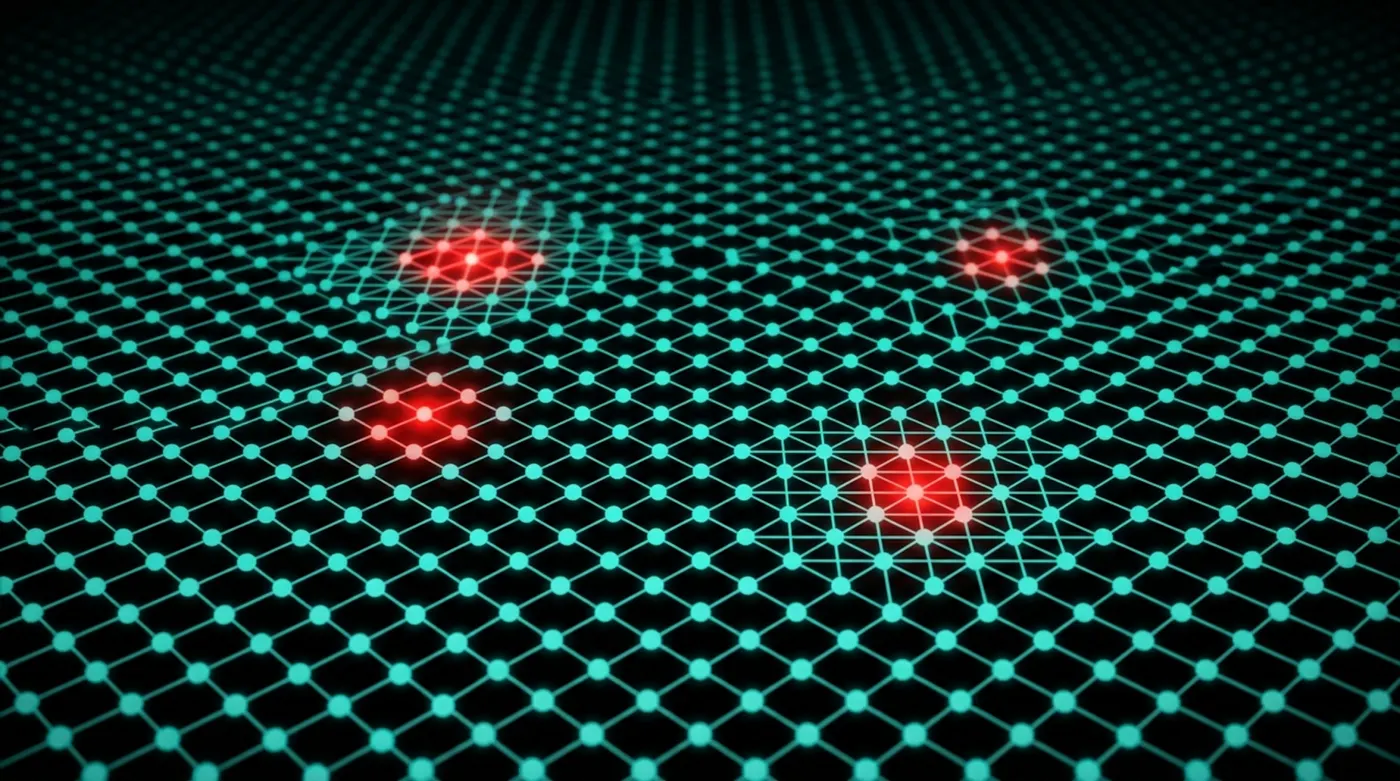
Quantum error correction (QEC) solves an apparently impossible problem: detecting and fixing errors in a qubit without ever measuring it. Measuring a qubit collapses its superposition and destroys the quantum information you were trying to protect. Yet without error correction, noise accumulates with every gate operation and eventually ruins the computation.
QEC threads this needle using a clever indirect approach: spread the quantum information across many entangled qubits, then measure collective properties of those qubits rather than the individual state. This reveals what kind of error occurred without revealing the quantum state itself.
The details
Classical error correction works by copying bits. Send as ; if you receive , majority vote says the original was . This is forbidden in quantum mechanics: the no-cloning theorem prohibits copying unknown quantum states.
QEC instead encodes one logical qubit across many physical qubits in a specific entangled pattern. The logical state is protected as long as not too many physical qubits experience errors simultaneously.
Errors on physical qubits are categorized using Pauli gates:
- X errors: Bit flips ()
- Z errors: Phase flips ()
- Y errors: Simultaneous bit and phase flip
Syndrome measurements are the key technique. Instead of measuring the qubit state directly, ancilla qubits are entangled with the data qubits and measured. The ancilla measurement outcomes form the error syndrome, a pattern that identifies which Pauli error occurred on which qubit, without collapsing the logical state. A classical decoder then determines which corrections to apply.
Three codes to understand in increasing order of practicality:
3-qubit repetition code: Encodes and . Detects and corrects single bit-flip errors by majority vote, but offers no phase-flip protection.
Shor code (9 qubits): Protects against all single-qubit errors (X, Y, and Z). Uses 9 physical qubits per logical qubit. Historically important as the first complete QEC code.
Surface code: The leading practical candidate. Uses a 2D grid of qubits with nearest-neighbor interactions only. Requires roughly physical qubits per logical qubit at current error rates, but has a threshold of approximately physical error rate.
The threshold theorem: If physical gate error rates fall below the code-specific threshold, logical error rates can be suppressed exponentially by increasing code size. Below threshold, adding more physical qubits always reduces the logical error rate.
Current best superconducting qubits achieve two-qubit gate error, just inside the surface code threshold. The logical error rate still needs orders of magnitude of suppression for most useful algorithms.
What has to work before a logical qubit exists
Error correction is the bridge between NISQ devices and fault-tolerant quantum computing. Without it, quantum computers are limited to shallow circuits where noise has not yet overwhelmed the signal. With it, in principle, quantum computers can run algorithms of arbitrary depth, making Shor’s algorithm and fault-tolerant quantum chemistry feasible.
Understanding QEC helps you interpret hardware progress. When a company announces a new qubit count or gate fidelity improvement, the relevant question is: how does this change the physical-to-logical qubit overhead? A improvement in gate fidelity can reduce the qubit overhead per logical qubit dramatically when you are close to the threshold.
The resource cost is sobering. Running Shor’s algorithm to factor RSA-2048 requires approximately logical qubits. At current surface code overhead, that implies roughly million physical qubits. IBM’s largest processor has about physical qubits. The gap defines the central challenge of the next decade.
Common misconceptions
Misconception 1: Quantum error correction is just classical error correction applied to qubits. The structures are completely different. Classical error correction copies bits and votes. QEC cannot copy; it instead uses entanglement and indirect measurement. The mathematical framework (stabilizer formalism, Pauli groups, syndrome extraction) has no classical analogue.
Misconception 2: Any error rate below 1% is good enough for fault tolerance. The figure is the threshold, meaning you can suppress errors further by adding more physical qubits per logical qubit. Being below threshold is necessary but not sufficient. You still need to add enough qubits to reach the extremely low logical error rates required for useful algorithms.
Misconception 3: Error correction works perfectly once you are below threshold. Even below threshold, QEC has a residual error rate that depends on the code distance and physical error rate. More physical qubits per logical qubit give a lower logical error rate, but never zero. The goal is to push logical errors low enough that they are negligible for a given algorithm’s length.