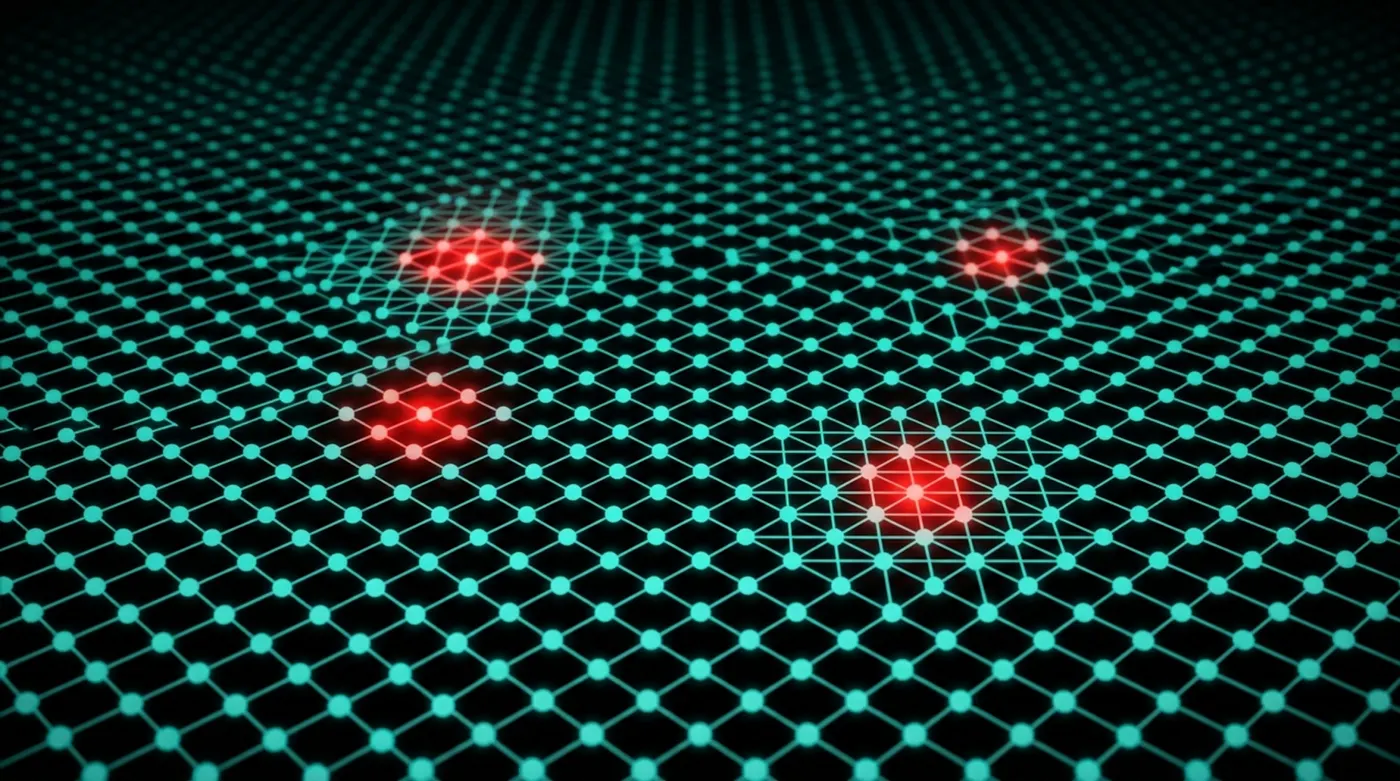
The surface code is currently the most practical quantum error correction code for building fault-tolerant quantum computers. It arranges physical qubits on a two-dimensional grid and detects errors using only nearest-neighbor interactions, making it compatible with the physical connectivity of most hardware platforms. Its high error threshold (around physical gate error rate) and the availability of efficient decoding algorithms make it the leading candidate for near-term fault-tolerant quantum computing.
Every major quantum computing roadmap, including those from IBM, Google, and Microsoft, relies on the surface code or closely related topological codes.
The details
The surface code encodes one logical qubit into a grid of physical qubits, where is the code distance. The physical qubits are divided into two types:
- Data qubits: Store the logical quantum information
- Ancilla (measure) qubits: Used for syndrome extraction; placed between data qubits
The ancilla qubits are used to measure two types of stabilizers:
- X-type stabilizers: Measure the parity of four neighboring data qubits in the X basis. Detect Z (phase-flip) errors.
- Z-type stabilizers: Measure the parity of four neighboring data qubits in the Z basis. Detect X (bit-flip) errors.
A small 3x3 example (d=3, so distance-3 surface code):
D ─ X ─ D
│       │
Z   D   Z
│       │
D ─ X ─ D
(D = data qubit, X = X-stabilizer ancilla, Z = Z-stabilizer ancilla)
Each stabilizer measurement is performed by entangling the ancilla with its four neighbors, then measuring the ancilla. The measurement outcome (a syndrome bit) is 0 if no error occurred and 1 if an odd number of errors occurred in that stabilizer’s neighborhood. Importantly, the measurement reveals information about errors without collapsing the logical qubit state.
A classical decoder (typically minimum-weight perfect matching, MWPM) processes the syndrome bits and determines the most likely error configuration. It then outputs a set of corrections to apply.
Threshold and overhead:
The surface code has a physical error rate threshold of approximately . Below threshold, increasing exponentially suppresses the logical error rate:
At physical error rate and threshold , a distance- code gives logical error rate:
| Code distance | Physical qubits per logical | Approximate logical error rate |
|---|---|---|
| 3 | 17 | ~ |
| 7 | 97 | ~ |
| 15 | 449 | ~ |
| 27 | 1{,}457 | ~ |
For Shor’s algorithm factoring RSA-2048, logical error rates below per gate are needed. At physical error, this requires roughly , or about physical qubits per logical qubit. With logical qubits needed, that is approximately million physical qubits total.
The code that sets the qubit budget
The surface code sets the scale for what fault-tolerant quantum computing will require. The numbers are sobering: millions of physical qubits, ultra-low error rates, and a real-time classical decoder that processes syndrome measurements at the clock rate of the quantum processor.
Google’s 2023 experiment directly demonstrated a key surface code property: logical error rates decreased when the code distance increased from to , the first experimental confirmation of below-threshold behavior in this code. This is a genuine milestone.
Understanding the surface code architecture helps interpret hardware announcements. When a company says they have qubits, the relevant question is whether those qubits are good enough and connected correctly to run surface code error correction.
Common misconceptions
Misconception 1: The surface code requires a 3D qubit arrangement. Despite the name suggesting a surface, the surface code arranges qubits on a flat 2D lattice. This 2D geometry is the key engineering advantage: it is compatible with how chips are fabricated. The “surface” refers to the code’s topological properties, not its physical arrangement.
Misconception 2: The surface code corrects any error. The surface code corrects errors affecting a number of qubits smaller than . If more than qubits are simultaneously in error (a “logical error”), the code can be defeated. Increasing increases the number of simultaneous errors required to defeat it, which is why larger distance reduces the logical error rate.
Misconception 3: Once you have the surface code running, fault-tolerant quantum computation is straightforward. The surface code protects memory but does not directly implement all logical gates fault-tolerantly. Clifford gates can be implemented via transversal operations. Non-Clifford gates (notably the T gate) require expensive magic state distillation procedures, which add roughly 10 to 100 times overhead in physical qubits per logical gate. The T gate count of an algorithm dominates its fault-tolerant resource estimates.