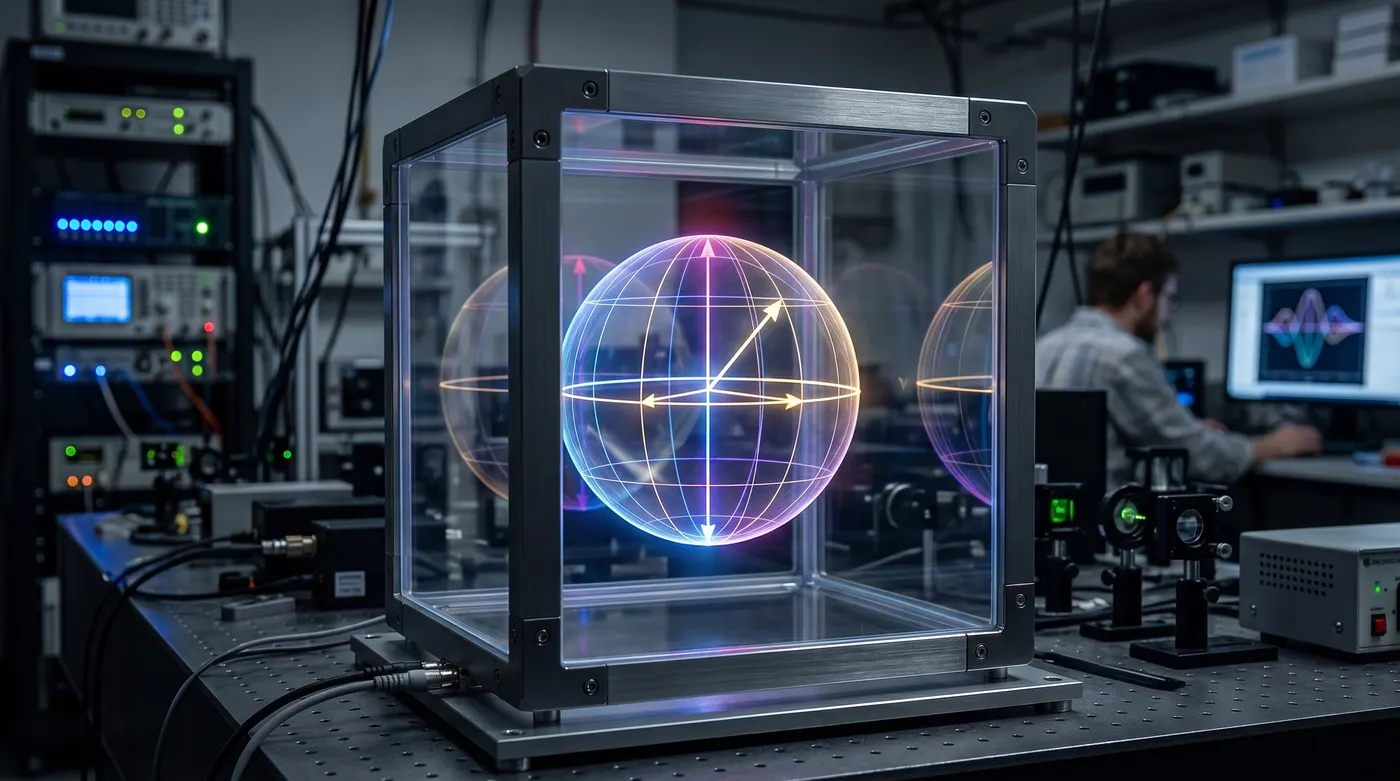
Superposition is the most frequently misrepresented concept in quantum computing. The common description, “a qubit is both 0 and 1 at the same time,” is technically accurate but dangerously easy to misinterpret. It sounds like a coin spinning in the air: definitely one face or the other, just unknown to us. Superposition is not that. The qubit genuinely has no definite value before measurement. This is not ignorance; it is a physical fact, confirmed by every interference experiment ever run.
Understanding superposition correctly is a prerequisite for understanding why quantum algorithms are powerful, and also what their limitations are.
The details
A qubit in superposition is described by a state vector:
where and are complex numbers satisfying . Measuring gives 0 with probability and 1 with probability .
The most important superposition state is created by the Hadamard gate acting on :
Both amplitudes equal , giving 50% probability for each outcome. The complementary state is:
These two states are physically different even though they have the same measurement statistics in the computational basis. The difference is the relative phase: has a amplitude on , while has a amplitude. This phase difference becomes observable through interference.
For qubits, applying Hadamard to each qubit creates a uniform superposition over all basis states:
This state encodes all possible -bit strings simultaneously, with equal amplitude.
The evidence for genuine superposition: If superposition were just classical uncertainty (a spinning coin), then quantum interference would not work the way it does. The double-slit experiment for single electrons demonstrates that particles genuinely pass through both slits at once; closing one slit changes the interference pattern in a way that is impossible if the electron always went through one particular slit.
What it does, and what it does not
Superposition alone does not give you computational power. This is the subtlest point and the most important:
A register of qubits in uniform superposition represents values simultaneously. But measuring it gives you one random value. You cannot “read out” all values. If superposition alone were the resource, quantum computers would just be random number generators.
What gives superposition its value is interference. Quantum algorithms manipulate the amplitudes in the superposition so that, by the time you measure, the amplitude for the correct answer is large and the amplitudes for wrong answers are small or zero. Shor’s algorithm uses the QFT to concentrate amplitude on the state encoding the period of a function. Grover’s algorithm uses repeated amplitude amplification. In both cases, the key resource is interference acting on a superposition.
The practical lesson: when you initialize a register with Hadamard gates, you are not “trying all inputs simultaneously” in any practically useful sense. You are setting up an initial state from which interference can extract useful information. The algorithm design must ensure that interference actually does this.
Common misconceptions
Misconception 1: Superposition means the qubit is randomly 0 or 1 and we just do not know which. This is classical uncertainty, not quantum superposition. A qubit in superposition is not secretly one value; it is genuinely in both states with a defined amplitude structure. The evidence is interference: two superpositions with opposite relative phases can cancel to give zero probability, which is impossible if they were just different probability distributions over definite values.
Misconception 2: Quantum computers try all inputs at once. The superposition holds all values, but measuring extracts only one. The trick is that you are not interested in reading out all inputs; you want the answer to a specific question. Quantum algorithms are designed so that interference concentrates probability on the answer. The superposition is the starting material, not the result.
Misconception 3: Superposition is destroyed when you apply gates. Gates transform superpositions into other superpositions. They do not collapse the state. Only measurement collapses the state. This is why long circuits are possible: many gates can be applied before measurement, each manipulating the amplitude structure in precise ways.