01 Hardware at a Glance
| Approach | Qubit count (2026) | 2-qubit fidelity | Coherence time | Connectivity | Cloud access |
|---|---|---|---|---|---|
| Superconducting | 127–1000+ | 99–99.9% (IBM Heron r2 best pairs) | ~100 microseconds | Heavy-hex / grid | IBM Quantum (free), Google (research), AWS Braket |
| Trapped Ion | 25–56 (algorithmic) | 99.5–99.9% | Seconds to minutes | All-to-all | IonQ via Braket / Azure / Google Cloud, Quantinuum via Azure Quantum |
| Neutral Atom | 256–1000+ | 99–99.5% | ~1 second | Reconfigurable | QuEra Aquila via AWS Braket (analog Hamiltonian simulation) |
| Photonic | N/A (optical modes) | N/A (probabilistic gates) | ~nanoseconds (photon loss) | Integrated optical circuits | Xanadu Borealis via Xanadu Cloud |
| Quantum Annealing (D-Wave) | 5000+ | N/A (not gate-based) | Microseconds (annealing schedule) | Pegasus graph | D-Wave Leap (free trial: 1 min QPU time in the first month) |
| Topological | Early stage (8 logical qubits demonstrated, Feb 2025) | Not yet publicly benchmarked | In principle much longer (hardware protected) | Linear chain | Not yet publicly cloud-accessible (research prototype) |
02 Superconducting Qubits
The industry workhorse with the widest ecosystem
| Specification | Superconducting Qubits |
|---|---|
| Qubit count (2026) | 127–1000+ |
| 2-qubit gate fidelity | 99–99.9% (IBM Heron r2 best pairs) |
| Coherence time | ~100 microseconds |
| Connectivity | Heavy-hex / grid (limited) |
| Cloud access | IBM Quantum (free), Google (research), AWS Braket |
| Best for | General algorithms, Grover, VQE, QAOA |
| Companies | IBM, Google, Rigetti, IQM |
| Frameworks | Qiskit (IBM), Cirq (Google), tket (any backend) |
How it works
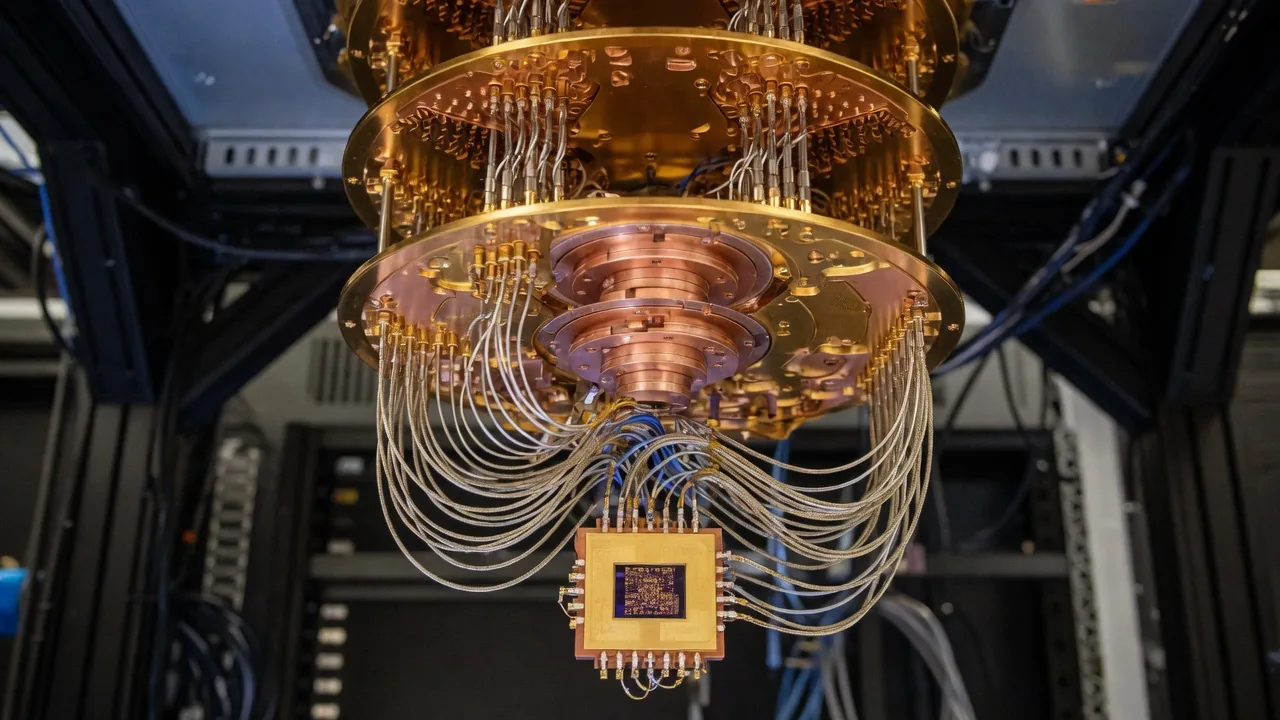
Superconducting qubits are tiny nonlinear circuits cooled to ~15 millikelvin inside a dilution refrigerator. A Josephson junction creates an anharmonic energy spectrum so the ground state |0⟩ and first excited state |1⟩ can be selectively driven with microwave pulses. Two-qubit gates (like CNOT or cross-resonance) couple neighbouring qubits capacitively or inductively. IBM's heavy-hex lattice reduces unwanted qubit-qubit crosstalk. Google Willow (2024) demonstrated error rates below the fault-tolerance threshold for the first time.
Key systems (2026)
IBM Heron r2 (156 qubits, ~99.9% two-qubit fidelity on best pairs) anchors the current fleet; the 127-qubit Eagle and the 1,121-qubit Condor demo chip were earlier milestones. Google Willow (105 qubits, ~99.7% average two-qubit fidelity, demonstrated below-threshold error correction).
Strengths
- Mature ecosystem with Qiskit, Cirq, and tket
- Free cloud access via IBM Quantum open plan
- Fastest gate times (10-100 ns) in the industry
- Among the largest gate-model qubit counts available today
- Extensive documentation, courses, and community
Limitations
- Short coherence (~100 microseconds) limits circuit depth
- Limited qubit connectivity requires SWAP overhead
- Requires dilution refrigerator at 15 millikelvin
- Fabrication variability between chips
When to use this platform
Learning, prototyping, and running most textbook algorithms (Grover, Shor, VQE, QAOA). The free IBM Quantum tier makes this the default starting point for anyone new to quantum computing.
Glossary: superconducting qubit, Josephson junction, VQE, QAOA
03 Trapped Ion Qubits
Highest gate fidelity and all-to-all connectivity
| Specification | Trapped Ion Qubits |
|---|---|
| Qubit count (2026) | 25–56 (algorithmic) |
| 2-qubit gate fidelity | 99.5–99.9% |
| Coherence time | Seconds to minutes |
| Connectivity | All-to-all (any qubit pair) |
| Cloud access | IonQ via Braket / Azure / Google Cloud, Quantinuum via Azure Quantum |
| Best for | High-fidelity circuits, deep algorithms, QEC demonstrations |
| Companies | IonQ, Quantinuum, Oxford Ionics, AQT |
| Frameworks | Qiskit (with IonQ/Quantinuum providers), Cirq, Amazon Braket |
How it works
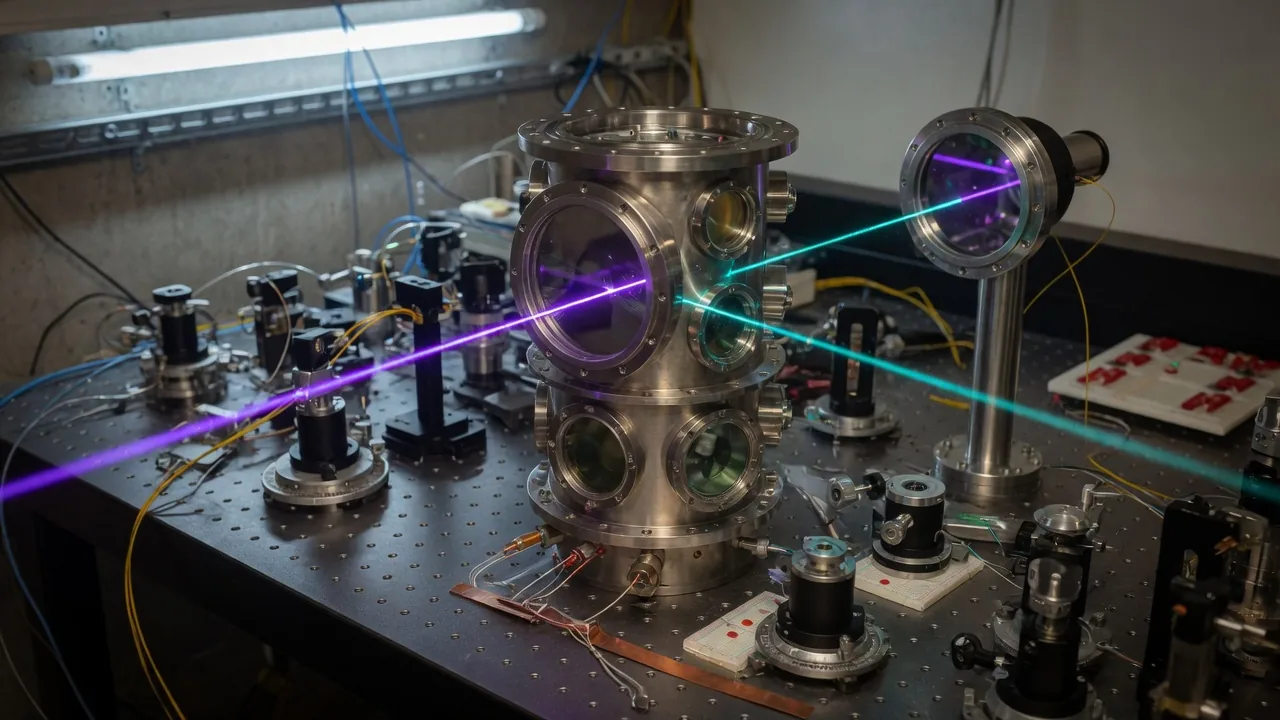
Individual atoms (typically Ytterbium or Barium) are ionised and suspended in a Paul trap using oscillating electric fields. Laser pulses or microwave radiation drive transitions between atomic hyperfine levels, acting as |0⟩ and |1⟩. Two-qubit gates use the shared motional modes of the ion chain: exciting the motion of one ion vibrates the whole chain, coupling it to any other ion. This gives full all-to-all connectivity with no SWAP overhead, which is a significant circuit depth advantage over nearest-neighbour architectures.
Key systems (2026)
IonQ Aria (25 qubits), IonQ Forte (36 qubits; IonQ reports an #AQ 36 score on its own algorithmic-qubit benchmark). Quantinuum H2 (56 qubits, ~99.9% two-qubit gate fidelity, among the highest published two-qubit fidelities of any commercial system, and the record quantum volume benchmark).
Strengths
- Highest gate fidelities (~99.9% two-qubit) of any commercial platform
- All-to-all connectivity eliminates SWAP overhead
- Long coherence times (seconds) enables deep circuits
- Identical qubits by nature (same ion species)
Limitations
- Slow gate times (1-100 microseconds vs nanoseconds for superconducting)
- Lower absolute qubit counts than superconducting
- Sensitive to vibration and laser noise
- Scaling to hundreds of qubits requires multi-trap architectures
When to use this platform
Algorithms requiring deep circuits or high fidelity: quantum error correction demonstrations, variational algorithms with many layers, and chemistry simulations where accuracy matters more than speed.
Glossary: trapped ion, quantum error correction, quantum volume
04 Neutral Atom Qubits
Reconfigurable arrays of thousands of atoms
| Specification | Neutral Atom Qubits |
|---|---|
| Qubit count (2026) | 256–1000+ |
| 2-qubit gate fidelity | 99–99.5% |
| Coherence time | ~1 second |
| Connectivity | Reconfigurable (atoms can be moved) |
| Cloud access | QuEra Aquila via AWS Braket (analog Hamiltonian simulation) |
| Best for | Optimization, quantum simulation, analog computing |
| Companies | QuEra, Pasqal, Atom Computing, Infleqtion |
| Frameworks | Amazon Braket (QuEra Aquila), Bloqade.jl (Julia, neutral atom simulation) |
How it works
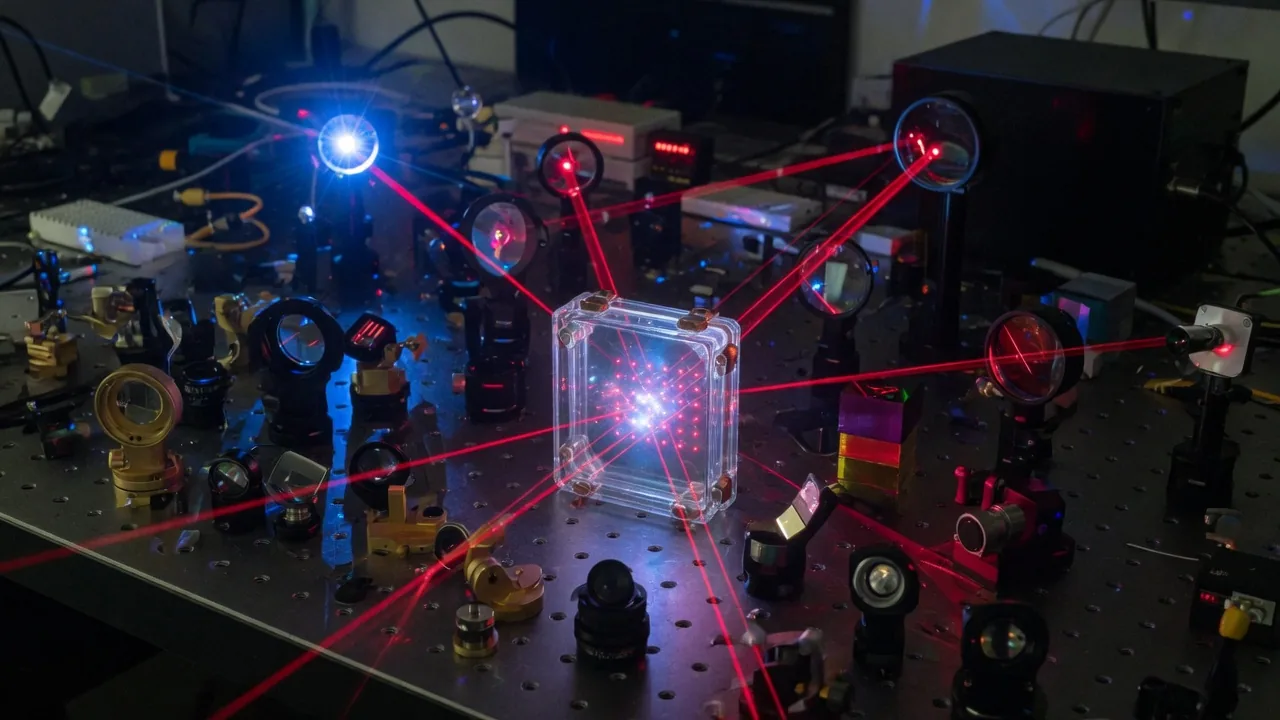
Neutral atoms are laser-cooled to microkelvin temperatures and trapped in arrays of optical tweezers: tightly focused laser beams that each hold a single atom. The atomic ground and hyperfine states encode |0⟩ and |1⟩. Unlike trapped ions, the atoms carry no charge, making them immune to electric field noise. Two-qubit gates use Rydberg excitation: laser pulses promote atoms to high-energy Rydberg states where enormous electric dipole moments create strong nearest-neighbour interactions (Rydberg blockade). Uniquely, the tweezer arrays can be reconfigured mid-circuit, effectively rewiring the qubit connectivity on the fly.
Key systems (2026)
QuEra Aquila (256 qubits, analog Hamiltonian simulation mode, available on AWS Braket). Pasqal Fresnel (100 qubits). Atom Computing demonstrated a 1,180-qubit array on its second-generation system in 2023 (its first-generation Phoenix had ~100 qubits).
Strengths
- Reconfigurable connectivity: atoms can be physically moved between operations
- Large qubit counts (256-1000+) already demonstrated
- Long coherence times (~1 second)
- Supports both analog and digital operating modes
Limitations
- Atom loss means qubit loss (no mid-circuit atom replacement yet at scale)
- Gate fidelities still improving (currently ~99%)
- Slower gates than superconducting
- Cloud access currently limited to analog mode (QuEra Aquila on Braket)
When to use this platform
Quantum simulation of spin models and optimization problems, especially when dynamic connectivity is needed. The analog Hamiltonian simulation mode on QuEra Aquila is ideal for studying quantum phase transitions and Ising-type optimization.
Glossary: neutral atoms, Rydberg atom, quantum simulation
05 Photonic / Continuous-Variable
Quantum computing with light at room temperature
| Specification | Photonic / Continuous-Variable |
|---|---|
| Qubit count (2026) | N/A (optical modes) |
| 2-qubit gate fidelity | N/A (probabilistic gates) |
| Coherence time | ~nanoseconds (photon loss) |
| Connectivity | Integrated optical circuits |
| Cloud access | Xanadu Borealis via Xanadu Cloud |
| Best for | Boson sampling, Gaussian simulation, quantum networking research |
| Companies | Xanadu, PsiQuantum, QuiX Quantum |
| Frameworks | Strawberry Fields (Xanadu), PennyLane (photonic device support) |
How it works
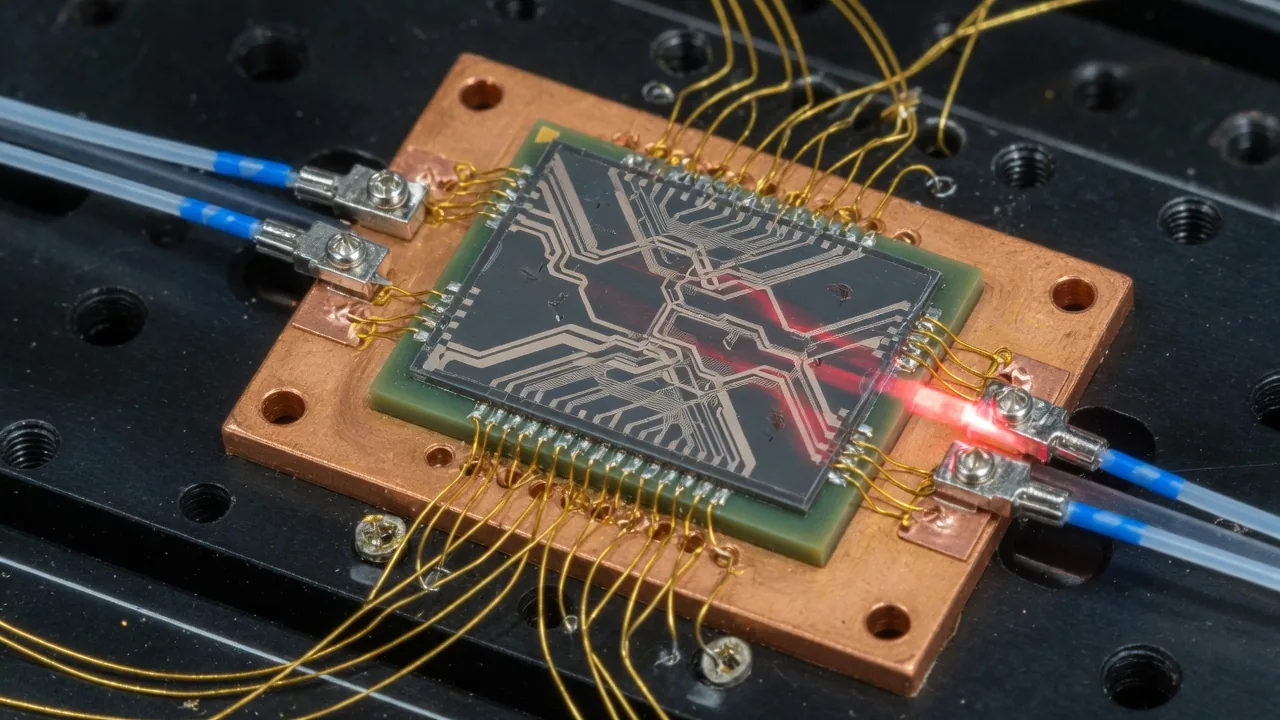
Photonic quantum computers encode quantum information in the quantum states of light. The continuous-variable (CV) approach used by Xanadu works with squeezed light: states of light where the quantum noise in one quadrature is reduced below the vacuum level. Beamsplitters and phase shifters implement linear optical transformations. Measurement is done by homodyne detection. Crucially, the photonic chip itself operates at room temperature, though the best single-photon detectors (superconducting nanowire) require cooling. PsiQuantum targets fault-tolerant photonic computing via photon fusion at scale.
Key systems (2026)
Xanadu Borealis (216 time-bin modes, demonstrated Gaussian Boson Sampling advantage in 2022, available via cloud). PsiQuantum (in development, targeting millions of photons via silicon photonics foundry processes).
Strengths
- Room temperature chip operation (no dilution fridge)
- Photons travel at the speed of light: natural for quantum networking
- Silicon photonics leverages mature semiconductor fabs
- Photons do not decohere (they only get lost)
Limitations
- Probabilistic gates: two-photon interactions are hard to engineer deterministically
- Photon loss is the dominant error source
- Universal quantum computation requires very large overhead
- High-quality single-photon sources remain challenging
When to use this platform
Boson sampling experiments, Gaussian quantum chemistry simulations, and quantum networking or repeater research. Not yet competitive with gate-based platforms for general algorithms.
Glossary: continuous variable, boson sampling, continuous variable
06 Quantum Annealing (D-Wave)
Massive qubit counts for combinatorial optimization
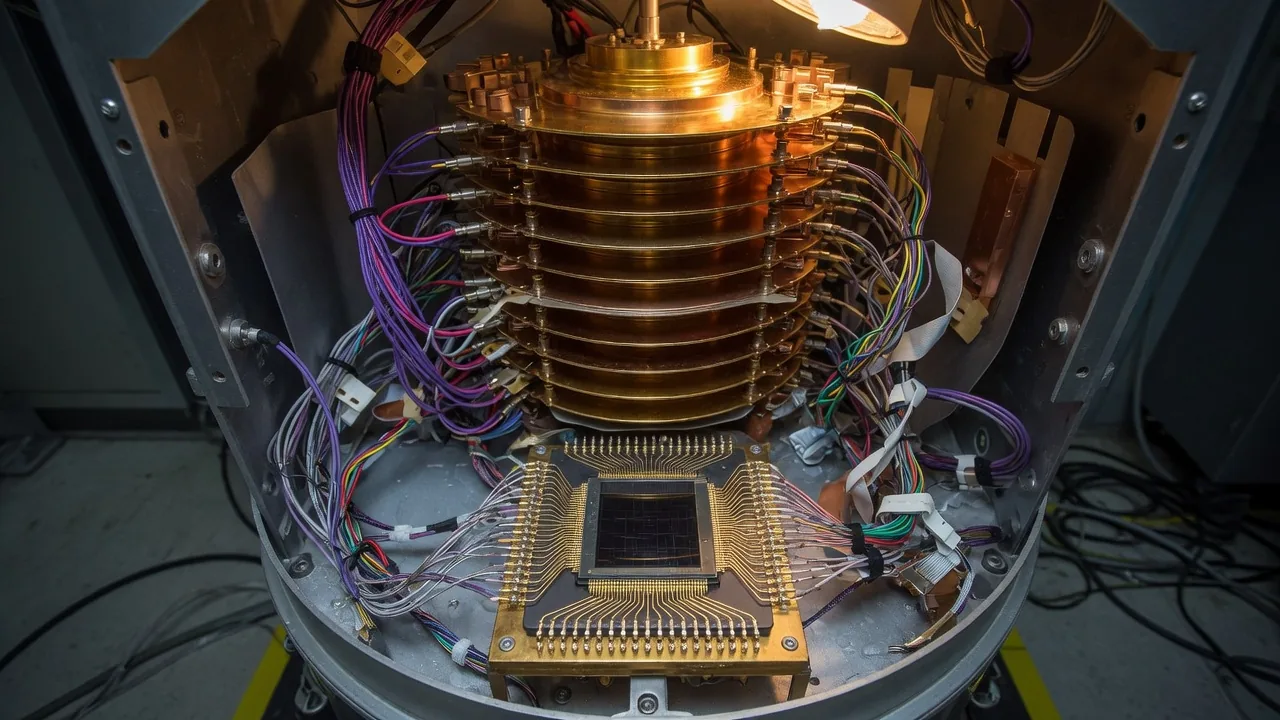
| Specification | Quantum Annealing (D-Wave) |
|---|---|
| Qubit count (2026) | 5000+ |
| 2-qubit gate fidelity | N/A (not gate-based) |
| Coherence time | Microseconds (annealing schedule) |
| Connectivity | Pegasus graph (~15 connections per qubit) |
| Cloud access | D-Wave Leap (free trial: 1 min QPU time in the first month) |
| Best for | QUBO optimization, scheduling, logistics, portfolio optimization |
| Companies | D-Wave |
| Frameworks | D-Wave Ocean SDK |
How it works
Quantum annealing is not gate-based computing. The processor encodes an optimization problem as an Ising Hamiltonian: a network of interacting spins. The system starts in a quantum superposition (transverse field) and slowly evolves (anneals) toward the ground state of the problem Hamiltonian. Quantum tunneling lets the system escape local minima that would trap a classical simulated annealer. D-Wave Advantage uses a Pegasus graph where each qubit connects to up to 15 others. Problems must be formulated as QUBO (Quadratic Unconstrained Binary Optimization) or Ising models. D-Wave also offers hybrid classical-quantum solvers for large problems that exceed the native QPU connectivity.
Key systems (2026)
D-Wave Advantage (5000+ qubits, Pegasus graph topology). Advantage2 (generally available since May 2025: 4,400+ qubits, Zephyr graph with 20 connections per qubit, higher energy scale and lower noise). Hybrid solvers handle problems up to 1 million variables.
Strengths
- Largest qubit counts of any commercial quantum system (5000+)
- Proven results on real optimization problems (scheduling, logistics)
- Free trial available via D-Wave Leap
- Hybrid solvers scale to million-variable problems
Limitations
- Only solves QUBO / Ising formulations: not a universal computer
- Limited connectivity (Pegasus graph) requires problem embedding
- Not suitable for algorithms requiring arbitrary quantum gates
- Quantum advantage over classical optimization remains contested for most practical problems
When to use this platform
Any combinatorial optimization problem that can be expressed as QUBO: vehicle routing, scheduling, portfolio optimization, protein folding formulations, and network design. The Ocean SDK makes QUBO formulation straightforward.
Glossary: quantum annealing, QUBO, Ising model
07 Topological Qubits
Hardware-protected qubits for long-term fault tolerance (early stage)
| Specification | Topological Qubits |
|---|---|
| Qubit count (2026) | Early stage (8 logical qubits demonstrated, Feb 2025) |
| 2-qubit gate fidelity | Not yet publicly benchmarked |
| Coherence time | In principle much longer (hardware protected) |
| Connectivity | Linear chain (current prototypes) |
| Cloud access | Not yet publicly cloud-accessible (research prototype) |
| Best for | Long-term fault-tolerant computation, research into protected qubits |
| Companies | Microsoft |
| Frameworks | Q# (Azure Quantum), Azure Quantum Development Kit |
How it works
Topological qubits encode quantum information in non-local degrees of freedom of a physical system, making the qubit state intrinsically protected from local noise. Microsoft's approach uses Majorana zero modes: exotic quasiparticles that appear at the ends of a semiconductor nanowire coated with a superconductor (InAs/Al heterostructure). The qubit is defined by the parity of two Majorana modes at opposite ends of the wire. Local perturbations (thermal noise, charge fluctuations) affect only one end and cannot flip the qubit state without a correlated event at both ends simultaneously. Microsoft's Majorana 1 chip (February 2025) demonstrated the first topological qubit system. The claimed advantage is that the hardware suppresses errors at the physical level, potentially requiring fewer error correction rounds than superconducting or trapped-ion qubits to achieve the same logical error rate.
Key systems (2026)
Microsoft Majorana 1 (February 2025): 8 topological qubits demonstrated, targeting a million-qubit chip on a single device. Hardware is based on a superconductor-semiconductor heterostructure fabricated using TSMC-compatible processes. Current status: early research prototype.
Strengths
- Hardware-level error suppression (not just software correction)
- Target: million qubits on a single chip via semiconductor fab processes
- If successful: dramatically lower overhead than surface codes on other hardware
Limitations
- Still in early research stage - no publicly available cloud access at scale
- Majorana qubits are difficult to create and measure reliably
- No gate fidelity numbers published comparable to other platforms
- Independent verification of Majorana mode claims is ongoing
- Years to decades from practical large-scale quantum computation
When to use this platform
Currently not available for practical use. Follow Microsoft's Azure Quantum announcements for any future research preview access. Relevant for long-term planning if your workload requires millions of reliable logical qubits.
Glossary: topological quantum computing
08 Which Platform for Which Problem?
Use these decision cards to match your problem type to the right hardware. For a deeper comparison of the software frameworks that run on each platform, see the framework comparison page or explore the qubit connectivity glossary entry.
Do you have an optimization problem expressible as QUBO?
D-Wave Ocean
Scheduling, logistics, portfolio optimization, and any Ising-type problem.
Do you need maximum gate fidelity for deep circuits?
Trapped Ion (IonQ or Quantinuum)
All-to-all connectivity and ~99.9% two-qubit fidelity with seconds of coherence.
Are you learning or prototyping a new algorithm?
Superconducting (IBM Quantum, free)
Free cloud access, Qiskit ecosystem, and the most learning resources.
Are you working on quantum chemistry or Gaussian simulation?
Photonic (Strawberry Fields) or Superconducting (VQE)
Xanadu Borealis for Gaussian Boson Sampling; IBM or Rigetti hardware for VQE.
Do you need dynamic or reconfigurable qubit connectivity?
Neutral Atoms (QuEra)
Optical tweezers can physically reposition atoms between circuit layers.
Are you building quantum ML models or hybrid algorithms?
Any gate-based platform with PennyLane
PennyLane works across IBM, IonQ, Braket, and simulators with autograd support.
09 Cloud Cost Comparison
Approximate pricing as of mid-2026. Shot-based pricing means you pay per circuit execution; task fees are fixed per job submission. Always verify current pricing on the provider's own page before budgeting a project.
| Provider / system | Detail | Approximate cost | Notes |
|---|---|---|---|
| IBM Quantum | Open Plan: 10 min QPU time per month on 156-qubit Heron systems | Free | Paid plans for more time and priority access |
| IonQ Forte (via Braket) | Per-task + per-shot pricing | $0.30 / task + $0.08 / shot | |
| IQM Garnet (via Braket) | Superconducting, per-task + per-shot | $0.30 / task + $0.00145 / shot | |
| Quantinuum H-series (via Azure) | Credit-based system (HQCs) | Credit-based; see Azure Quantum pricing | Paid tiers for more credits |
| D-Wave Leap | QPU time quota | Free trial: 1 min QPU time (first month) | Paid plans for more time |
| Rigetti Cepheus (via Braket) | Per-task + per-shot pricing | $0.30 / task + $0.000425 / shot | |
| AWS SV1 Simulator | State vector simulator (up to 34 qubits) | $0.075 / minute of simulation time | |
| QuEra Aquila (via Braket) | Analog Hamiltonian simulation | $0.30 / task + $0.01 / shot |
Costs change frequently. For current pricing, see: AWS Braket pricing, Azure Quantum pricing, and D-Wave LEAP plans.
10 Continue Learning
Framework Syntax Comparison
Side-by-side code for Qiskit, Cirq, PennyLane, Braket, and Ocean.
Framework Tutorials
Step-by-step hello-world guides for every major quantum SDK.
Framework Reference Docs
Complete API summaries for Qiskit, Cirq, PennyLane, Braket, Ocean, and more.
Qubit Connectivity
Why connectivity topology matters for circuit depth and SWAP overhead.
Types of Qubits
How superconducting, trapped-ion, neutral-atom, spin, and NV-center qubits differ.
Glossary
Plain-language definitions for every quantum computing term used on this page.