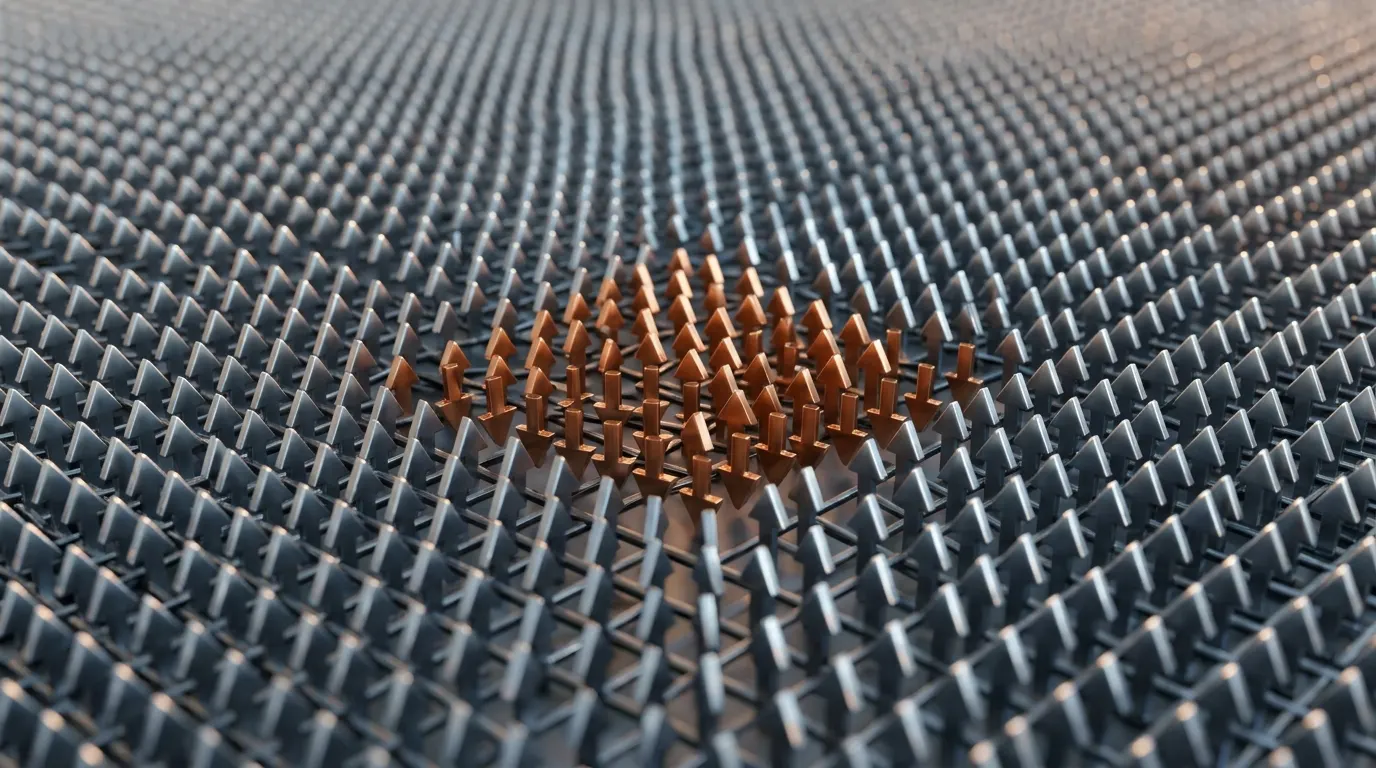
The Quantum Approximate Optimisation Algorithm (QAOA), introduced by Farhi, Goldstone, and Gutmann in 2014, is a near-term variational algorithm designed to find good solutions to combinatorial optimisation problems. These are problems where you must choose a configuration from a large discrete set to minimise or maximise some objective, such as partitioning a graph or scheduling tasks. Exact solutions are believed to require exponential time on any classical computer for the hardest instances. QAOA does not guarantee exact solutions either, but it systematically searches for good approximate ones by training a quantum circuit on a classical optimiser loop.
The details
Every QAOA instance starts by encoding the problem as a cost Hamiltonian whose ground state encodes the optimal solution. For MaxCut on a graph , where the goal is to partition vertices into two sets to maximise edges between them:
The circuit alternates between two parameterised unitaries applied times (the depth parameter):
where the cost unitary encodes the problem and the mixer unitary with drives exploration across the solution space. The circuit starts in a uniform superposition , which is an equal-weight superposition over all bitstrings.
The angles are optimised classically by repeatedly running the circuit, measuring the expectation value , and updating the angles. This is the same variational loop used in the Variational Quantum Eigensolver.
The key theoretical result is that as with angles chosen correctly, QAOA converges to the exact optimum, recovering adiabatic quantum computing in the limit. At for MaxCut, QAOA is analytically guaranteed to achieve at least times the optimal cut value on any 3-regular graph.
import pennylane as qml
from pennylane import qaoa
import numpy as np
from scipy.optimize import minimize

# MaxCut on a 4-node ring graph
edges = [(0, 1), (1, 2), (2, 3), (3, 0)]
cost_h, mixer_h = qaoa.maxcut(edges)

dev = qml.device("default.qubit", wires=4)

@qml.qnode(dev)
def circuit(params, p=2):
    for w in range(4):
        qml.Hadamard(wires=w)
    qaoa.cost_layer(params[0], cost_h)
    qaoa.mixer_layer(params[1], mixer_h)
    return qml.expval(cost_h)

params0 = np.random.uniform(0, np.pi, 2)
result = minimize(lambda p: -circuit(p), params0, method="COBYLA")
PennyLane’s qml.qaoa module and Qiskit’s QAOAnsatz both provide ready-made QAOA circuits with cost Hamiltonians for common graph problems.
The near-term algorithm people cite for optimization
QAOA is the algorithm most commonly cited when discussing near-term quantum advantage for optimisation. It sits at the intersection of quantum computing, machine learning (the classical optimiser loop), and combinatorial mathematics, making it a rich case study. Understanding QAOA requires understanding quantum circuits, variational methods (shared with VQE), and why running on NISQ hardware is both the motivation and the bottleneck.
QAOA also illustrates an important lesson: a quantum algorithm can be theoretically motivated, practically implementable on current hardware, and still lack a proven advantage over the best classical heuristics. Current evidence suggests classical solvers (simulated annealing, GUROBI) remain competitive or superior on problem sizes accessible to today’s hardware. Whether deeper QAOA circuits will outperform classical methods on larger instances is an open and actively contested research question.
Common misconceptions
Misconception 1: QAOA guarantees a quantum speedup for optimisation. No such guarantee exists. QAOA produces approximate solutions, and for the problem sizes reachable today, classical approximation algorithms often match or beat its solution quality. Quantum advantage for QAOA, if it exists, likely requires large and fault-tolerant hardware.
Misconception 2: Higher always means better performance on real hardware. In theory, larger improves approximation quality. In practice, deeper circuits on NISQ devices accumulate more noise, and beyond a certain depth the solution quality degrades. The optimal for noisy hardware is typically small (1 to 3 layers).
Misconception 3: QAOA and the Variational Quantum Eigensolver are the same algorithm. Both use parameterised circuits optimised by a classical loop, but they solve different problems. VQE minimises the energy of a quantum Hamiltonian (eigenvalue problem); QAOA maximises a classical objective function encoded as a diagonal Hamiltonian. The circuit structure and motivation are distinct even though the training loop is similar.