The definitive reading list, from popular science to graduate textbooks
Online courses build intuition and practical skills quickly, but books offer something different: depth, mathematical rigour, and a lasting reference you can return to at any point in your learning. A good textbook works through the proofs rather than skipping them, gives you a complete picture of a topic rather than a curated highlight reel, and holds up over years as your understanding deepens. This list covers the best books at every level, from popular science titles that require no prerequisites through to graduate references used in university research groups.
🔖
Amazon affiliate links - we earn a small commission at no extra cost to you.
No prerequisites
Popular Science
These books require no mathematics or physics background. They are the best starting point for curious readers, executives, and anyone who wants to understand what quantum computing is and why it matters before diving into the technical details.
01Popular
Computing with Quantum Cats
John Gribbin·
An accessible popular science account of how quantum computing emerged from the strange physics of superposition and entanglement. Gribbin traces the history from Schrodinger's cat through to early quantum processors.
Best for
General readers with no science background who want an engaging, jargon-light overview.
02Popular
Quantum Computing Since Democritus
Scott Aaronson·
A witty and intellectually demanding tour through quantum computing, complexity theory, and the nature of knowledge itself. Based on a popular lecture series, it is rigorous without requiring formal physics prerequisites.
Best for
Technically inclined readers who enjoy philosophy of computation alongside the theory.
03Popular
The Quantum Age
Brian Clegg·
A broad survey of quantum technologies including computing, cryptography, sensing, and communication, written for general audiences. Good for building intuition about the quantum technology landscape as a whole.
Best for
General readers who want context on where quantum computing sits among other quantum technologies.
04Popular
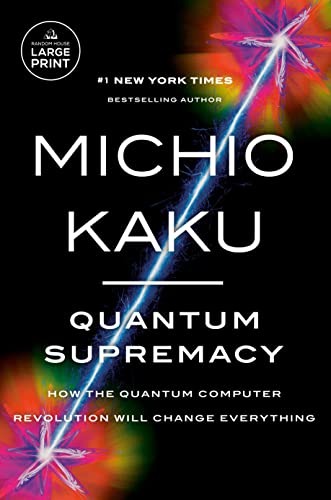
Quantum Supremacy
Michio Kaku·
A popular science overview of the quantum computing landscape and its potential societal impact, covering computing, cryptography, AI, and medicine. Kaku surveys the current state of the industry and speculates on near-future breakthroughs.
Best for
General readers who want an optimistic, big-picture view of where the field is heading.
Requires linear algebra
Undergraduate / Introductory Textbooks
These textbooks assume familiarity with linear algebra and basic probability. Some assume a little physics; others are written specifically for computer scientists. They are the right level for upper-division undergraduates and self-taught engineers who have done the maths prerequisites.
05Undergraduate
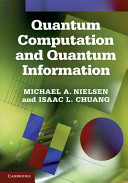
Quantum Computation and Quantum Information
Michael Nielsen & Isaac Chuang·
The definitive reference textbook for the field. It covers quantum circuits, algorithms, complexity, error correction, and quantum information theory from first principles, with rigorous proofs throughout. Every researcher owns a copy.
Best for
Anyone serious about the field. This is the standard reference regardless of background.
06Undergraduate
Introduction to Classical and Quantum Computing
Thomas G. Wong·
A self-contained textbook that starts from classical logic gates and binary arithmetic before building up to quantum gates, interference, and major algorithms including Deutsch-Jozsa, Grover, and Shor. Every step is shown in full - no hand-waving. Available free on the author's website.
Best for
Self-taught engineers and undergraduates who want the most methodical, no-gaps-allowed introduction available. The free PDF makes it the obvious first pick.
07Undergraduate
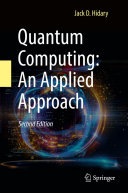
Quantum Computing: An Applied Approach
Jack Hidary·
A practical introduction combining conceptual explanation with real code in Qiskit and Cirq. Covers linear algebra foundations, major quantum algorithms, and hands-on circuit implementation. One of the few textbooks that keeps the code central rather than an afterthought.
Best for
Software engineers and developers who want a code-first path through the undergraduate material - less theorem, more runnable circuits.
08Undergraduate
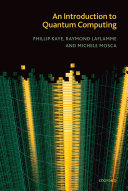
An Introduction to Quantum Computing
Phillip Kaye, Raymond Laflamme & Michele Mosca·
A clear and compact undergraduate textbook covering quantum circuits, key algorithms (Deutsch, Simon, Shor, Grover), and an introduction to error correction. The physics prerequisites are kept to a minimum.
Best for
Computer science students who want a clean, self-contained first textbook without heavy physics.
09Undergraduate
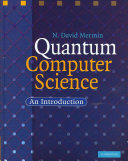
Quantum Computer Science: An Introduction
N. David Mermin·
A CS-focused introduction written by a physicist who wanted to spare computer scientists unnecessary physics baggage. The notation and framing are tailored for programmers and theorists rather than physicists.
Best for
Computer scientists who want a compact, no-physics-assumed introduction to quantum algorithms.
10Undergraduate
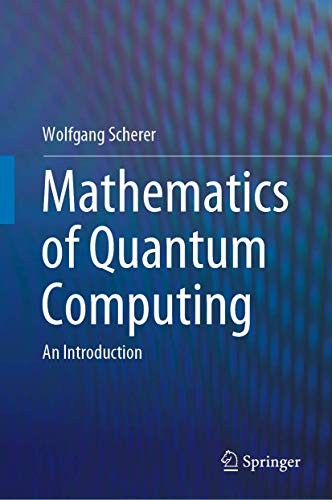
Mathematics of Quantum Computing
Wolfgang Scherer·
Covers the complete mathematical foundation: linear algebra, tensor products, probability, quantum mechanics formalism, quantum circuits, and major algorithms. Very explicit about the maths, making it ideal for bridging the gap between theory and implementation.
Best for
Students who want to build rigorous mathematical foundations before tackling Nielsen and Chuang.
Graduate level
Advanced / Graduate Texts
These are research-level references for those working at the frontier of quantum computing. They assume strong backgrounds in linear algebra, probability theory, and in some cases quantum mechanics. Recommended after you have worked through an undergraduate textbook.
11Graduate
Quantum Information Theory
Mark M. Wilde·
A rigorous graduate treatment of quantum Shannon theory, channel capacities, entropy measures, and quantum information protocols. Covers classical and quantum data compression, channel coding, and entanglement theory with full proofs.
Best for
Graduate students and researchers working on quantum communication, cryptography, or information theory.
12Graduate
Quantum Error Correction
Daniel A. Lidar & Todd A. Brun (eds.)·
A comprehensive graduate reference on quantum error correction, covering stabilizer codes, fault-tolerant computation, decoherence-free subspaces, and topological codes. Each chapter is written by leading researchers in that sub-area.
Best for
Researchers and advanced graduate students specialising in fault-tolerant quantum computation.
13Graduate
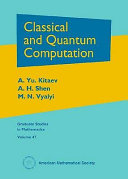
Classical and Quantum Computation
A. Yu. Kitaev, A. H. Shen & M. N. Vyalyi·
A theoretical computer science and mathematical physics approach to quantum computation, with a strong focus on complexity theory and the algebraic structures underlying quantum algorithms. Dense and rigorous.
Best for
Theoretical computer scientists interested in quantum complexity and the mathematical structures of quantum computation.
Specialised topic
Quantum Machine Learning
Quantum machine learning sits at the intersection of quantum computing and classical ML. These books cover quantum linear algebra subroutines, variational quantum circuits as ML models, and hybrid classical-quantum approaches.
14Specialised
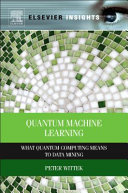
Quantum Machine Learning
Peter Wittek·
The foundational text on quantum ML: covers quantum linear algebra, quantum PCA, quantum support vector machines, and early hybrid approaches. Written before variational circuits dominated, so it focuses on near-ideal quantum speedups.
Best for
ML practitioners and researchers who want to understand the theoretical basis of quantum ML algorithms.
15Specialised
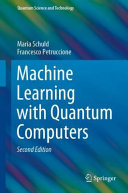
Machine Learning with Quantum Computers
Maria Schuld & Francesco Petruccione·
The modern treatment of quantum ML with PennyLane examples throughout. Covers quantum kernels, variational circuits, quantum neural networks, and the debate around genuine quantum advantage in ML tasks.
Best for
ML engineers and researchers who want a practical, up-to-date guide to variational and hybrid quantum ML.
Specialised topic
Post-Quantum Cryptography
Post-quantum cryptography designs classical cryptographic schemes that remain secure against quantum attacks. With NIST finalising post-quantum standards, this area is increasingly important for security engineers and cryptographers.
16Specialised
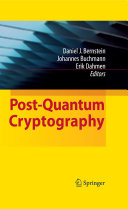
Post-Quantum Cryptography
Daniel J. Bernstein, Johannes Buchmann & Erik Dahmen (eds.)·
The academic reference for post-quantum cryptographic schemes, covering lattice-based, code-based, hash-based, and multivariate polynomial systems. Each chapter is written by the researchers who developed the relevant scheme.
Best for
Cryptographers, security engineers, and researchers who need rigorous coverage of quantum-resistant algorithms.
No books match your search.
We use cookies to improve your experience and track affiliate performance.
See our Cookie Policy.