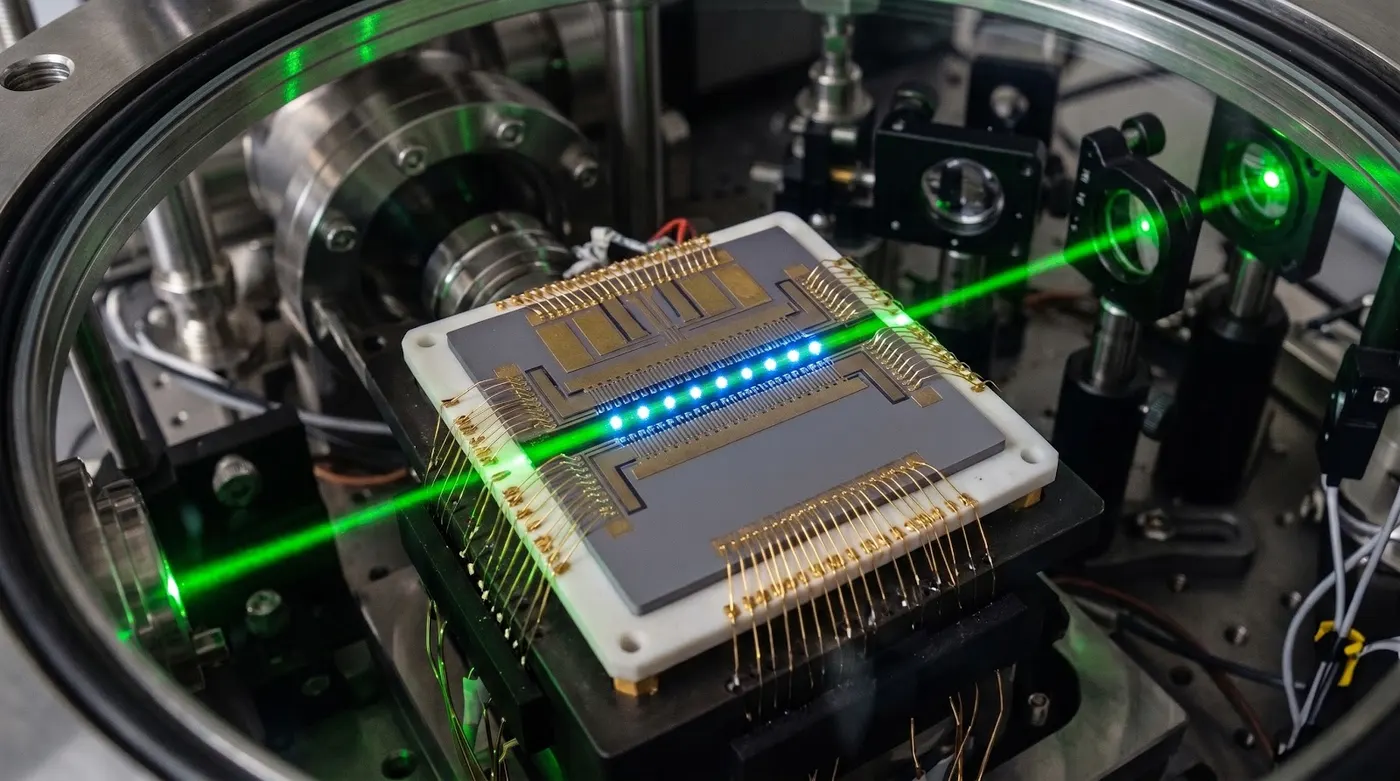
Trapped ion quantum computing uses individual charged atoms, held in place by electromagnetic fields, as qubits. This is one of the oldest qubit technologies and, as of 2026, the platform with the highest gate fidelities and longest coherence times of any scalable approach. IonQ and Quantinuum are the primary commercial players.
The core appeal is qubit quality. Trapped ions are natural, identical objects: every ytterbium-171 ion (for example) is exactly the same. They do not require chip fabrication with its inevitable variability. Their energy levels are defined by atomic physics to extraordinary precision. This gives them a fundamental advantage in coherence and gate fidelity over engineered alternatives.
The details
Physical mechanism: Individual ions (typically ytterbium Yb or barium Ba) are confined in a linear Paul trap, an electromagnetic trap that uses oscillating electric fields to hold charged particles. The ions form a chain in the trap, separated by Coulomb repulsion.
Qubit encoding: The two computational states and are encoded in either:
- Hyperfine levels: long-lived ground state spin sublevels separated by microwave frequencies (GHz). Coherence times of seconds to minutes.
- Optical levels: ground state and metastable excited state separated by optical frequencies. Faster manipulation but shorter coherence.
Single-qubit gates: Applied using laser beams or microwave radiation precisely tuned to the qubit transition frequency. Single-qubit gate fidelities routinely exceed .
Two-qubit gates: Implemented via the Molmer-Sorensen (MS) gate or related methods. The ions’ shared vibrational modes (phonons) of the ion chain act as a bus connecting distant ions. Applying laser pulses that couple to the internal state and the motional modes creates an effective interaction between any two ions in the chain. This provides all-to-all connectivity: any pair of qubits can interact directly without SWAP gates.
Two-qubit gate fidelities from leading platforms:
- Quantinuum H-series:
- IonQ Forte:
For comparison, best superconducting two-qubit gate fidelities are on neighboring pairs only.
Coherence times: Hyperfine-encoded trapped ions maintain coherence for seconds to thousands of seconds, compared to microseconds for superconducting qubits. The gate budget (coherence time / gate time) for trapped ions is enormous despite slow gates.
Gate speed: The main disadvantage. Two-qubit gates take , compared to for superconducting qubits. This limits the number of operations per second.
Scalability: A single Paul trap holds on the order of ions stably. Adding more ions complicates the vibrational mode structure, making two-qubit gates harder to implement. Current research focuses on modular architectures: linking multiple small, high-fidelity traps using photonic interconnects to create a larger quantum processor.
Fewer qubits, higher fidelity
Trapped ions illustrate a key principle in quantum hardware: quality and quantity are not the same thing. Superconducting processors have more qubits; trapped ion processors have better qubits. Which matters more depends on the application.
For small quantum computations where algorithm depth matters, trapped ions can outperform larger superconducting devices because their lower error rates per gate mean the circuit can run much deeper before noise overwhelms it. For large-scale computation requiring thousands of qubits, the scalability challenges of trapped ions become the bottleneck.
The all-to-all connectivity of trapped ions is also educationally important. Most superconducting architectures have nearest-neighbor connectivity; running an algorithm that needs long-range qubit interactions requires SWAP gates, which increase circuit depth and error. Trapped ions avoid this overhead entirely for small system sizes.
Common misconceptions
Misconception 1: Trapped ions are slow and therefore less useful. Slow gates are a disadvantage for raw computational throughput, but what matters for algorithm success is the gate budget (coherence time / gate time), not gate speed alone. Trapped ions have enormous gate budgets. For algorithms that fit within those budgets, slow gates with high fidelity produce better results than fast gates with lower fidelity.
Misconception 2: Trapped ions cannot scale to thousands of qubits. Current single traps are limited, but modular approaches are actively being developed. Photonic links between ion trap modules allow qubit connections without requiring all ions in one trap. The qubit shuttle approach (moving ions between zones within a larger chip trap) is another active direction.
Misconception 3: All trapped ion systems use the same species. Different ion species have different properties. Ytterbium and barium are favored for their accessible microwave transitions and convenient laser wavelengths. Calcium-40 is used in many research systems. Mixed-species crystals (e.g., combining ytterbium for computation and barium for sympathetic cooling) are used to manage heating issues during computation.