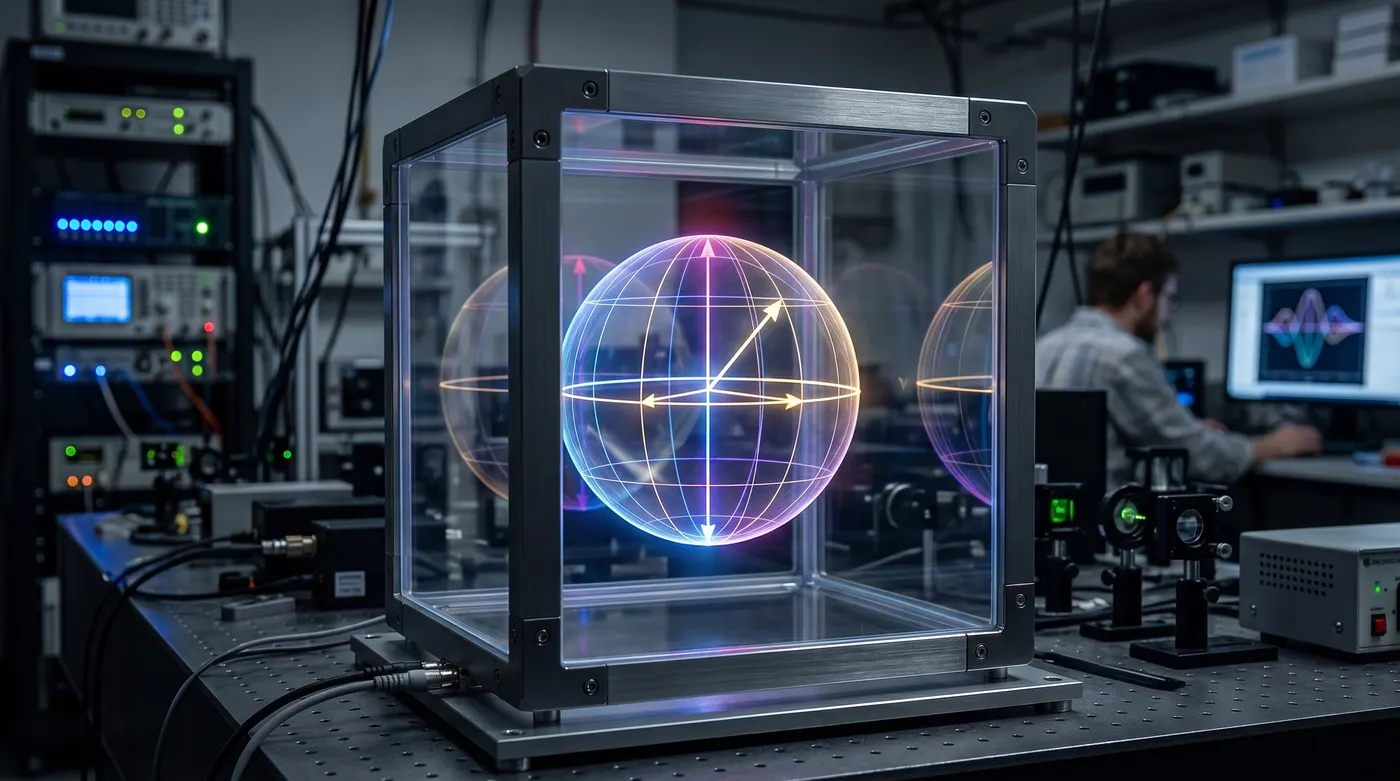
A qubit is to quantum computing what a bit is to classical computing: the fundamental unit of information. But the analogy breaks down quickly. A classical bit is always exactly 0 or 1. A qubit can exist in a superposition of 0 and 1 simultaneously, its state described by two complex numbers rather than a single Boolean value. This extra mathematical structure is the origin of quantum computing’s power.
The catch: when you measure a qubit, you always get a definite 0 or 1. The superposition collapses. The complex numbers determine the probability of each outcome, but the measurement always yields a classical bit.
The details
A qubit’s pure state is written as:
where and are complex numbers satisfying . The probability of measuring 0 is and of measuring 1 is .
The complex phase of and matters. The states and have identical measurement probabilities in the computational basis (50/50 each), but they are physically different states that can be distinguished by measuring in the right basis. This phase difference is exploited by quantum interference.
The state space of a single qubit is the surface of a unit sphere, the Bloch sphere. The north pole is , the south pole is , and every other point is a superposition. Quantum gates rotate the state around this sphere.
For qubits, the state space is -dimensional complex vector space. A complete description requires complex numbers. For 50 qubits: complex numbers, roughly a petabyte. For 300 qubits: classical storage is practically impossible. This exponential scaling in the state description is why quantum computers can potentially solve problems beyond classical reach.
Physical implementations: Multiple hardware platforms realize qubits using different physical systems:
| Platform | How the qubit is encoded | Key players |
|---|---|---|
| Superconducting | Energy levels of a Josephson junction circuit | IBM, Google, Rigetti |
| Trapped ion | Hyperfine or electronic levels of individual ions | IonQ, Quantinuum |
| Photonic | Polarization or path of a single photon | PsiQuantum, Xanadu |
| Neutral atom | Ground and excited states of atoms in optical tweezers | QuEra, Atom Computing |
| Spin qubit | Spin states of electrons in silicon | Intel, QuTech |
Each platform has different coherence times, gate speeds, connectivity, and scalability challenges. None is decisively ahead overall.
What the two-level system actually is
Understanding what a qubit actually is, physically and mathematically, prevents the most common misconceptions about quantum computing. The qubit is not a magical bit that tries both values simultaneously; it is a physical system described by quantum mechanics whose state before measurement does not have a definite classical value.
The difference between classical and quantum information at the qubit level is also why decoherence is so destructive. A classical bit can be imperfect and still hold a clear 0 or 1. A qubit’s phase relationship (the relative angle between and in the complex plane) can be destroyed by environmental noise without the qubit flipping, and this phase loss eliminates the interference effects that make quantum algorithms work.
The Bloch sphere is the most useful visualization for understanding single-qubit gates. Every quantum gate is a rotation of the Bloch sphere.
Common misconceptions
Misconception 1: A qubit stores more information than a bit. Measuring a qubit yields exactly one classical bit of information, not more. The extra mathematical structure in the qubit state (complex amplitudes, phase) is a resource for computation (through interference and entanglement), not extra storage. Holevo’s theorem makes this precise: you cannot extract more than 1 classical bit of information from a single qubit measurement.
Misconception 2: Quantum computers with qubits can process classical bits simultaneously. While the state space is -dimensional, you cannot access all components directly. Measurement gives you one outcome, not all . The state components are useful only to the extent that interference can concentrate probability on the desired outcome. This is the design challenge of quantum algorithms.
Misconception 3: All qubits are equally good. Physical qubits vary enormously in quality. Metrics include gate fidelity (how accurately gates are applied), coherence time (how long the qubit survives), readout fidelity (how accurately the measurement is recorded), and connectivity (which other qubits can it interact with). A system with 1,000 low-quality qubits may be less powerful than one with 100 high-quality qubits.