The most urgent driver of quantum-secure communication is the harvest-now-decrypt-later (HNDL) attack, also called store-now-decrypt-later. Adversaries with access to encrypted network traffic are archiving ciphertext today with the intent to decrypt it once a sufficiently powerful quantum computer is available. Because Shor’s algorithm breaks RSA and elliptic-curve cryptography in polynomial time, data that must remain confidential for a decade or more is already at risk. Encrypted government communications, medical records, financial transactions, and intellectual property are all potential targets. Organizations that handle long-lived sensitive data must therefore begin migrating to quantum-secure alternatives before a cryptographically relevant quantum computer is built, not after.
The primary tool for most organizations is post-quantum cryptography (PQC), which replaces classically vulnerable algorithms with ones believed to be hard for both classical and quantum computers. NIST finalized its first PQC standards in 2024: ML-KEM (Module Lattice Key Encapsulation Mechanism, formerly CRYSTALS-Kyber) for key encapsulation and public-key encryption, and ML-DSA (Module Lattice Digital Signature Algorithm, formerly CRYSTALS-Dilithium) for digital signatures. A third standard, SLH-DSA (formerly SPHINCS+), provides a hash-based signature scheme as an alternative. These algorithms are based on the hardness of lattice problems and hash functions, for which no efficient quantum algorithms are known. Modern TLS libraries, VPN software, and browser vendors began rolling out hybrid PQC modes, which combine a classical and a post-quantum key exchange in a single handshake, so that security holds as long as either algorithm remains unbroken.
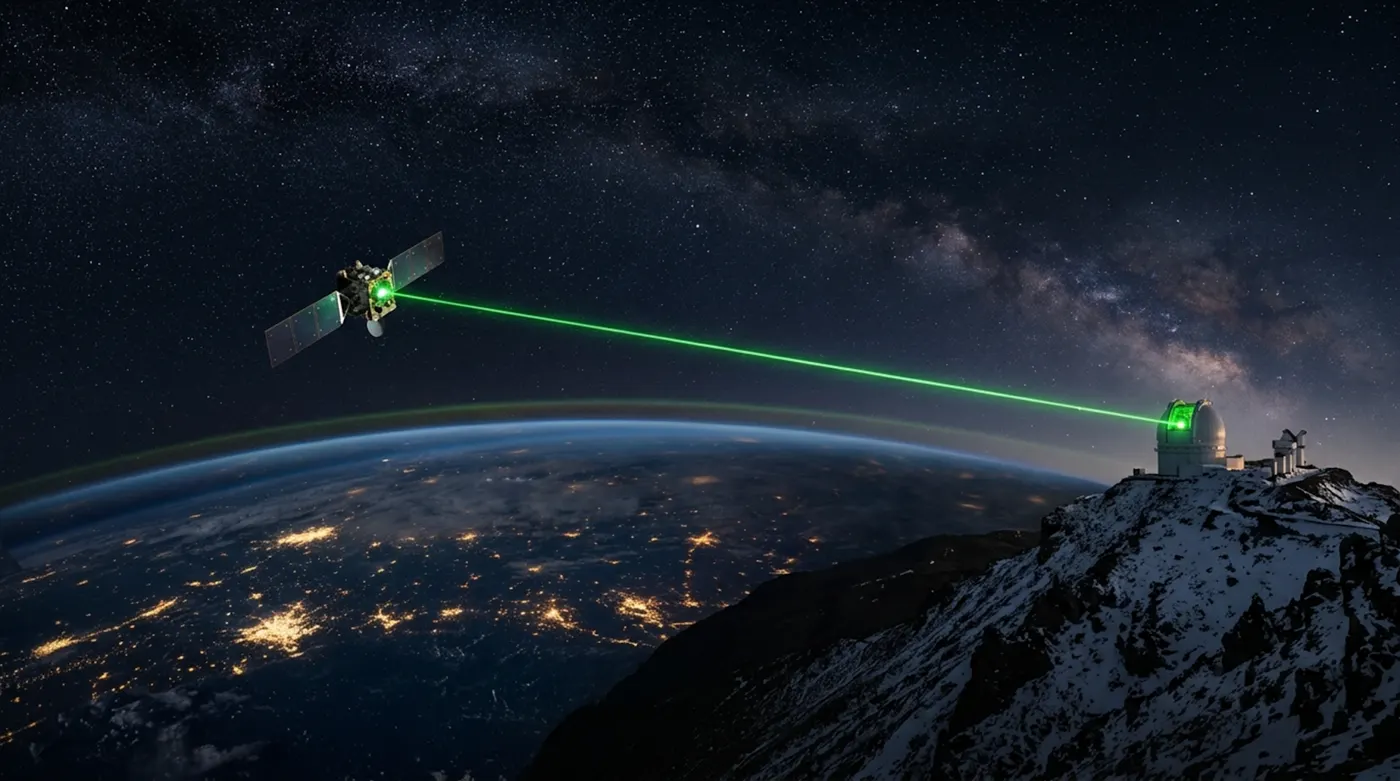
For the highest-security environments, quantum key distribution (QKD) offers a complementary layer of protection grounded in physics rather than computational hardness. QKD protocols such as BB84 use the quantum properties of photons to distribute symmetric keys in a way that any eavesdropping attempt disturbs the quantum states and is detectable. Banks, government agencies, and critical infrastructure operators in several countries have deployed QKD over dedicated fiber links and free-space optical links. Because QKD produces information-theoretically secure key material, it is not merely computationally secure but provably secure under the laws of quantum mechanics, provided the hardware implementation is trusted and authenticated. Current limitations include distance constraints of roughly 100-300 km per fiber segment without quantum repeaters, and high deployment costs relative to software-only PQC.
A hybrid architecture that combines PQC with QKD provides defense-in-depth: PQC handles the vast majority of connections at low cost, while QKD secures the highest-value channels where the additional infrastructure investment is justified. Organizations planning a migration should inventory all cryptographic assets, prioritize data with long confidentiality requirements, adopt PQC for new deployments, and plan a phased replacement of legacy RSA and elliptic-curve systems. NIST and NSA have both issued guidance recommending transitions to PQC begin immediately, with target completion dates in the late 2020s for national security systems. The migration timeline is long because cryptography is embedded in hardware, firmware, protocols, and software across every layer of the network stack, making quantum-secure communication as much an organizational project as a technical one.