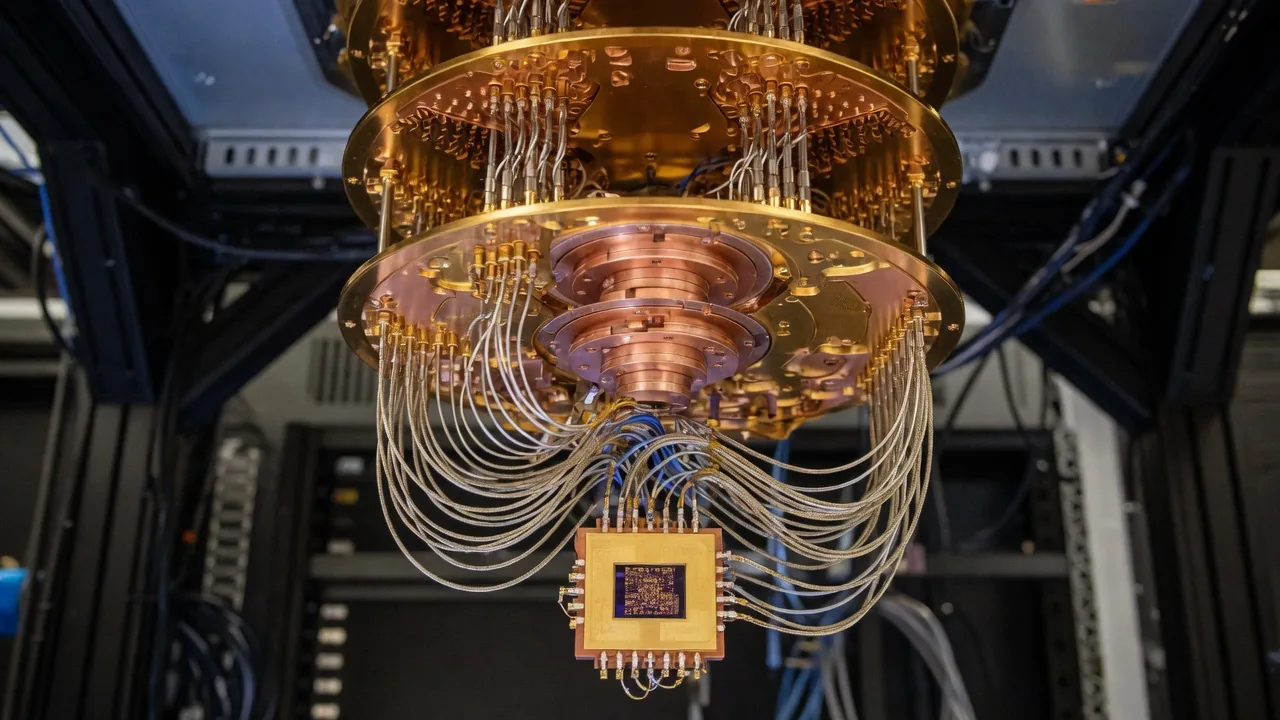
Superconducting qubits are the most widely deployed qubit technology in commercial and research quantum computers. IBM, Google, Rigetti, and AWS all build processors based on this approach. The architecture uses macroscopic electrical circuits cooled to cryogenic temperatures, where quantum effects dominate behavior. The key component is the Josephson junction: a tunnel junction between two superconductors that gives the circuit the anharmonicity needed to function as a qubit.
The appeal is scalability: fabrication techniques are borrowed from the semiconductor industry, and the rapid progress in qubit count from tens (2016) to hundreds (2021) to over a thousand (2023) reflects this manufacturing leverage.
The details
Physical mechanism: A superconducting qubit is an LC circuit (inductor-capacitor oscillator) where the inductor is replaced by a Josephson junction. A classical LC circuit is a harmonic oscillator with evenly spaced energy levels; you cannot isolate two levels to use as a qubit. The Josephson junction makes the energy levels unequal (anharmonic), allowing the transition between the ground state and first excited state to be addressed independently.
The most common architecture is the transmon qubit, which reduces sensitivity to charge noise (a major early limitation) by operating in a regime where the Josephson energy dominates the charging energy. The transmon qubit has a transition frequency in the microwave range.
Control: Gates are applied by sending microwave pulses tuned to the qubit frequency through control lines. Single-qubit gates use shaped pulses typically lasting . Two-qubit gates (CX or CZ) take and are implemented by temporarily tuning adjacent qubits into resonance or through microwave-driven cross-resonance interactions.
Temperature requirements: Superconducting circuits must operate below the superconducting transition temperature. Aluminum-based qubits superconduct at around , but thermal photon noise is significant at those temperatures. Full operation requires dilution refrigerators that reach , roughly of room temperature and colder than the average temperature of outer space ().
Key performance figures (2025-2026 state of the art):
| Metric | Typical value |
|---|---|
| Single-qubit gate fidelity | |
| Two-qubit gate fidelity | |
| Readout fidelity | |
| (relaxation) | |
| (dephasing) | |
| Single-qubit gate time | |
| Two-qubit gate time |
Connectivity: Most superconducting processors use heavy-hex or similar 2D lattice connectivity. Each qubit connects to 2 to 5 neighbors. Long-range interactions require SWAP gates (each SWAP uses 3 CNOT gates), adding circuit depth and error.
The platform most cloud backends use
Superconducting qubits are the platform you are most likely to run code on. IBM Quantum is accessible via cloud, and their Qiskit SDK is the most widely used quantum programming framework. Understanding the physical limitations of superconducting hardware directly informs how to write practical quantum circuits.
The most important constraints to internalize:
-
Coherence time limits circuit depth. With and gate times , the gate budget is about gates before noise dominates.
-
Two-qubit gates are the error bottleneck. Two-qubit gate fidelity is typically 10 to 100 times worse than single-qubit gate fidelity. Minimize CNOT count.
-
Connectivity matters. An algorithm written assuming full connectivity must be transpiled to the device’s actual qubit graph. This transpilation adds SWAP gates and increases depth.
Comparing superconducting qubits to trapped ions reveals a fundamental trade-off: superconducting systems win on speed and scalability; trapped ions win on fidelity, coherence time, and connectivity. Neither is definitively better overall.
Common misconceptions
Misconception 1: Superconducting qubits are just cold classical circuits. At , quantum effects dominate. The Josephson junction is an intrinsically quantum device; its behavior cannot be explained without quantum mechanics. The qubits exhibit genuine quantum superposition and entanglement, not classical behavior at low temperature.
Misconception 2: More qubits means a more powerful processor. Qubit quality matters as much as count. A 1,000-qubit processor with two-qubit error rates is less useful for many algorithms than a 100-qubit processor with error rates. The useful gate budget scales differently for different quality levels.
Misconception 3: Superconducting qubits are limited to dilution refrigerators forever. Research is exploring higher-temperature superconducting materials and new qubit designs that might operate at higher temperatures. The main push is to improve coherence times (not temperature), because even perfect cooling does not eliminate non-thermal noise sources like charge noise, flux noise, and substrate two-level systems.