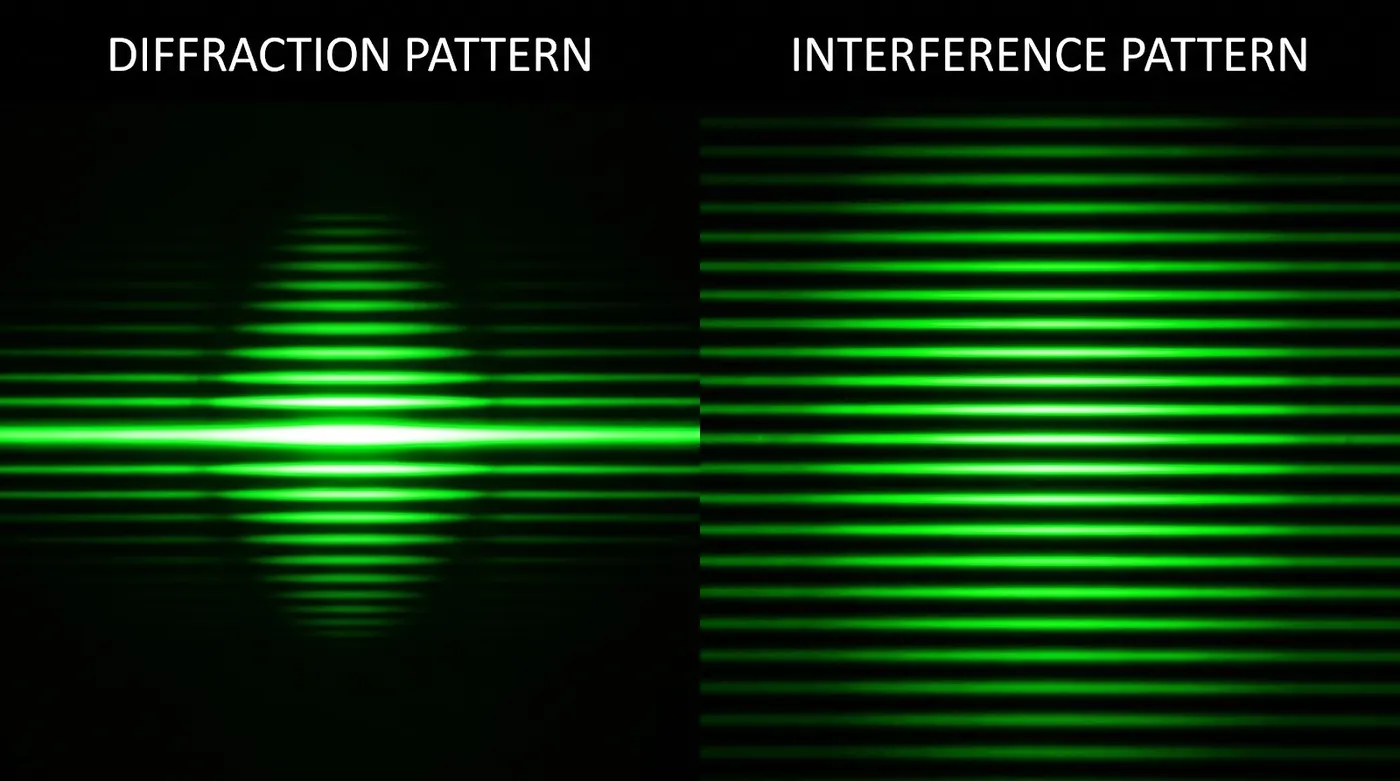
Quantum interference is what separates quantum computing from “trying all answers at once.” Superposition lets a quantum computer hold all possible inputs simultaneously, but that alone is useless: measuring a random superposition just gives a random answer. Interference is the mechanism that makes the correct answer more probable and wrong answers less probable before measurement.
Without interference, there is no quantum speedup. It is the core of what quantum computers actually do differently.
The details
Classical probabilities add and are always non-negative. Quantum probability amplitudes are complex numbers that can cancel. When two paths through a computation lead to the same final state, their amplitudes add algebraically:
- If both have the same sign: amplitudes add constructively, increasing the probability of that outcome
- If they have opposite signs: amplitudes cancel destructively, decreasing or eliminating that outcome
The analogy is wave interference in physics. In the double-slit experiment, light waves passing through two slits create a pattern of bright bands (constructive interference) and dark bands (destructive interference) on a screen. Quantum algorithms engineer the same effect in the abstract space of probability amplitudes.
Formally, if two computational paths lead to state with amplitudes and , the combined amplitude is , and the probability is , not (which would be the classical case).
Deutsch-Jozsa algorithm: The simplest demonstration. Given a function that is either constant (same output for all inputs) or balanced (equal numbers of 0 and 1 outputs), classical algorithms need up to queries to be certain. Quantum interference answers in one query:
|0...0⟩ ──[H⊗n]──[Oracle]──[H⊗n]──[M]
|1⟩     ──[H]────[Oracle]───────────
For a constant function, all amplitudes interfere constructively at , giving a certain 0 outcome. For a balanced function, they cancel completely at and accumulate elsewhere.
Grover’s diffusion operator: Each step of Grover’s algorithm uses interference to amplify the marked state’s amplitude. The oracle flips the sign of the target amplitude, making it negative. The diffusion operator then reflects about the mean: the negative target amplitude is raised above the mean, while all positive non-target amplitudes are pushed below. After iterations, the target dominates.
The reason a quantum program is not a classical one
Interference explains why quantum algorithm design is hard and why it is different from classical programming. You cannot simply iterate over possibilities or branch conditionally. You have to engineer a sequence of unitary operations (gates) such that wrong answer amplitudes cancel and the correct answer amplitude grows.
This is also why classical simulation of quantum computers is difficult. A classical simulator must track all complex amplitudes and allow them to interfere during every gate operation. For qubits, this requires storing complex numbers, roughly a petabyte. For , classical simulation is practically impossible.
Understanding interference also clarifies the relationship between superposition and computational power. The common statement “quantum computers try all possibilities at once” is only half-right. They process all possibilities simultaneously through interference, and this is what extracts useful computation from the superposition.
Common misconceptions
Misconception 1: Quantum computers evaluate all inputs in parallel and pick the best one. This is the most persistent misconception. After superposition, the amplitudes must be carefully manipulated through interference before measurement. You cannot simply measure the superposition and get the best answer; you get one random answer. The interference step is what concentrates probability on the correct outcome.
Misconception 2: Interference requires entanglement. Single-qubit interference is possible with one qubit and no entanglement. Applying , then a gate, then again demonstrates interference: . The phase shift is invisible in the Z basis but becomes observable through the second , which converts the phase difference into a computational basis difference.
Misconception 3: More superposition means more interference and better speedup. The amount of interference is determined by the structure of the algorithm, not just the number of qubits in superposition. A random circuit with maximal superposition produces a noisy output with no useful interference. Useful interference requires careful gate design that exploits the specific structure of the problem being solved.