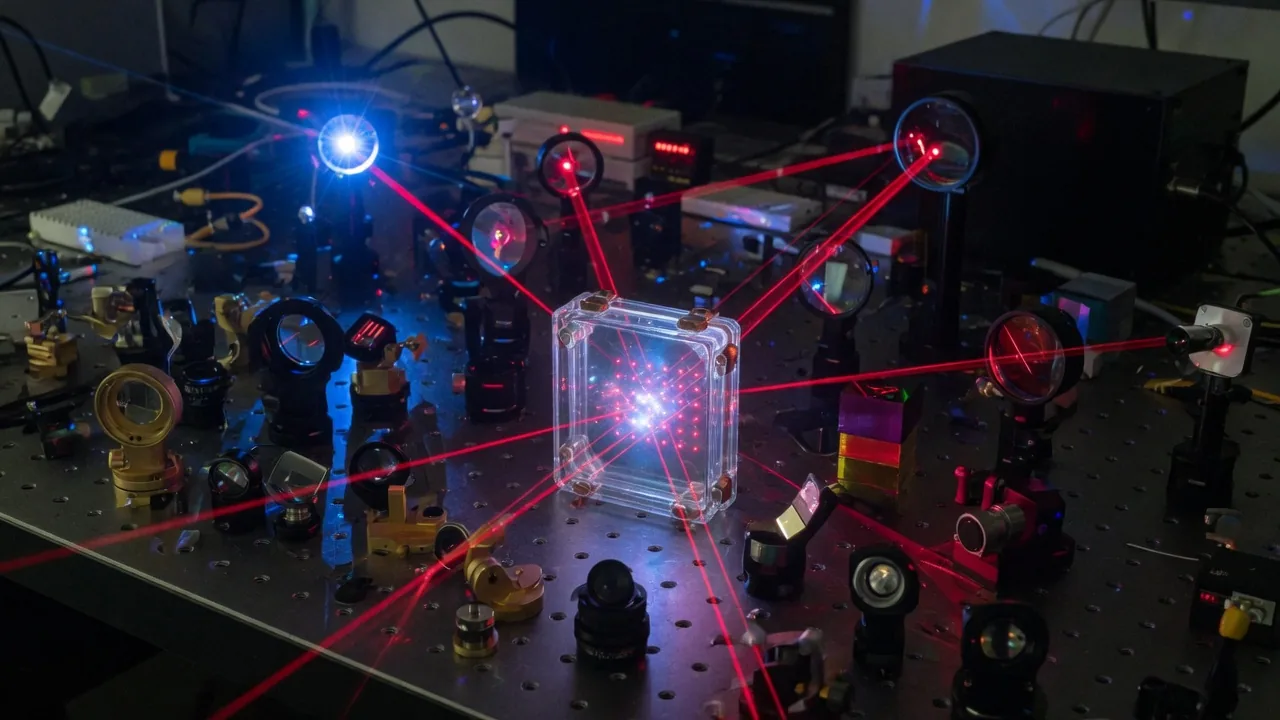
Neutral atom quantum computers are the youngest major qubit platform to reach practical scale. Unlike superconducting qubits (cooled circuit elements) or trapped ions (charged atomic ions levitated by electric fields), neutral atom systems use uncharged atoms (typically rubidium or cesium) held in place by focused laser beams called optical tweezers. As of 2025-2026, companies like QuEra Computing (Harvard spin-out), Pasqal (Paris), and Atom Computing have demonstrated neutral atom systems with 100-1000+ qubits, making this the platform that currently holds the qubit count record for gate-model systems.
How Neutral Atoms Become Qubits
Neutral atoms are isolated from their environment because they carry no net charge, making them highly insensitive to electric field noise. The qubit states are typically two hyperfine ground states of the atom (like rubidium-87), separated by a microwave frequency of about 6.8 GHz for Rb-87. Alternatively, some systems use the ground state and an optically excited state.
Optical tweezers trap individual atoms by focusing an infrared laser to a diffraction-limited spot. The AC Stark effect causes the atom to be pulled toward the focus of the laser beam. A single tweezer holds a single atom. By using a spatial light modulator (SLM) or acousto-optic deflector (AOD), you can produce hundreds or thousands of individual tweezer sites in arbitrary 2D or even 3D configurations.
Key trapping facts:
- Atoms are cooled to microkelvin temperatures using laser cooling (magneto-optical traps) before being loaded into tweezers
- Each tweezer holds exactly 0 or 1 atoms (probabilistic loading: ~50% filling rate initially; reconfiguration improves this)
- The tweezer array defines the qubit geometry and can be reprogrammed between shots
Rydberg Interactions: The Entangling Mechanism
The challenge with neutral atoms is coupling them together for two-qubit gates. Neutral atoms don’t naturally interact strongly at the distances (a few microns) required for optical trapping. The solution is Rydberg states: highly excited electronic states with principal quantum number n ~ 50-100.
A Rydberg atom is enormous compared to a ground-state atom. For n=70, the orbital radius is about 260 nanometers (compared to ~0.5 angstroms for the ground state). The electric dipole moment scales as n^2, and the van der Waals interaction between two Rydberg atoms scales as n^11/r^6, extraordinarily strong at short range.
The Rydberg blockade is the key effect:
- Start with two nearby atoms in their ground state |g>
- Drive atom A toward the Rydberg state |r>
- If atom A is in |r>, the energy of atom B’s Rydberg state shifts by the van der Waals interaction energy V(r)
- If V(r) >> laser linewidth, atom B cannot be excited to |r> while A is already in |r>
- Only one atom in the pair can be in the Rydberg state at a time
This blockade mechanism enables a controlled-phase (CZ) gate between any two atoms within the blockade radius (~10 microns). The gate:
- Applies a pi pulse to the control qubit (|g> -> |r> if control is in |1>)
- Applies a 2pi pulse to the target qubit (creates a pi phase shift if blockaded, does nothing otherwise)
- Applies another pi pulse to the control
Error rates for Rydberg two-qubit gates have reached below 0.5% for best-in-class demonstrations (2024), competitive with superconducting and trapped-ion systems.
Analog vs. Digital Mode
This is a key distinction that separates neutral atom platforms from most other qubit types.
Digital mode implements discrete gate operations (like H, CNOT, T gates) similar to circuit-model quantum computing. Individual gates are applied sequentially. This is the mode used for universal quantum computation.
Analog mode (also called quantum simulation mode) continuously drives the system with a Hamiltonian and measures the result. Rather than discrete gates, the laser drive implements:
H = sum_i Omega_i(t)/2 * sigma_x_i - sum_i Delta_i(t) * n_i + sum_{i<j} V_ij * n_i * n_j
Where:
Omega_i(t)is the Rabi frequency (laser drive strength) for atom iDelta_i(t)is the detuning from Rydberg resonanceV_ij = C6 / r_ij^6is the van der Waals interactionn_i = |r><r|_iis the Rydberg state projector
This Hamiltonian naturally implements an Ising-type model, exactly the form needed to simulate quantum magnets, combinatorial optimization (QUBO problems), and constraint satisfaction.
QuEra’s Aquila system (accessible via Amazon Braket) operates in analog mode. Users specify the geometry of the atom array and a time-varying Omega(t) and Delta(t) drive, and the system evolves under the above Hamiltonian.
Programmable Connectivity
One of the key advantages of neutral atom systems is reconfigurable connectivity. Unlike superconducting processors (fixed coupling map) or even trapped ions (all-to-all but slow), neutral atom systems can physically move atoms between shots using the tweezer arrays.
In a typical sequence:
- Load atoms into a large reservoir zone
- Rearrange atoms using tweezers to achieve a target spatial pattern
- Run the quantum computation (digital gates or analog evolution)
- Measure by fluorescence imaging
This allows:
- Arbitrary 2D/3D connectivity within the blockade radius
- Zone-based architectures (QuEra’s approach): separate storage, entanglement, and readout zones
- Mid-circuit measurement and reset: measure specific atoms, reset them to |g>, and continue the circuit
The zone-based approach is particularly powerful for quantum error correction. Logical qubits can be encoded in data qubits, syndrome qubits can be measured mid-circuit, and corrections can be applied, all without losing the computational state.
Comparing Neutral Atoms to Other Platforms
| Feature | Neutral Atoms | Superconducting | Trapped Ion |
|---|---|---|---|
| Physical qubit | Rb/Cs atom in tweezer | Transmon, fluxonium | Yb+, Ca+ ion |
| Temperature | ~10 microkelvin | ~15 millikelvin | Room temperature (trap) |
| Qubit count (2025) | 100-1000+ | 100-1000+ | 25-50 |
| 1Q gate fidelity | 99.5-99.9% | 99.5-99.9% | 99.9% |
| 2Q gate fidelity | 99-99.8% | 99-99.9% | 99-99.5% |
| Gate time (2Q) | ~0.1-1 ms | ~100-500 ns | ~100-500 us |
| Connectivity | Reconfigurable, local | Fixed coupling map | All-to-all |
| Coherence time | ~1-10 seconds | ~100-500 us | ~1 second |
| Analog mode | Yes (native) | No (typically) | Limited |
| Mid-circuit measurement | Yes | Difficult | Yes |
Advantages of neutral atoms:
- Native reconfigurable connectivity enables arbitrary graph topologies
- Analog mode for Ising/combinatorial problems with no gate overhead
- Long coherence times (approaching trapped ion quality)
- Atom arrays scale more easily than ion traps (more atoms can be loaded)
- Zone-based architecture naturally supports error correction
Disadvantages:
- Lower two-qubit gate speed than superconducting (milliseconds vs nanoseconds)
- Probabilistic loading means you don’t always get the atom you need (mitigated by rearrangement)
- Optical control complexity increases with qubit count
- Less mature software ecosystem than Qiskit/Cirq
Accessing Neutral Atom Systems
QuEra Aquila via Amazon Braket (analog mode):
from braket.aws import AwsDevice
from braket.ahs import AtomArrangement, AnalogHamiltonianSimulation
from braket.ahs.driving_field import DrivingField
from braket.timings.time_series import TimeSeries
import numpy as np

# Define a 3x3 atom array
register = AtomArrangement()
for i in range(3):
    for j in range(3):
        register.add((i * 5e-6, j * 5e-6))  # 5 micron spacing

# Define a simple time-varying drive (adiabatic sweep)
time_points = [0, 0.5e-6, 3.5e-6, 4e-6]  # seconds

# Rabi frequency profile (Omega): rise, plateau, fall
omega = TimeSeries()
omega.put(0, 0)
omega.put(0.5e-6, 1.57e7)      # max Omega = 2*pi * 2.5 MHz
omega.put(3.5e-6, 1.57e7)
omega.put(4e-6, 0)

# Detuning profile (Delta): sweep from negative to positive
delta = TimeSeries()
delta.put(0, -1.26e8)          # -20 MHz initial detuning
delta.put(0.5e-6, -1.26e8)
delta.put(3.5e-6, 1.26e8)      # +20 MHz final detuning
delta.put(4e-6, 1.26e8)

# Phase (constant)
phi = TimeSeries()
phi.put(0, 0)
phi.put(4e-6, 0)

drive = DrivingField(amplitude=omega, phase=phi, detuning=delta)
ahs_program = AnalogHamiltonianSimulation(register=register, hamiltonian=drive)

# Run on local simulator first
from braket.devices import LocalSimulator
device = LocalSimulator("braket_ahs")
result = device.run(ahs_program, shots=1000).result()
print(result.measurements[0])  # List of 0/1 per atom per shot
Bloqade (QuEra’s open-source neutral atom framework):
# pip install bloqade
from bloqade import start, var
from bloqade.atom_arrangement import Square
import numpy as np

# Create a square lattice
atom_array = Square(3, lattice_const=5.0)  # 3x3 square, 5 um spacing

# Define a pulse sequence using Bloqade's DSL
adiabatic = (
    start
    .add_positions(atom_array)
    .rydberg.rabi.amplitude.uniform.piecewise_linear(
        durations=[0.5, 3, 0.5],
        values=[0, 15.8, 15.8, 0],   # MHz
    )
    .rydberg.detuning.uniform.piecewise_linear(
        durations=[0.5, 3, 0.5],
        values=[-20, -20, 20, 20],    # MHz
    )
)

# Run on emulator
result = adiabatic.bloqade.python().run(100)
Use Cases Where Neutral Atoms Excel
Quantum simulation of spin models. The natural Hamiltonian of a Rydberg array is an Ising model. Studying magnetic phase transitions, frustrated magnets, and thermalization dynamics maps directly to the hardware without any gate decomposition overhead.
Combinatorial optimization. Maximum independent set (MIS) on unit disk graphs maps exactly to the Rydberg blockade constraint: no two adjacent atoms can both be in the Rydberg state. This has been used for portfolio optimization, scheduling, and network design problems.
Quantum error correction. The reconfigurable connectivity and mid-circuit measurement capabilities make neutral atoms well-suited for surface codes and other topological codes. Zone-based architectures allow logical qubit operations without moving data. In December 2023, a Harvard/QuEra team demonstrated a 280-qubit neutral atom processor that encoded 48 logical qubits and ran transversal logical gates with error rates below the physical error rate, one of the most significant fault-tolerant demonstrations on any platform.
Large-scale entanglement experiments. The ability to create hundreds of qubits in well-defined geometric arrangements makes neutral atoms ideal for generating and studying large entangled states, including cluster states for measurement-based quantum computing.
Scale Records
Neutral atom systems currently hold the largest publicly demonstrated qubit count for gate-model quantum computers:
- QuEra Aquila: 256-qubit programmable neutral atom array (analog mode via Amazon Braket)
- Atom Computing: 1,180-qubit neutral atom system demonstrated in 2023
- Pasqal: 324-qubit neutral atom processor demonstrated in 2024
The qubit count advantage comes with caveats: many of these qubits are used for error correction or are not simultaneously addressable as independent logical qubits. The meaningful metric is logical qubit count with error-corrected gates, which remains an active research challenge.
The platform is still maturing; software tooling, gate fidelity on large arrays, and error correction demonstrations are all active research areas. But the combination of scale (qubit count), reconfigurability, and analog mode makes neutral atom computing a serious contender alongside superconducting and trapped-ion approaches.