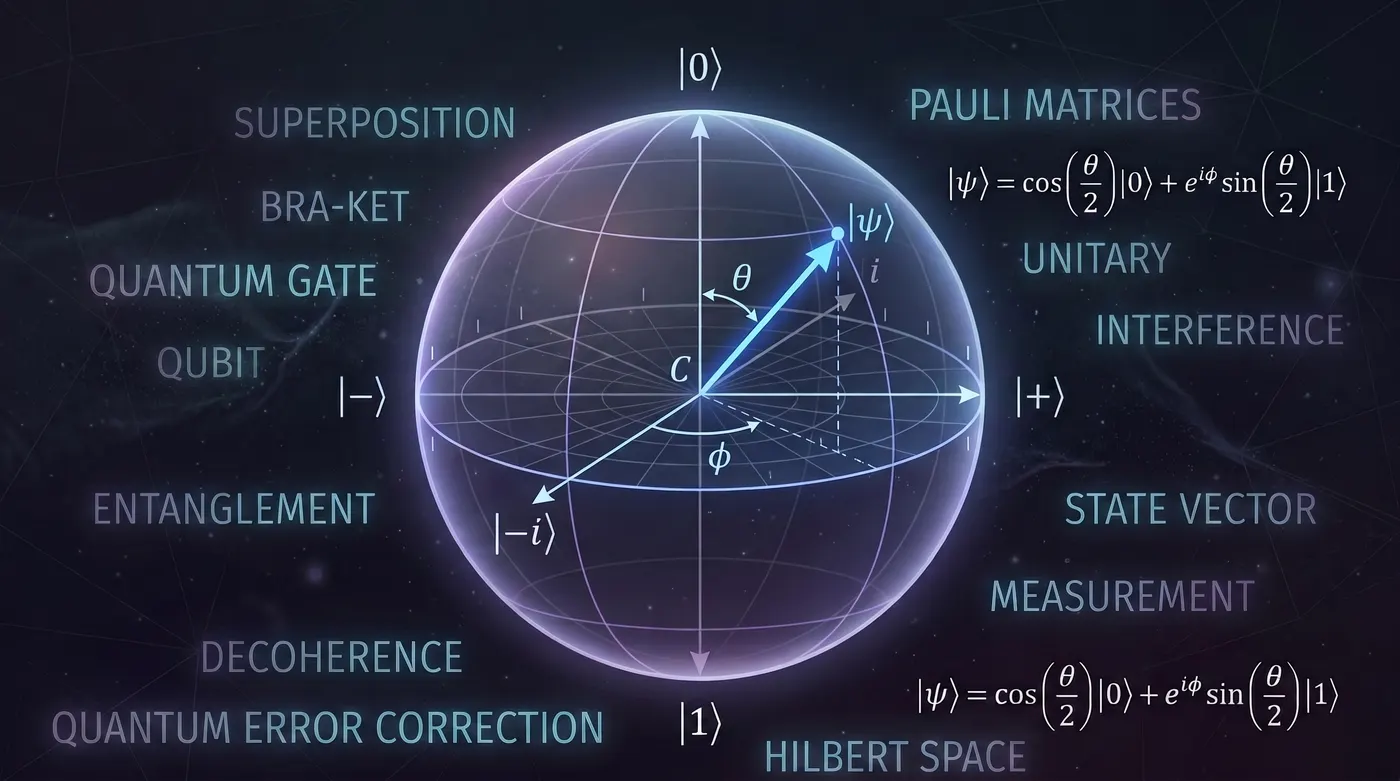
A physical qubit is a single quantum two-level system realized in actual hardware, such as a superconducting circuit, a trapped ion, a neutral atom, or a photonic mode. Physical qubits are the raw building blocks of quantum processors. They are inherently noisy: they decohere over time, their gates have finite fidelity, and their measurements are imperfect. The distinction between physical qubits and logical qubits is fundamental to understanding the path from today’s noisy devices to future fault-tolerant quantum computers.
Physical vs logical qubits
A logical qubit is a single unit of quantum information protected by quantum error correction, encoded across many physical qubits. The relationship is analogous to classical RAID storage: a single logical “disk” is spread across many physical disks for redundancy. The key parameters connecting the two:
- Code distance (): The minimum number of physical errors needed to corrupt the logical qubit. Higher distance means better protection but more physical qubits.
- Physical-to-logical ratio: For the surface code, a distance- code requires approximately physical qubits per logical qubit (counting both data and ancilla qubits).
| Code distance | Physical qubits per logical qubit | Approximate logical error rate (at physical error) |
|---|---|---|
| 3 | 17 | |
| 7 | 97 | |
| 15 | 449 | |
| 25 | 1,249 |
For algorithms like Shor’s algorithm factoring RSA-2048, which require logical error rates below per gate, the ratio can reach roughly 1,000 physical qubits per logical qubit. This is why millions of physical qubits may be needed for cryptographically relevant quantum computing.
Current physical qubit counts
As of early 2026, the largest quantum processors include:
- IBM: Heron processors with 156 qubits; the Condor processor reached 1,121 superconducting qubits (though primarily as a technology demonstration)
- Google: Willow processor with 105 superconducting qubits, notable for demonstrating below-threshold surface code performance
- Atom Computing / Quantinuum: Neutral atom and trapped ion systems with hundreds of qubits
- QuEra: Neutral atom arrays exceeding 256 qubits
These numbers represent physical qubits. None of these systems currently operate at the scale needed for fault-tolerant computation with practical logical qubit counts. A system with 1,000 physical qubits, even at excellent error rates, can support at most a handful of logical qubits at modest code distances.
Physical qubit quality metrics
The raw number of physical qubits is far less informative than their quality. Key metrics include:
- Gate fidelity: How accurately single-qubit and two-qubit gates are performed. State-of-the-art two-qubit gate fidelities range from to depending on the platform.
- Coherence time: How long the qubit retains its quantum state ( and times). Superconducting qubits typically achieve to ; trapped ions can exceed seconds.
- Readout fidelity: How accurately the qubit’s state is measured. Typical values range from to .
- Connectivity: Which pairs of qubits can interact directly. Limited connectivity requires SWAP operations that add noise and increase circuit depth.
The device qubit, before encoding
Understanding the distinction between physical and logical qubits is essential for interpreting quantum computing announcements. Headlines reporting “1,000-qubit quantum computer” refer to physical qubits, which does not mean the system can run algorithms requiring 1,000 error-free qubits. The NISQ era is defined precisely by this gap: we have hundreds to thousands of physical qubits but cannot yet implement enough logical qubits for the algorithms (like Shor’s) that would provide transformative quantum advantage. The transition from NISQ to fault tolerance is fundamentally a story about improving physical qubit quality until the error rates cross the threshold needed for scalable error correction.