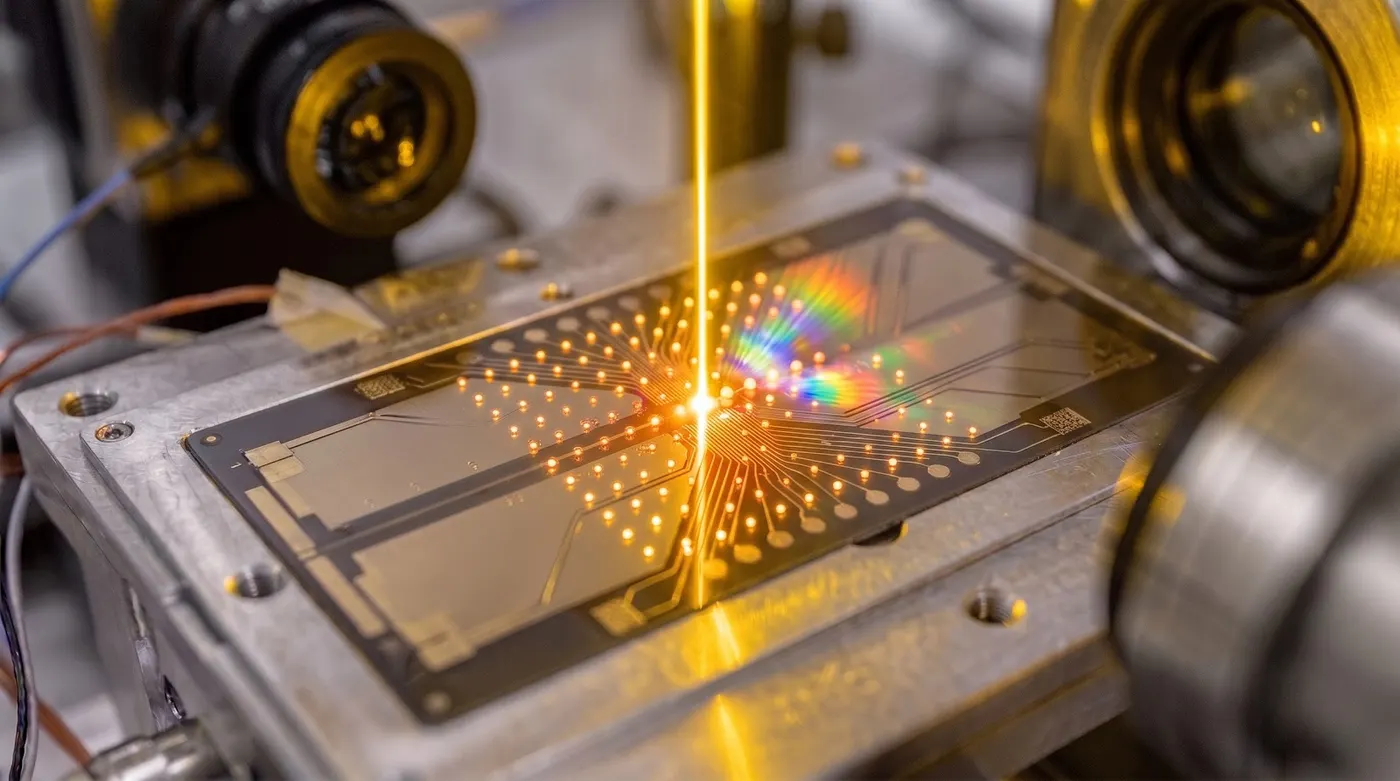
Understand the physical layer of quantum computing - how qubits are built, operated, and controlled in the lab. This course from Delft University of Technology covers the major hardware platforms in quantum computing, the engineering challenges of maintaining coherence, and how classical control systems operate the quantum processor.
Core to the Quantum 101: Quantum Computing and Quantum Internet professional certificate. Taught by QuTech researchers who build and operate real quantum hardware systems.
What you’ll learn
- Why physical qubits are fragile: what decoherence is, the T1 relaxation time, the T2 dephasing time, and what physical processes limit them
- What a gate fidelity is, why it is always less than 1, and what “99.9% fidelity” actually means for computation
- Superconducting qubits: the transmon qubit’s energy levels, how microwave pulses drive transitions between them, and why Josephson junctions are the key element
- How superconducting qubits are coupled: capacitive and inductive coupling schemes for two-qubit gates
- Readout of superconducting qubits: dispersive coupling to microwave resonators
- Trapped-ion qubits: how laser pulses manipulate atomic spin states, the Mølmer-Sørensen gate for two-qubit operations, and why trapped ions have high gate fidelity
- Silicon spin qubits: quantum dots in semiconductor devices, exchange coupling, and why the CMOS-compatibility of silicon makes it attractive for scaling
- Photonic qubits: how single photons encode quantum information and the challenges of photon-photon interactions
- Why most hardware platforms require dilution refrigerators: what millikelvin temperatures mean and how a dilution refrigerator achieves them
- Classical control electronics: signal generation, arbitrary waveform generators, readout chains, and the timing and synchronisation requirements
Course structure
The course runs for six weeks at six to eight hours per week.
The first module establishes the problem: maintaining quantum coherence is extremely difficult, and the practical metrics (T1, T2, gate fidelity, readout fidelity) tell you how well a qubit platform is doing. You learn to evaluate hardware from these numbers before studying how any specific platform achieves them.
The superconducting qubit module is the most detailed, reflecting their current dominance in the field. You learn the transmon Hamiltonian at a conceptual level, understand how microwave pulses implement single-qubit gates, and see how dispersive readout extracts information without collapsing the state unnecessarily.
Trapped-ion and silicon spin qubit modules each highlight their distinct physics and engineering trade-offs. A module on cryogenics covers the dilution refrigerator that most platforms require. The control electronics module covers the room-temperature infrastructure that drives the quantum processor.
The course closes with a comparative assessment: where each platform stands on the path to fault-tolerant quantum computation.
Who is this for?
- Physics and engineering graduates entering the quantum hardware industry
- Software engineers and computer scientists who want to understand the physical constraints that shape quantum algorithm design
- Anyone pursuing the Quantum 101 professional certificate who wants to understand what the hardware actually does
- Hardware engineers from semiconductor, microwave, or cryogenics industries considering a transition to quantum computing
Prerequisites
Some undergraduate physics background is helpful - familiarity with quantum mechanics concepts (energy levels, wave functions) and basic circuit theory (resonators, capacitors, inductors). The course uses mathematical formalisms but does not require graduate physics.
Completion of Fundamentals of Quantum Information is recommended so that you have a clear picture of what qubits and quantum gates are supposed to do before studying how hardware implements them.
Hands-on practice
Problem sets include:
- Calculating decoherence rates from physical parameters and estimating gate fidelity
- Working through the mathematics of dispersive readout for superconducting qubits
- Comparing performance metrics of different qubit platforms using real published data
- Estimating how many physical qubits are required to implement a logical qubit under error correction, given specific error rates
Some exercises use Python to model simple qubit dynamics. The emphasis is on developing the quantitative intuition to evaluate hardware platforms critically.
Why take this course?
Hardware literacy is valuable even for software-focused quantum computing practitioners. Understanding why two-qubit gates are more error-prone than single-qubit gates shapes which circuit decompositions you choose. Understanding why qubit connectivity graphs are sparse (not every qubit can interact with every other qubit directly) constrains algorithm design. Understanding what “quantum volume” or “circuit layer operations per second” actually measure helps you evaluate hardware announcements critically.
Part of the Quantum 101 certificate, this course is taught by researchers who build real quantum hardware. That combination of academic rigor and practical experience is rare and makes the course genuinely valuable.
Topics covered
Enrol in this course
The Hardware of a Quantum Computer is $185 on edX, at intermediate level, and runs 6 weeks, 6-8 hours per week. A certificate is included.
Affiliate link. We may earn a commission at no extra cost to you.