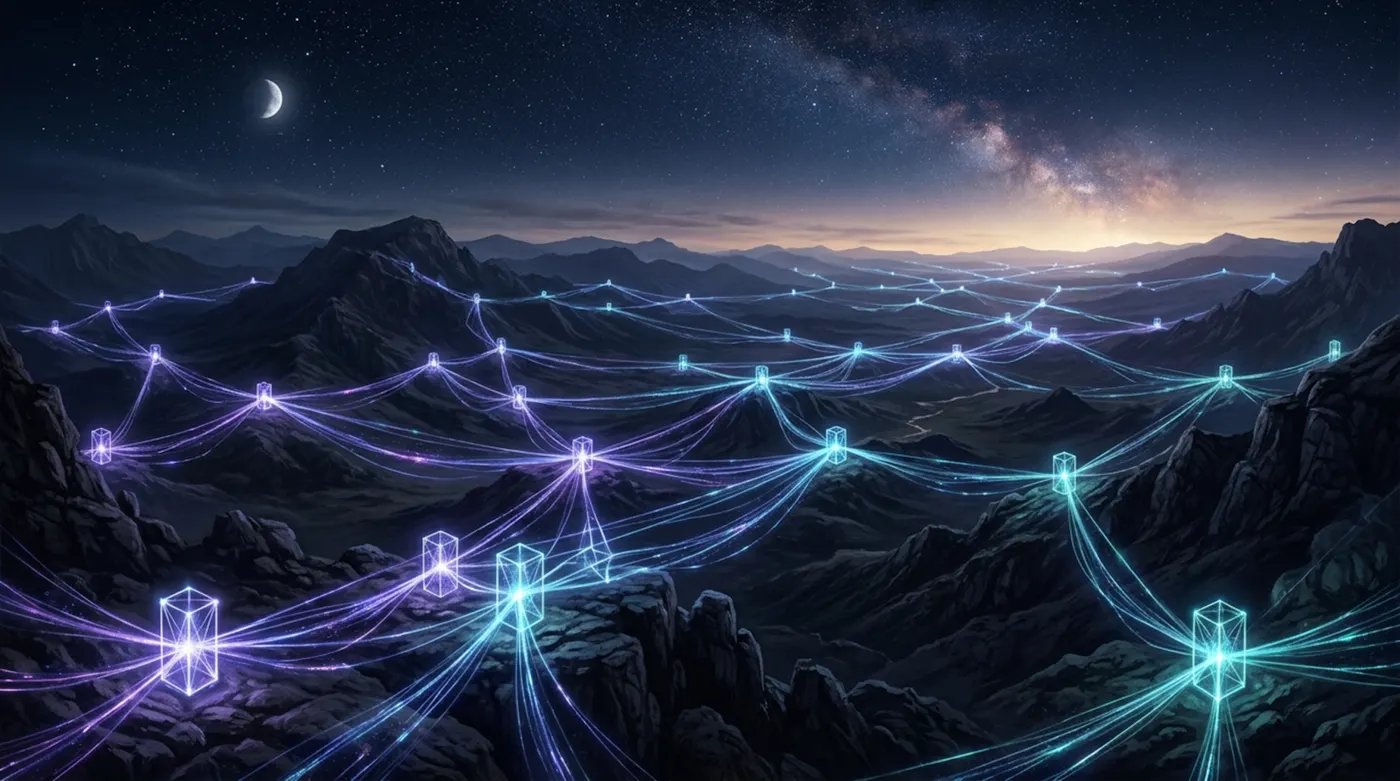
The quantum internet is a future network that would transmit quantum states between distant nodes using entanglement as its fundamental resource. It is not simply a faster classical internet; it enables capabilities that are physically impossible on any classical network. The most immediate application is unconditionally secure communication through quantum key distribution. The longer-term applications include distributed quantum computing, linking many small quantum processors into a single large quantum system, and blind quantum computing, where a client can perform quantum computation on a server without the server learning what is being computed.
Building this network is a profound engineering challenge. The fundamental obstacle is that quantum states cannot be amplified the way classical signals can.
The details
Classical networks amplify signals at repeater stations to extend range. Copying a quantum state is forbidden by the no-cloning theorem. This makes long-distance quantum communication fundamentally different from classical networking.
The solution is quantum repeaters, which extend range through entanglement swapping:
- Create entanglement between node A and a middle repeater station M
- Create entanglement between M and node B
- Perform a Bell measurement at M, “swapping” the entanglement so A and B are now entangled, consuming the A-M and M-B entangled pairs
This process requires quantum memories at each repeater node: devices that can store quantum states for long enough to synchronize operations across the network. Quantum memories are one of the hardest open problems in quantum networking. Current implementations use atomic ensembles, rare-earth-doped crystals, or nitrogen-vacancy centers in diamond, with storage times ranging from microseconds to seconds.
The quantum internet architecture has several layers:
- Physical layer: Photonic channels (fiber or free-space), photon sources, and detectors
- Link layer: Entanglement generation between adjacent nodes
- Network layer: Entanglement routing and swapping across multiple hops
- Application layer: QKD, teleportation, distributed computation
Existing deployments (as of 2026):
- City-scale quantum networks operate in several research contexts in China, the Netherlands (QuTech), and the US (DOE quantum internet blueprint)
- China’s Micius satellite demonstrated entanglement distribution over km and QKD over km
- The fiber-based Vienna-to-Beijing quantum network spans km using trusted relays (not full quantum repeaters)
True quantum repeaters, using entanglement swapping and quantum memory, have been demonstrated in laboratory conditions but not yet deployed at scale.
Communication that moves quantum states
The quantum internet illustrates how quantum mechanics enables new communication capabilities, not just computation. The security of QKD and the efficiency of quantum teleportation both depend on distributed entanglement, which requires networking infrastructure.
Understanding quantum networking also clarifies the limits of quantum computing hardware. A future where many small quantum processors are linked by a quantum network is a plausible path to large-scale computation, complementary to building monolithic million-qubit processors.
The engineering challenges are also instructive: photon loss, quantum memory limitations, and the need for synchronization across a network make the quantum internet harder than the quantum computer, not easier.
Common misconceptions
Misconception 1: The quantum internet will replace the classical internet. The quantum internet complements the classical internet; it does not replace it. Quantum channels transmit quantum states; classical channels are still needed to coordinate quantum operations (as in teleportation) and to carry ordinary data. A quantum internet node will always have both quantum and classical connections.
Misconception 2: Quantum internet enables faster-than-light communication. Quantum teleportation requires two classical bits sent over a classical channel to complete the state transfer. The classical channel limits the speed of communication to at most the speed of light. Quantum correlations cannot be used to send information superluminally.
Misconception 3: The quantum internet is just a more secure classical internet. It is qualitatively different. QKD offers physical security guarantees that no classical system can provide. Distributed quantum computing enables computations that no classical network can replicate. These are new capabilities, not improvements to existing ones.