The short answer
Start with Qiskit if you are learning. It has the larger tutorial corpus on this site, IBM's free hardware tier, and more courses. Choose Cirq when you need Google hardware, moment-structured circuits, or the low-level control Cirq was built for. If your goal is quantum machine learning, neither is the first pick: that is PennyLane.
Side by side
| Qiskit | Cirq | |
|---|---|---|
| Vendor | IBM | Google Quantum AI |
| Language | Python | Python |
| Native hardware | IBM Quantum | Google (Sycamore, Willow) |
| Circuit model | Gate list on a QuantumCircuit | Moments: operations that fire together |
| Beginner material | Large: textbook, IBM Learning, this site's Qiskit track | Smaller: Cirq docs and a handful of tutorials |
| Best for | Learning, general software, IBM devices | Research circuits, Google devices, fine timing |
How to pick
- If you do not yet have a hardware target, use Qiskit. Skills transfer.
- If your lab or job uses Google hardware, use Cirq as the native SDK.
- If you need one SDK across vendors, look at Amazon Braket or PennyLane plugins, not a Qiskit-versus-Cirq shootout.
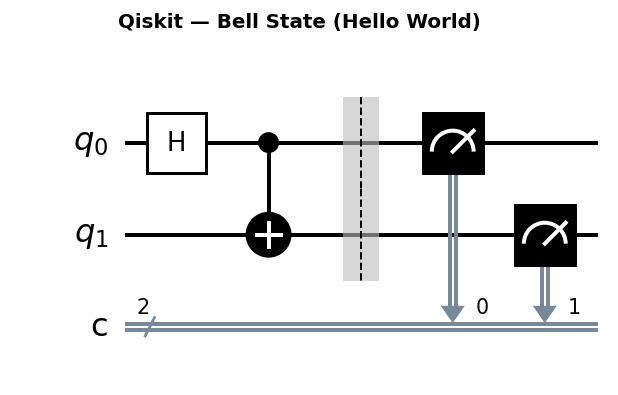
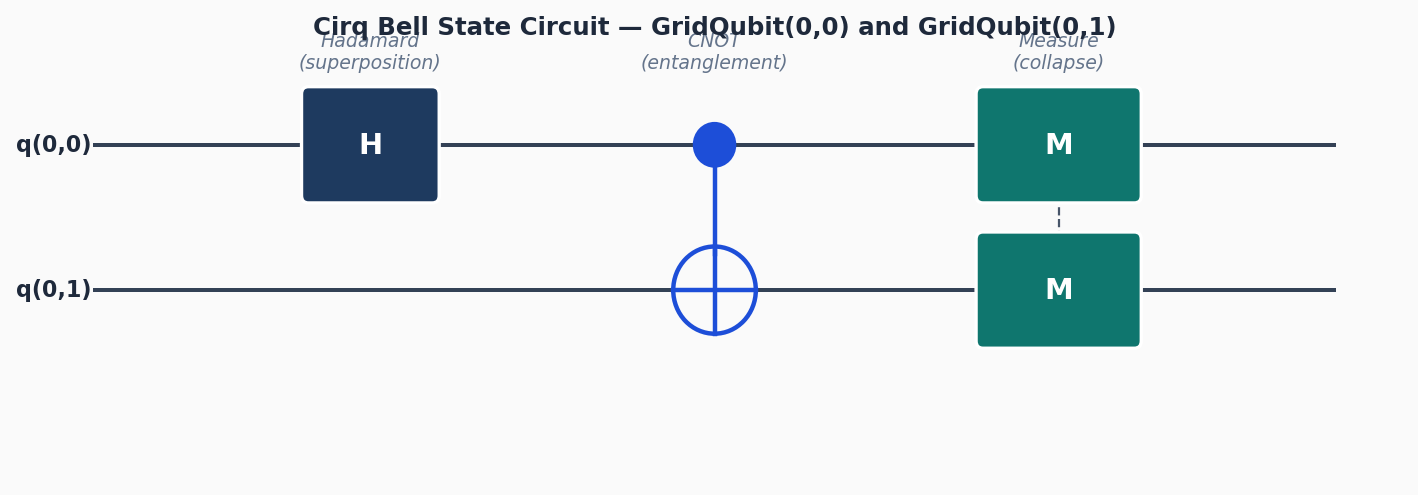
Syntax for the same Bell state in both is on the framework comparison page.
Qiskit courses on this site
-
IBM Quantum
Basics of Quantum Information (IBM Learning)
IBM's free interactive introduction to quantum information. Covers single and multi-qubit states, quantum circuits, and entanglement with interactive exercises.
-
IBM Quantum
Introduction to Quantum Computing with Qiskit (openHPI / IBM Quantum)
Dr. Elisa Bäumer and Carmen Recio Valcarce, IBM Quantum
Free two-week Qiskit course on the Hasso Plattner Institute's openHPI platform, taught by IBM Quantum researchers. Covers quantum computing fundamentals, the Qiskit SDK, and implements Deutsch-Jozsa and Grover's algorithm from scratch.
-
Qiskit
Learn Quantum Computing with Qiskit Textbook
IBM Quantum / Qiskit Team
The original open-source Qiskit Textbook, now archived on GitHub, covering everything from quantum gates and basic circuits to Grover's algorithm, Shor's algorithm, quantum error correction, and quantum machine learning with interactive Jupyter notebooks.
Cirq and Google courses
-
Google
Cirq Tutorials and Documentation (Google Quantum AI)
Google Quantum AI
Google Quantum AI's free self-paced tutorial series for the Cirq quantum programming framework. Covers circuit construction, noise models, algorithm implementation, and access to Google's Quantum Virtual Machine via Google Colab.
-
Google
Hands-On Quantum Error Correction with Google Quantum AI
Austin Fowler
Google Quantum AI's free-to-audit Coursera course on quantum error correction. Covers the surface code, stabilizer formalism, and the Stim and Crumble software tools used by Google researchers, with hands-on coding labs.
-
Udemy
The Complete Quantum Computing Course with Python [2025]
Hoang Quy La
A hands-on Udemy course by Hoang Quy La covering qubits, quantum gates, and quantum circuits in Python with Cirq and Qiskit, plus the Deutsch-Jozsa algorithm, Grover's algorithm, the quantum Fourier transform, quantum phase estimation, variational quantum circuits, and an introduction to quantum error correction.
Questions people ask
Should I learn Qiskit or Cirq first?
Learn Qiskit first unless you already know you will run on Google hardware. Qiskit has more beginner courses, a larger community, and free IBM hardware. Cirq is the better second framework if you need moment-level control or Google's devices.
Can Cirq run on IBM hardware?
Not natively. Cirq targets Google's devices and simulators. To run a Cirq circuit on IBM, export to OpenQASM and import it in Qiskit, or use a third-party converter. PennyLane and Amazon Braket are designed for that kind of backend hopping; Cirq is not.
Are the core ideas the same?
Yes. Qubits, gates, measurement, superposition and entanglement are the same in both. A Bell state is a Hadamard plus a CNOT in either library. Switching later is days of API work, not a new subject.