IBM’s official entry point into quantum computing education. All exercises run in the browser on IBM Quantum simulators, so there is nothing to install to get started.
Basics of Quantum Information is designed to take a complete newcomer from zero to comfortable with the core formalism of quantum information: state vectors, quantum gates, measurement, and entanglement. The interactive format means concepts are reinforced through coding exercises immediately after each explanation.
What you’ll learn
- Single-qubit states: the state vector representation, the Bloch sphere as a geometric picture of qubit states, and the physical meaning of superposition
- Quantum gates on a single qubit: X, Y, Z, H, S, T, and arbitrary rotations, with their matrix representations and effects on the Bloch sphere
- Measurement: the Born rule, projective measurement, and the fact that measurement collapses a superposition irreversibly
- Multi-qubit systems: tensor products of state spaces, two-qubit state vectors, and the exponential growth of the state space with qubit count
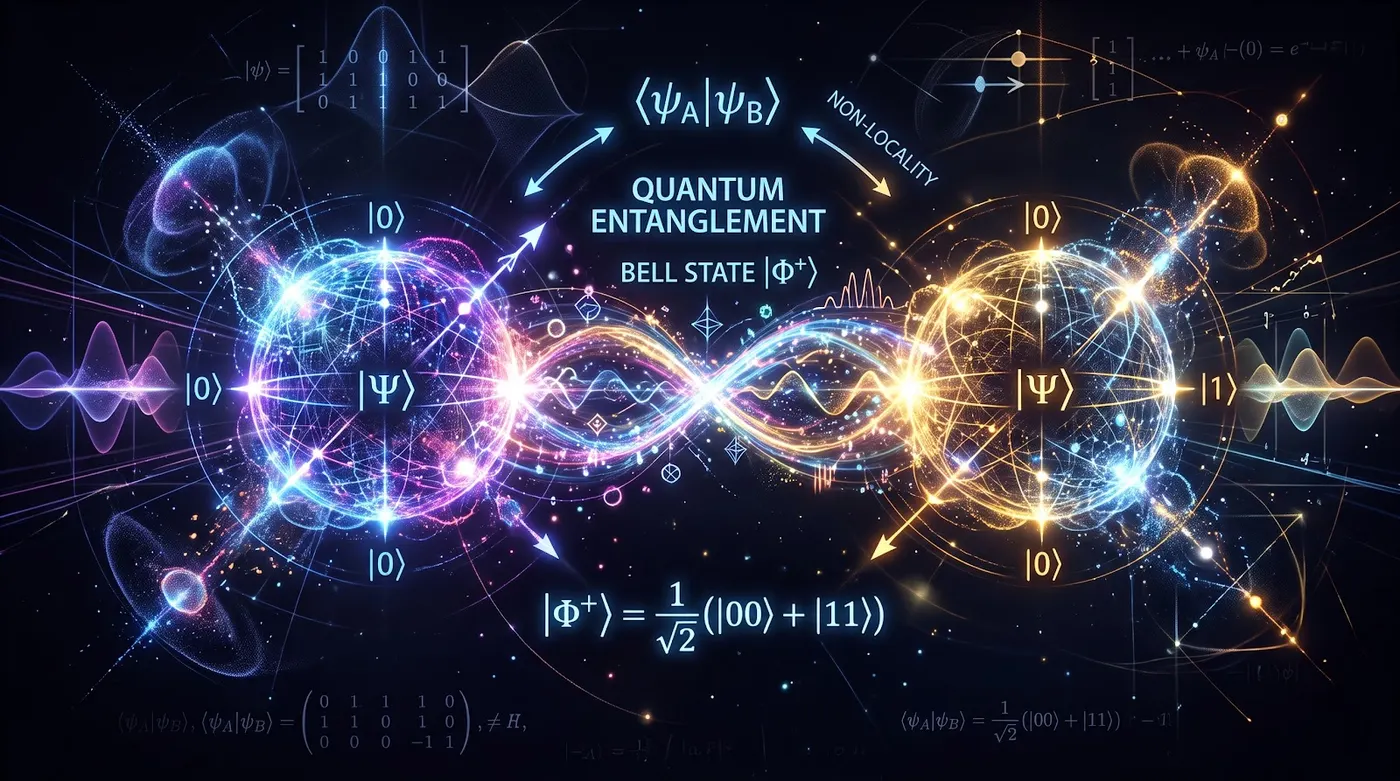
- Entanglement: the definition of an entangled state, why it cannot be described as a product of individual qubit states, and why this matters for computation
- Bell states: the four maximally entangled two-qubit states and how to prepare them with a Hadamard gate followed by a CNOT
- Quantum teleportation: the protocol that transfers a qubit state using entanglement and two classical bits, as a concrete application of Bell states and measurement
Course structure
The course is organised into four units. Each unit mixes explanatory text, worked examples, and interactive coding exercises using IBM’s course platform.
The first unit covers the mathematical description of single qubits. The second introduces quantum circuits and single-qubit gates. The third extends the formalism to multiple qubits and introduces entanglement. The fourth unit covers applications of entanglement including quantum teleportation and superdense coding.
Exercises are embedded throughout and run directly against IBM Quantum simulators in the browser. Answers are validated immediately, with hints available if you get stuck.
Who is this for?
- Complete beginners to quantum computing who want a rigorous but accessible starting point
- Software engineers curious about quantum computing who prefer learning by coding
- Students who have heard of qubits and quantum gates but have never worked through the formalism properly
- Anyone who wants to start using IBM Quantum tools and needs the conceptual foundations
Prerequisites
High school linear algebra is sufficient: vectors, matrices, and matrix multiplication. Complex numbers are used throughout, so comfort with i and Euler’s formula is helpful. No prior quantum mechanics or quantum computing knowledge is assumed.
Hands-on practice
Every concept in the course is reinforced with a browser-based exercise. You will:
- Prepare specific qubit states by composing gate sequences and verify with the simulator
- Implement the circuits for all four Bell states from scratch
- Build the quantum teleportation circuit step by step and verify the output state
- Experiment with measurement and observe how it collapses superpositions
- Explore how entanglement affects measurement outcomes across qubits
All exercises use IBM’s web-based environment. No local Python or Qiskit installation is required, making this genuinely frictionless to start.
Why take this course?
IBM Learning is the official IBM Quantum educational platform, and this course is the designed starting point for anyone who wants to use IBM Quantum hardware and software. The content is accurate, current, and maintained by the team that builds the platform.
Compared to many beginner courses that rely on analogies and avoid mathematics, this one teaches the actual formalism from the start. That investment pays off immediately: you finish the course able to read and write circuit diagrams, understand what a state vector means, and continue into more advanced IBM Learning courses with a solid foundation.
The free, browser-based format removes every barrier to entry. There is no reason not to start here if you are new to quantum information.
Topics covered
Start this course
Basics of Quantum Information (IBM Learning) is free on IBM Quantum, at beginner level, and runs Self-paced. A certificate is included.
Affiliate link. We may earn a commission at no extra cost to you.