IBM Quantum
Basics of Quantum Information (IBM Learning)
IBM's free interactive introduction to quantum information. Covers single and multi-qubit states, quantum circuits, and entanglement with interactive exercises.
Topic
19 courses · 10 tutorials
IBM Quantum
IBM's free interactive introduction to quantum information. Covers single and multi-qubit states, quantum circuits, and entanglement with interactive exercises.

QWorld
QWorld's free, self-study quantum computing workshop. Covers quantum states, quantum operators, quantum protocols, and quantum search using Python and Jupyter notebooks. No physics background required.
edX
CertificateDelft University of Technology (QuTech)
A professional certificate from Delft University of Technology. Qubits, quantum hardware, algorithms, error correction, and the quantum internet.
IBM Quantum
IBM SkillsBuild
IBM SkillsBuild's free beginner learning content on quantum computing fundamentals. Visual learning activities and virtual labs covering qubits, superposition, entanglement, quantum gates, and basic circuit building.

Brilliant
Brilliant's quantum computing course uses puzzles and pictures. It sits inside a Brilliant subscription, and the free trial includes it.
Dr Steven Herbert, University of Cambridge
University of Cambridge's undergraduate Quantum Computing course, with lecture notes publicly available, covering qubits, superposition, entanglement, core quantum algorithms, and quantum cryptography. Accessible at no cost.

Qubit
QuantumComputingCourses
Nine free modules on this site, from what a qubit is to a circuit in Qiskit, using the Bloch sphere and the circuit builder. No signup.
Coursera
Fractal Analytics (Srinjoy Ganguly, Shalini Devendrababu)
Fractal Analytics on Coursera, for beginners. Two modules: history and theory, then qubits, gates, and circuits in Qiskit.
Microsoft
Microsoft Quantum
Microsoft's free Q# exercises, in the browser. Each one is a programming problem, from single qubits through algorithms, checked as you go.
Brilliant
Brilliant / Sabine Hossenfelder
Quantum mechanics on Brilliant, with Sabine Hossenfelder. You work the simulations: states, superposition, and measurement.
Coursera
SpecialisationPackt
Packt specialization on Coursera, three courses. High-school maths to start, then Qiskit and algorithms on IBM hardware. No programming experience required.
edX
Delft University of Technology (QuTech)
A Delft introduction with little maths: what a quantum computer is, and what a quantum internet is for.
Keio University / Rodney Van Meter
Keio University's accessible introduction to quantum computing on FutureLearn, taught by Rodney Van Meter. Explains the motivation for building quantum computers, the key principles, important algorithms, and a look at quantum hardware and the emerging industry, with minimal mathematics.
edX
Delft University of Technology (QuTech)
Quantum networks on QuTech's Quantum Network Explorer. The simulations use QNE-ADK and SquidASM.

Coursera
SpecialisationUniversity of Colorado Boulder / Wounjhang Park
University of Colorado Boulder's three-course specialization giving engineers the quantum mechanics foundation behind modern electrical, mechanical, and quantum engineering. Covers superposition, entanglement, measurement, the uncertainty principle, angular momentum, and approximation methods.
edX
Delft University of Technology (QuTech)
A Quantum 201 course from Delft. Quantum information written as circuits, and what you can do with entanglement.
Coursera
KAIST / Joonwoo Bae
KAIST's beginning-graduate-level introduction to quantum information, taught by Joonwoo Bae. Covers qubits, the axioms of quantum theory, entanglement as a resource, quantum teleportation, gates, circuits, and quantum communication channels.
IQC Faculty, University of Waterloo
Graduate quantum information at the University of Waterloo's Institute for Quantum Computing. Courses on information, cryptography, and error correction.
Dr. Daniel Gottesman, Perimeter Institute
Daniel Gottesman's graduate-level quantum information lecture series recorded at Perimeter Institute. Fifteen recorded lectures covering entanglement, channels, error correction, and cryptography. Freely available on PIRSA.
The Bloch sphere is a map with edges. This final part covers what measurement does to the arrow, why real qubits drift inside the ball, and why an entangled qubit has no arrow at all.
Build a working quantum teleportation circuit in Qiskit - create an entangled pair, perform a Bell measurement, apply classical corrections, and verify the teleported state.
Derive the CHSH inequality, understand why classical correlations cannot violate it, and verify that quantum entanglement does, with working Qiskit code that reproduces Bell test results.
Implement quantum teleportation in Q# using Bell state preparation and classical communication. Run on Azure Quantum simulators and understand the protocol step by step.
Understand the real mechanism behind quantum speedup: not 'exploring all paths at once,' but engineering interference to amplify right answers and cancel wrong ones.
Cut through the hype and understand what actually separates quantum computers from classical ones, what problems they genuinely help with, and what realistic expectations look like.
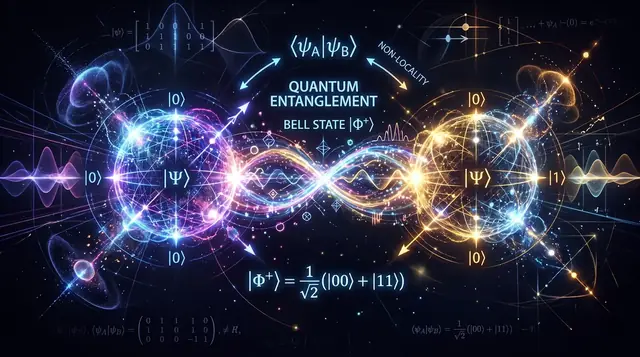
A clear explanation of quantum entanglement: what it is, what it is not, how it differs from classical correlations, and why it is a resource in quantum computing.
What entanglement actually is, why Einstein hated it, and why it's essential for quantum computing and quantum communication.
Implement quantum teleportation in PennyLane: creating the entangled pair, Bell measurement, classical correction, and verifying the teleported state.
Understand the quantum teleportation protocol from first principles, learn why it does not violate relativity or the no-cloning theorem, and implement a working teleportation circuit using Qiskit dynamic circuits.