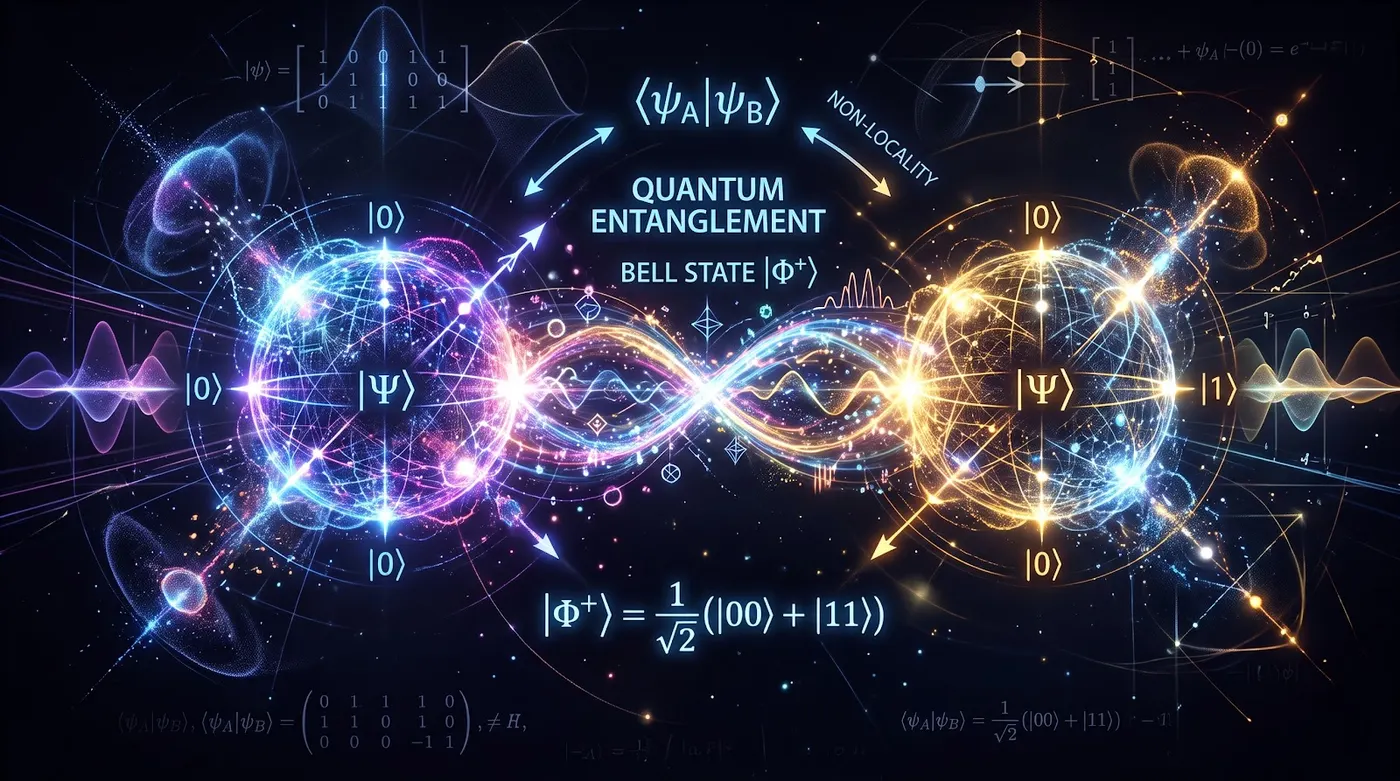
Learn the fundamentals of quantum networks and get hands-on with QuTech’s Quantum Network Explorer (QNE). While most quantum computing courses focus on quantum processors, this course addresses the equally important quantum internet - the distributed network infrastructure needed for quantum key distribution, blind quantum computing, and distributed quantum sensing.
Part of the Quantum Computer and Quantum Internet Applications professional certificate program from Delft University of Technology.
What you’ll learn
- Quantum network fundamentals: how entanglement is generated and distributed between network nodes, and what makes quantum networks fundamentally different from classical networks
- The quantum repeater: why photon loss over optical fibre limits direct long-distance quantum communication, and how quantum repeaters using entanglement swapping overcome this
- Quantum network application categories: quantum key distribution (QKD), blind quantum computing, distributed quantum sensing, and entanglement-based clock synchronisation
- The QNE platform architecture: how the Quantum Network Explorer provides a simulation environment and the Community Application Library
- QNE-ADK programming: the Python-based Application Development Kit for writing quantum network applications - how nodes, connections, and quantum operations are specified
- SquidASM: QuTech’s advanced simulator for quantum network applications, supporting multiple noise models and configurable network topologies
- Building applications from scratch: designing, implementing, and testing a complete quantum network protocol end-to-end using QNE-ADK
- Debugging and validation: how to verify that a quantum network application does what it is supposed to do and understand why simulations fail
Course structure
The course runs for four weeks at four to five hours per week. The opening module covers quantum network fundamentals: why quantum networks are difficult to build (photon loss, no-cloning, decoherence), what quantum repeaters need to do, and what applications become possible with working quantum network links.
You then explore the QNE Community Application Library - a collection of pre-built applications (quantum key distribution, GHZ state distribution, and others) that you can run and inspect before writing your own.
The programming modules introduce QNE-ADK: how quantum network applications are structured in Python, how nodes are defined, and how quantum operations are expressed in the application code. You modify existing applications before building new ones.
The SquidASM module covers advanced simulation: configuring realistic noise models (depolarising noise, gate errors, photon loss), running multi-node protocols, and interpreting simulation results and error rates.
The course closes with a capstone project: designing and implementing a quantum network application of your choice.
Who is this for?
- Software developers who want practical quantum networking skills beyond theory
- Quantum computing students who want experience with a real quantum network simulation platform
- Network engineers and security professionals investigating quantum communication
- EU quantum technology professionals seeking QTIndu certification (available for both audit and verified learners, funded by the European Union’s Digital Europe Programme, grant no. 101100757)
Prerequisites
Python programming experience is required - you will write QNE-ADK application code throughout. Basic quantum computing knowledge (qubits, gates, entanglement, circuits) is needed from the start. You should know what entanglement is and be comfortable with quantum circuit notation. The Quantum 101 courses from Delft or equivalent background is the right preparation.
Hands-on practice
This is a genuinely hands-on course. You will:
- Write Python code using QNE-ADK to implement quantum network protocols
- Run protocols through SquidASM with configurable network topologies
- Implement quantum key distribution over a simulated two-node network
- Build an entanglement distribution application spanning three nodes
- Test protocol performance under different noise configurations and compare results
All tools are open-source. The QNE-ADK and SquidASM run in a standard Python environment. EU participants (audit and verified) are eligible for a QTIndu certificate upon completion.
Why take this course?
The quantum internet is not a distant concept - the first quantum network links are being built now, and QuTech operates the first experimental multi-node quantum network. This course gives you direct experience with the tools QuTech researchers use to design and test quantum network applications.
SquidASM in particular enables realistic protocol testing with proper noise models before any physical hardware is needed. For anyone targeting a career in quantum networking, quantum communication, or quantum-safe infrastructure, this is one of the most practically relevant courses available.
Topics covered
Enrol in this course
Quantum Communication and the Quantum Network Explorer is $150 on edX, at intermediate level, and runs 4 weeks, 4-5 hours per week. A certificate is included.
Affiliate link. We may earn a commission at no extra cost to you.