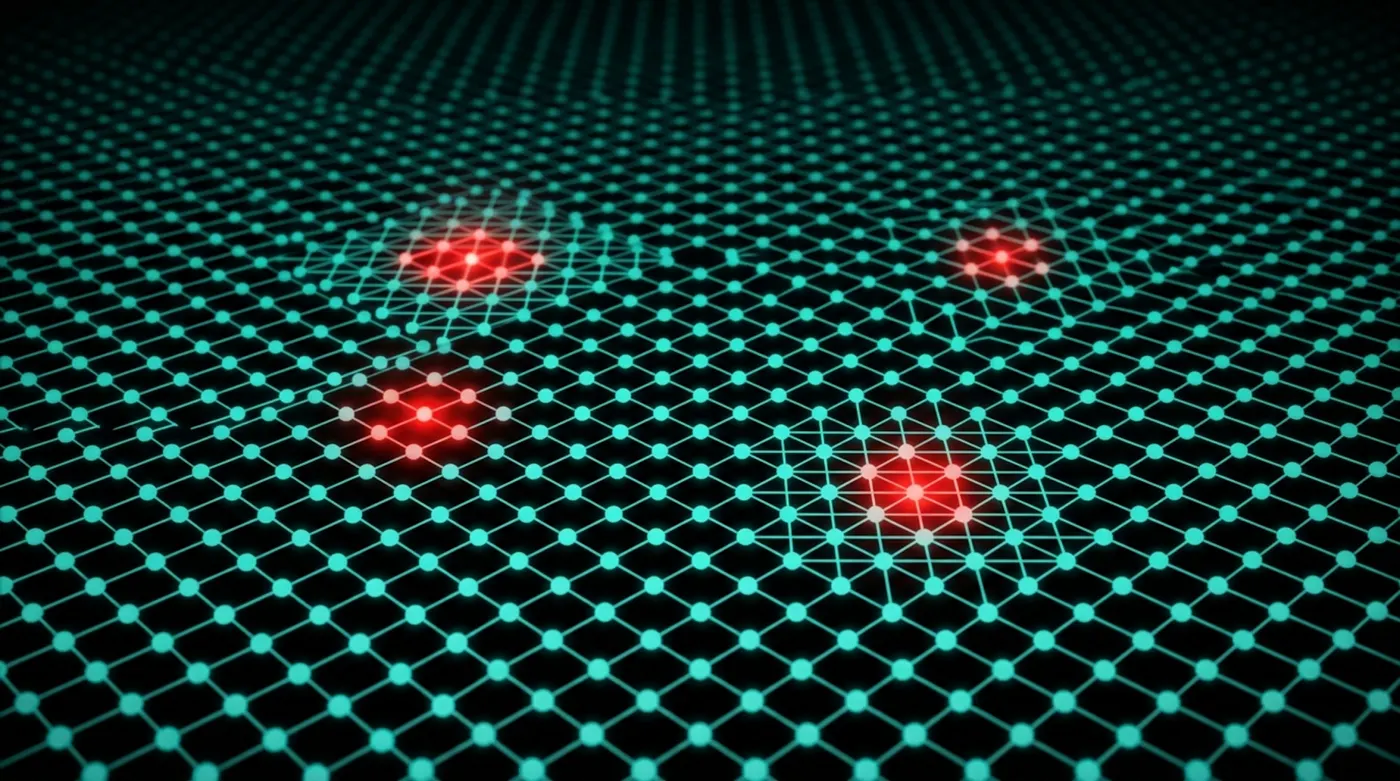
Standard quantum error correction is designed to correct errors within a two-dimensional computational subspace: bit flips, phase flips, and combinations of the two. Leakage is different. When a qubit leaks into a higher energy level, the quantum information does not get flipped or dephased inside the qubit subspace; it escapes the subspace entirely. The physical system still exists and interacts with its neighbors, but the two-level model that error correction codes are built on no longer applies. This makes leakage one of the most disruptive error types in quantum hardware.
The details
Physical qubits are not ideal two-level systems. A superconducting transmon qubit is actually an anharmonic oscillator with many energy levels: , , , , and so on. The qubit is encoded in the lowest two levels, and quantum gates are designed using microwave pulses at the transition frequency. Because the oscillator is anharmonic, the transition is at a slightly different frequency (this separation is the anharmonicity) and that is what makes selective addressing possible. In transmons, the anharmonicity is roughly 200-300 MHz.
However, fast gate pulses contain frequency components that can excite the transition even when the pulse is nominally centered at . If the gate pulse is too short (and hence bandwidth-broadened), or if calibration drifts, population can accumulate in or higher levels. This population is outside the computational subspace and constitutes leakage.
For trapped-ion qubits, leakage often involves transitions to atomic energy levels outside the chosen qubit pair. Neutral-atom Rydberg qubits face leakage into adjacent Rydberg levels when the control fields are imprecise.
Why leakage is especially harmful:
- Standard syndrome measurements in stabilizer codes assume qubits are in . A leaked qubit produces anomalous syndrome patterns that the decoder may misinterpret as multiple Pauli errors rather than a single leakage event, leading to decoding failures.
- A leaked qubit in state can spread errors to neighboring qubits through cross-coupling, converting one leakage event into multiple correlated Pauli errors on the surrounding qubits.
- Leakage does not decay like a Pauli error under standard error models. The population in has its own relaxation time (typically decay) and can persist, causing correlated errors across many subsequent gate cycles.
Leakage reduction units (LRUs): Purpose-built circuits or operations designed to detect whether a qubit has leaked and, if so, reset it back to the computational subspace. An LRU for a superconducting qubit might apply a conditional pulse that transfers population from back to (a -pulse on the transition, applied with a flag conditioned on leakage detection). LRUs are increasingly incorporated into fault-tolerant architectures because codes that do not address leakage explicitly can see their effective logical error rates degrade significantly.
Leakage rate as a distinct metric: Hardware benchmarks should report leakage rates separately from depolarizing error rates. A gate with 0.1% leakage rate per operation does not simply add 0.1% to the total error budget; it adds errors of a qualitatively different type that standard decoders handle poorly.
When the qubit leaves the computational subspace
Leakage illustrates why real-world quantum hardware is more complex than the idealized two-level qubit of textbooks. Understanding leakage helps you interpret hardware specifications more critically: a gate fidelity number measured by standard randomized benchmarking may not fully capture leakage errors, since leakage population can partly escape the fidelity measurement depending on the readout basis. Error budgets for fault-tolerant quantum computing must account for leakage separately, and architectures that ignore it can fall short of their projected logical error rates.
Common misconceptions
Misconception 1: Leakage is just another form of decoherence. Decoherence operates within the qubit subspace, degrading superpositions via and processes. Leakage removes population from the qubit subspace entirely. The two processes require different detection and correction strategies.
Misconception 2: Standard error correction codes handle leakage automatically. Stabilizer codes are constructed for Pauli errors in a two-dimensional space. A leaked qubit violates the code’s assumptions and can cause the decoder to misidentify the error type. Specific leakage-aware decoding or active leakage reduction is required.
Misconception 3: Anharmonicity can be made large enough to eliminate leakage. Larger anharmonicity does suppress leakage, but it also reduces the coherence times and complicates coupling between qubits. Hardware designers must balance anharmonicity, coherence, and coupling strength, keeping leakage as a residual but manageable error channel rather than eliminating it entirely.