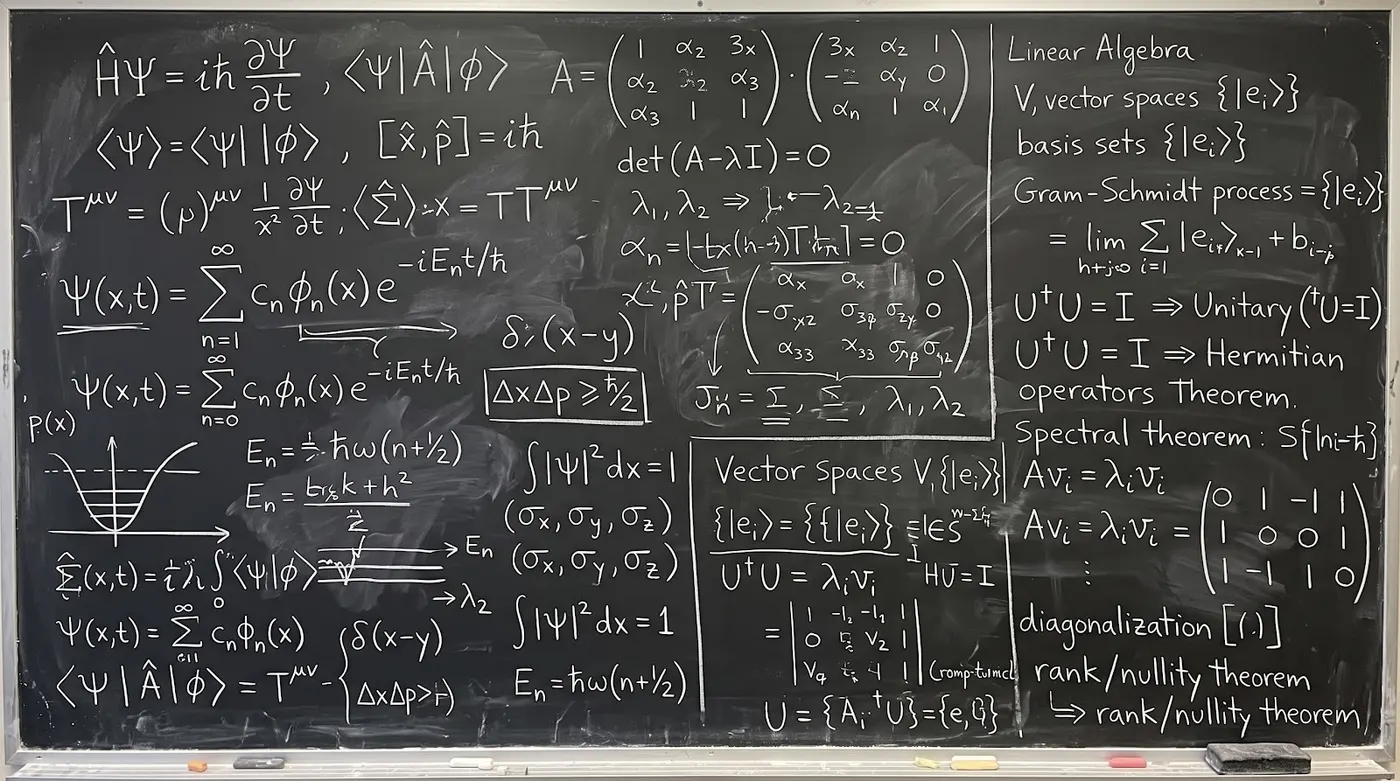
Linear algebra is the language of quantum computing. Quantum states are vectors. Quantum gates are matrices. Quantum measurements are eigenvalue problems. Every formula in every quantum computing textbook uses linear algebra - there is no way around it, only through it.
This course builds that foundation interactively, through visual intuition rather than dry symbol manipulation. By the end, the mathematics of quantum computing will feel motivated and concrete rather than abstract.
What you’ll learn
- Vectors and vector spaces: the geometric objects that represent quantum states, including the idea of a basis and how to decompose a vector in that basis
- Matrix multiplication: the engine behind quantum gate operations - why multiplying two matrices corresponds to applying two transformations sequentially
- Linear transformations: how matrices act on vectors geometrically, and why quantum gates are a specific type of linear transformation
- Determinants: what they measure geometrically (area and volume scaling) and what it means for a determinant to be zero (the transformation collapses dimensions)
- Matrix inverses: why invertibility matters and the connection to reversible operations
- Inner products and orthogonality: the machinery that underlies quantum measurement and the Born rule
- The Gram-Schmidt process: turning any basis into an orthonormal one, the workhorse behind projections and clean coordinate systems
- Eigenvalues and eigenvectors: the special vectors that are only scaled (not rotated) by a matrix - these are measurement outcomes in quantum mechanics
- Diagonalizable matrices: when a transformation can be reduced to simple scalings along the right axes, and what to do when it cannot (Jordan normal form)
- Tensors and tensor products: the construction quantum mechanics uses to combine systems into multi-qubit state spaces
- Change of basis: how to express the same vector in a different coordinate system - directly relevant to changing measurement bases in quantum computing
Course structure
The course follows a visual-first approach across 41 lessons and 164 exercises, organised into seven levels. Every concept begins with geometric intuition before any formula appears.
Vectors are introduced as arrows in space - geometric objects - before coordinates are attached to them. Matrix multiplication is introduced by asking: what does this matrix do to a square? You see the square transform before the multiplication rule is given. Systems of equations are connected to intersecting lines and planes.
Determinants are taught through their geometric meaning (area scaling) before the formula. Dot products are taught through angles and projections. Eigenvalues emerge naturally when you ask: for what vectors does this transformation only stretch or shrink, without rotating?
The later levels reach genuinely advanced material: the Gram-Schmidt process, diagonalization, tensor products, singular value decomposition, and Jordan normal form. These are exactly the tools quantum mechanics is written in, even though the course itself stays within mathematics and its applications (image compression, cryptography, and coding among them).
Who is this for?
- Anyone starting quantum computing who needs to build the mathematics foundation
- CS and engineering students who want to understand the “why” behind matrix operations rather than just the algorithm for multiplying them
- Self-learners who found university linear algebra too abstract or too fast
- Physicists and chemists who need linear algebra for quantum mechanics
- Data scientists who use linear algebra daily (PCA, neural nets) and want deeper intuition for what they are doing
Prerequisites
Brilliant lists a basic understanding of calculus and linear equations as the expected background. Familiarity with coordinate geometry (x-y plane, plotting points) helps with the early vector sections. No prior linear algebra is assumed, but this is a full university-style treatment rather than a light introduction.
Hands-on practice
Every concept is practised through Brilliant’s interactive browser-based problems:
- Drag vectors and matrices and see transformations applied in real time
- Manipulate eigenvalue sliders to see eigenvectors emerge from a transformation
- Step through Gaussian elimination on concrete 3x3 matrices
- Decompose vectors in different bases and see coordinates change
- Run the Gram-Schmidt process on concrete sets of vectors to build orthonormal bases
No software to install. All exercises run in the browser, including on mobile. The emphasis is on understanding what operations do geometrically, not on practising arithmetic calculation.
Why take this course?
This is the single most important prerequisite for quantum computing study.
A qubit state is a unit vector in a two-dimensional complex vector space. A quantum gate is a unitary matrix acting on that vector. A measurement outcome is an eigenvalue of a Hermitian observable matrix. These three facts are not just useful to know - they are the entire mathematical structure of quantum computing.
Without linear algebra, you can follow quantum circuit diagrams at a superficial level but you cannot reason about what a circuit actually does to a quantum state. With linear algebra, every quantum gate, every measurement, every algorithm becomes a concrete mathematical object you can analyse and reason about.
Brilliant’s visual approach builds the right kind of understanding quickly. After this course you will be ready to take on a dedicated quantum computing course with genuine mathematical confidence.
Related tutorials
Practise the concepts from this course with these hands-on tutorials:
- What Is a Qubit? - A plain-English explanation of qubits, superposition, and the Bloch sphere
- Quantum Gates Explained - How quantum gates work, with circuit diagrams and Qiskit examples for every common gate
Topics covered
Enrol in this course
Vectors and Matrices is a paid course on Brilliant, at intermediate level, and runs Self-paced.
Affiliate link. We may earn a commission at no extra cost to you.