Role Profile
Quantum Cryogenics / Control Systems Engineer
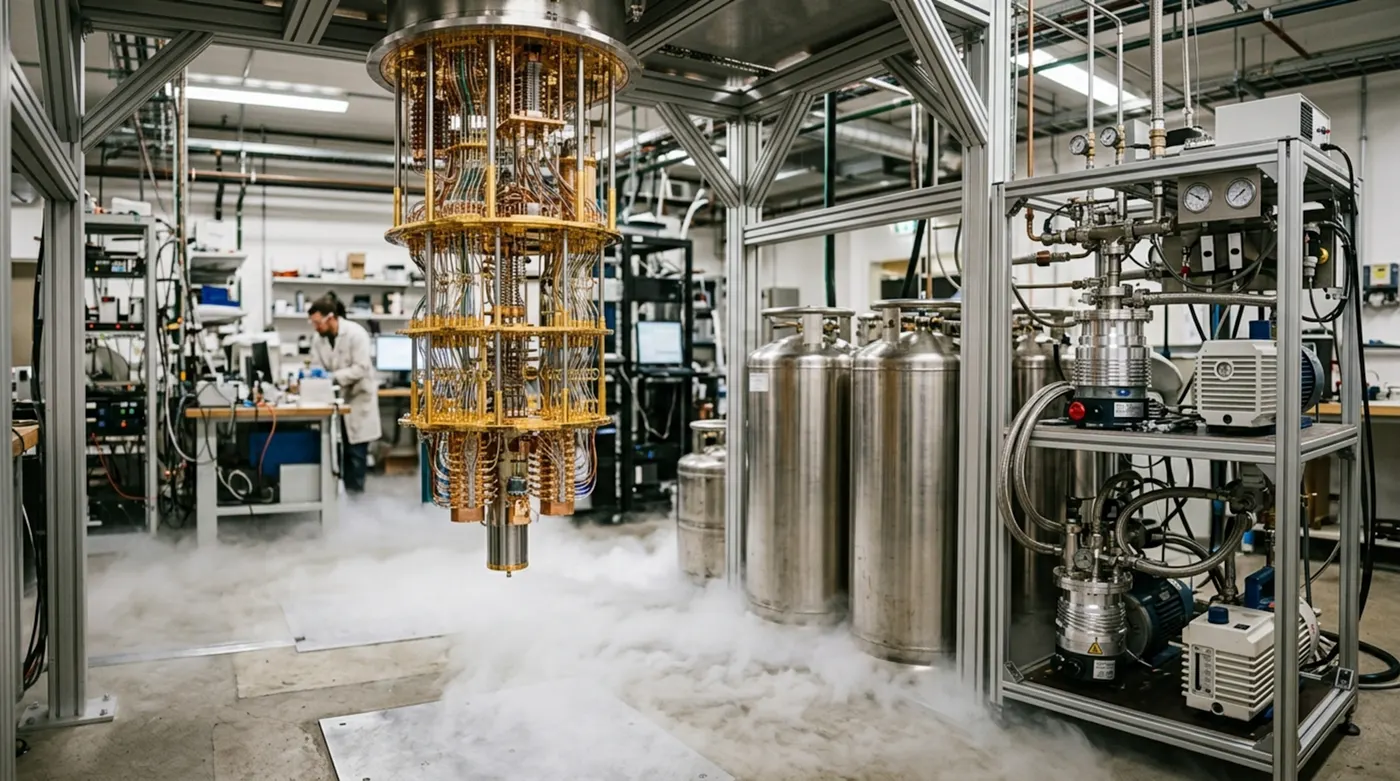
A quantum cryogenics and control systems engineer builds and runs the physical machinery that makes quantum computing possible. For superconducting platforms that means dilution refrigerators holding qubits near absolute zero, carefully engineered microwave chains to drive and read them, and fast FPGA-based electronics that fire pulses with nanosecond timing. It is a deeply hands-on, lab-based role at the meeting point of cryogenics, RF and microwave engineering, electronics, and experimental physics, and the talent pool is genuinely scarce.
A typical day
This is a bench-heavy role. A day might begin by checking a dilution refrigerator's cooldown, verifying it has reached base temperature and that the wiring and filtering are behaving. The bulk of the day is often spent on the control stack: shaping microwave pulses, programming the FPGA timing, and tuning the readout chain to separate qubit states cleanly. When fidelity drops, the work becomes detective work, isolating whether the culprit is thermal noise, a bad cable, an amplifier, or the device itself. Periods of intense lab work alternate with data analysis in Python and design work for the next, larger system, since scaling the control and cryogenic infrastructure is the field's central engineering challenge.
Core responsibilities
- Operate and maintain dilution refrigerators that hold qubits at millikelvin temperatures.
- Design the cryogenic wiring, filtering, attenuation, and thermal anchoring that carry signals to the chip without adding noise.
- Engineer the microwave and RF chains used to drive and read out superconducting qubits.
- Build and program FPGA-based control electronics and arbitrary waveform generators for pulse sequences.
- Develop signal-processing pipelines for fast, high-fidelity qubit readout.
- Calibrate gates and characterise devices, diagnosing where coherence and fidelity are being lost.
- Work with lab instrumentation: vector network analysers, spectrum analysers, oscilloscopes, and DC sources.
- Plan how the control and cryogenic stack scales as qubit counts grow into the thousands.
Skills
Required
- Cryogenics and dilution refrigerators
- Microwave and RF engineering
- FPGA and control electronics
- Signal processing
- Lab instrumentation
- Electromagnetics and circuit theory
- Python / MATLAB for control and analysis
- Experimental physics intuition
Nice to have
Equipment and tools
-
Dilution refrigerators
Systems from vendors like Bluefors and Oxford Instruments that cool qubits to roughly 10 millikelvin.
Learn more → -
Microwave instrumentation
Vector network analysers, signal generators, mixers, amplifiers, and filters for the qubit drive and readout chains.
-
FPGA control systems
Platforms such as Quantum Machines OPX, Zurich Instruments, and Xilinx FPGAs that time pulses to the nanosecond.
-
Arbitrary waveform generators
Devices that shape the precise microwave pulses implementing single- and two-qubit gates.
Learn more → -
Characterisation software
Python and MATLAB stacks for calibration, readout discrimination, and noise characterisation.
Learn more →
Salary by seniority
Approximate US base-salary ranges for 2026. The scarcity of cryogenic and microwave talent keeps pay strong; total compensation at well-funded hardware firms adds equity. Major metros add 20-40%, while national labs trade some pay for research freedom and benefits.
| Level | Base range | What changes |
|---|---|---|
| Junior (0-3 yr) | $110k - $140k | Supports fridge operation, wiring, calibration, and control-electronics testing in the lab. |
| Mid (3-7 yr) | $140k - $180k | Owns cryogenic or microwave subsystems and the control stack for a class of devices. |
| Senior / Staff (7 yr+) | $180k - $240k+ | Architects the full control and cryogenic system and leads scale-up across many qubits. |
See the full quantum computing salary guide for geographic breakdowns and why hardware plus software cross-expertise commands a premium.
Demand and outlook
Demand is high and supply is thin. Every superconducting and trapped-ion hardware company needs people who can keep refrigerators cold, microwave chains clean, and control electronics precise, yet very few engineers have hands-on experience with this specific stack. Scaling from hundreds to thousands of qubits makes control and cryogenic engineering a critical bottleneck, so the outlook is strong for years to come. The field rewards specialists: pick a layer, whether cryogenics, RF, or control electronics, and go deep.
Who hires for this role
Browse current openings on the quantum jobs board, and see how this role fits alongside others in the careers overview.
Want to be in line for roles like this? Join the talent pool and we will email you when a matching listing is posted.
How to become a cryogenics / control engineer
This is a hardware-engineering path, usually built on an electrical engineering or experimental physics background. Our quantum engineer roadmap walks through the physics, qubit modalities, control, and characterisation skills this role depends on.
Read the full guide: How to become a quantum engineer →