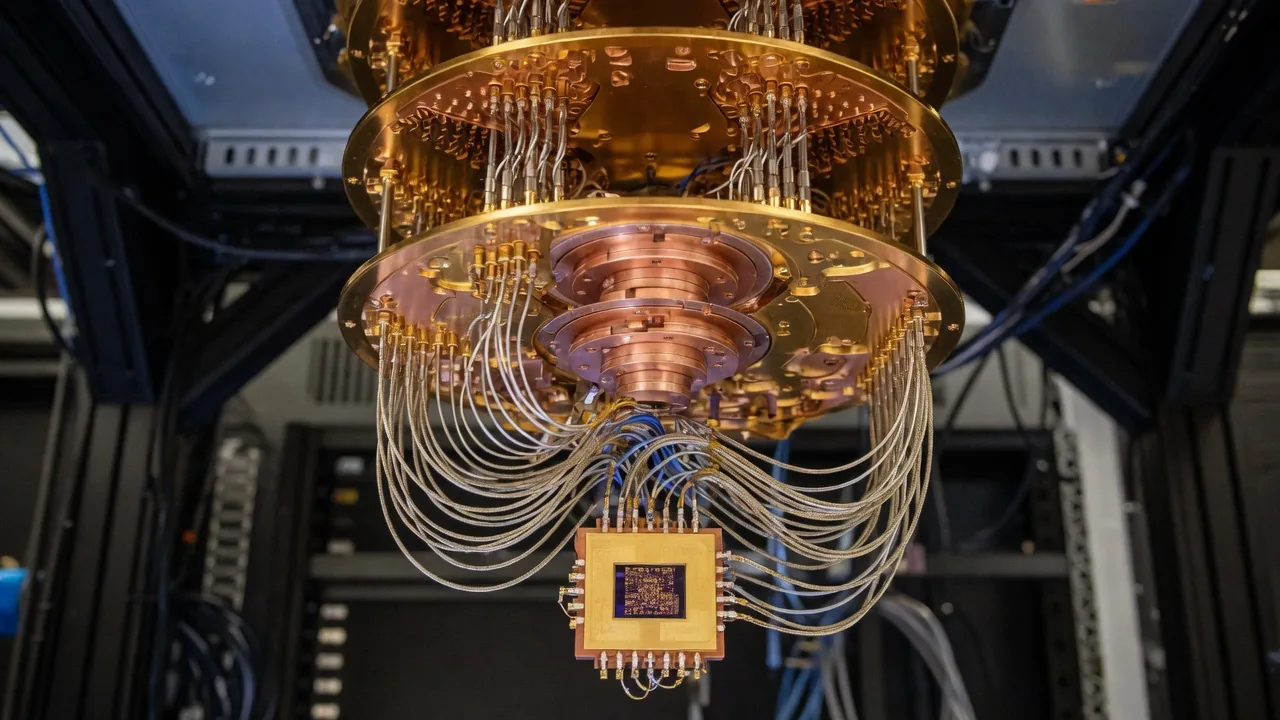
The transmon is the most widely deployed superconducting qubit design, used by IBM, Google, Rigetti, and others as the core building block of their quantum processors. It was introduced by Koch et al. in 2007 as an improvement over the Cooper pair box (CPB), solving the CPB’s extreme sensitivity to charge noise by trading off anharmonicity for noise resilience.
How it works
A transmon consists of a Josephson junction shunted by a large capacitor. The Josephson junction provides a nonlinear inductance, and the capacitor forms an LC-like oscillator whose energy levels are not equally spaced. The two lowest energy levels, and , serve as the qubit states.
The key design parameter is the ratio , where is the Josephson energy and is the charging energy. In the Cooper pair box, , making the energy levels highly sensitive to stray electric charges on the chip. The transmon operates at to , which exponentially suppresses charge dispersion while only reducing the anharmonicity algebraically.
The anharmonicity is the difference between the transition frequency and the transition frequency:
Typical transmon anharmonicities are to MHz, while qubit frequencies are to GHz. This means the transition can be selectively driven with microwave pulses without accidentally exciting the state, as long as pulses are not too short (which would broaden their frequency spectrum).
Control and readout
Transmon qubits are controlled by applying shaped microwave pulses at the qubit’s resonant frequency. Single-qubit gates (X, Y, Z rotations) are implemented by varying the amplitude, phase, and duration of these pulses. Typical single-qubit gate times are 20 to 50 nanoseconds.
Two-qubit gates are implemented through coupling between neighboring transmons. Common approaches include:
- Fixed-frequency transmons with cross-resonance gates: Used by IBM. One transmon is driven at the frequency of its neighbor, producing a ZX interaction. This is the basis for the CNOT gate.
- Tunable-frequency transmons with flux-tunable couplers: Used by Google. The qubit frequency is adjusted via an external magnetic flux through a SQUID loop, enabling fast two-qubit gates like the iSWAP or CZ.
Readout uses the dispersive interaction between the transmon and a coupled microwave resonator. The resonator frequency shifts depending on the qubit state, so measuring the resonator’s response reveals whether the qubit is in or without directly measuring the qubit’s energy.
Performance metrics
Modern transmon qubits achieve:
| Metric | Typical value (2025) |
|---|---|
| (energy relaxation) | 100 to 500 microseconds |
| (dephasing) | 100 to 300 microseconds |
| Single-qubit gate fidelity | 99.9%+ |
| Two-qubit gate fidelity | 99.0% to 99.9% |
| Readout fidelity | 99%+ |
These numbers vary significantly across platforms and individual qubits on the same chip.
The superconducting circuit in most announcements
The transmon is the workhorse of the current quantum computing industry. When you run a circuit on IBM Quantum or Google’s processors, you are almost certainly using transmon qubits. Understanding transmon physics helps interpret hardware specifications, noise characteristics, and the design choices behind native gate sets and transpilation strategies. The transmon’s limited anharmonicity also explains why leakage to the state is a real concern, motivating leakage error mitigation techniques.