
Qubit
Quantum Computing 101: From Zero to Your First Circuit
QuantumComputingCourses
Nine free modules on this site, from what a qubit is to a circuit in Qiskit, using the Bloch sphere and the circuit builder. No signup.
Topic
1 course · 9 tutorials
Qubit
QuantumComputingCourses
Nine free modules on this site, from what a qubit is to a circuit in Qiskit, using the Bloch sphere and the circuit builder. No signup.
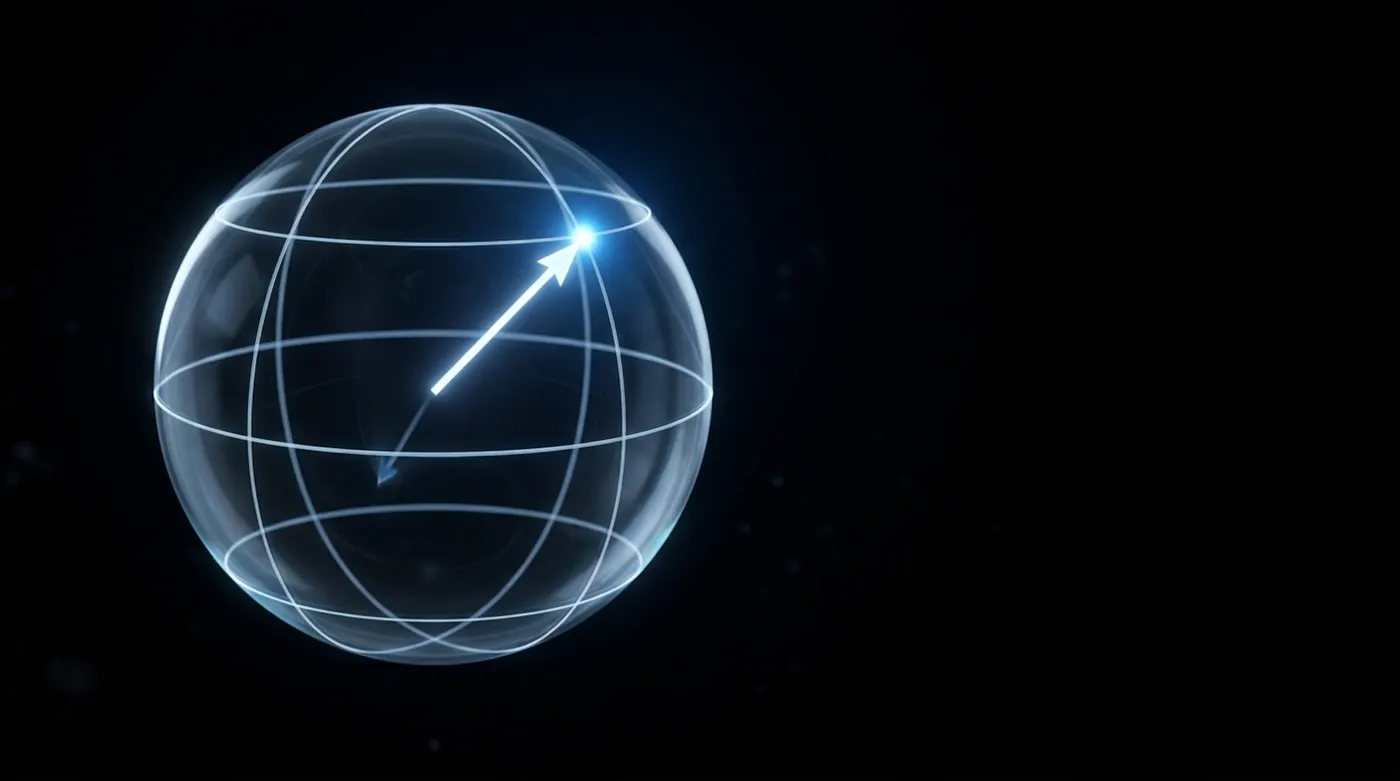
The Bloch sphere is a map with edges. This final part covers what measurement does to the arrow, why real qubits drift inside the ball, and why an entangled qubit has no arrow at all.
Give a rotation a dial instead of a fixed angle and you can steer a qubit anywhere on the Bloch sphere with two gates. This is the Euler decomposition, and it is what your transpiler does to every circuit you run.
The Hadamard gate is a half-turn about a diagonal axis, and S and T are partial twists about the vertical one. Seen on a live Bloch sphere, the H, S and T gates stop being matrices and start being furniture-moving.
Watch the X, Y and Z gates run on a live Bloch sphere. All three are half-turns around an axis, which explains why X flips a qubit, why Z appears to do nothing, and why applying any of them twice gets you back where you started.
A guided tour of the Bloch sphere using a live simulator: what the poles, the equator and the two angles actually mean, and why two states with identical measurement odds can sit on opposite sides of the ball.
A side-by-side comparison of classical bits and qubits: what makes a qubit fundamentally different, what it can and cannot do, and common misconceptions.
How to visualize quantum circuits, measurement histograms, statevectors, and Bloch sphere representations using Qiskit's built-in tools.
A plain-English explanation of qubits, what makes them different from classical bits and why that matters for computing.
The mathematics behind the Bloch sphere: how the angles θ and φ map to quantum state vectors, why single-qubit gates are rotations, and how to read any single-qubit state geometrically.