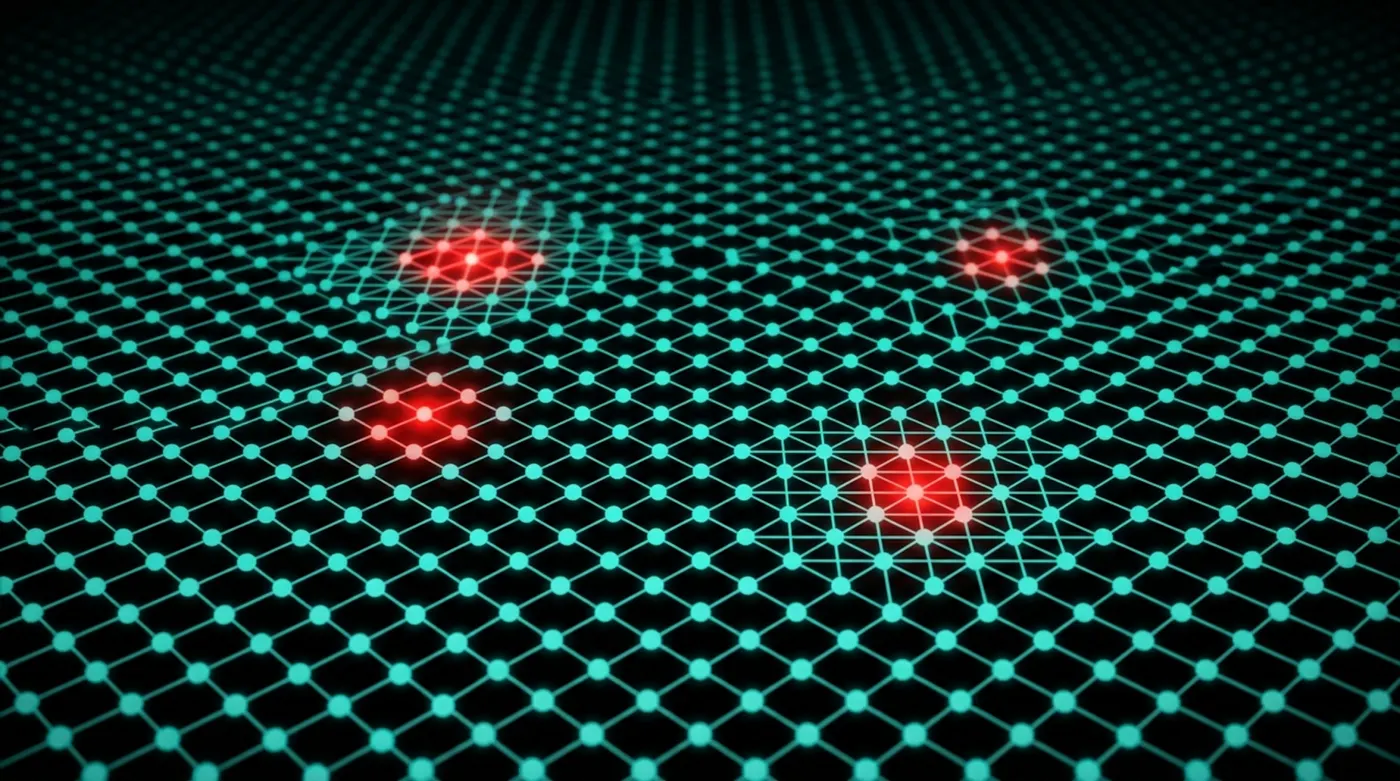
The Gottesman-Kitaev-Preskill (GKP) code, proposed in 2001, encodes a logical qubit into a harmonic oscillator by distributing logical information across a grid of points in phase space. The logical and states are superpositions of evenly-spaced position eigenstates, and errors that displace the state by less than half a grid spacing can be corrected by measuring the displacement modulo the grid period. GKP codes are particularly powerful because small displacement errors, which arise from photon loss and thermal noise, map directly onto correctable shifts. The challenge is that ideal GKP states have infinite energy, so experimental implementations use finitely-squeezed approximations, and preparing high-quality GKP states requires significant squeezing, which has been demonstrated in optical and microwave cavities and trapped-ion motional modes.
Cat codes encode logical information in superpositions of coherent states, as in the cat qubit, while binomial codes use carefully chosen Fock state superpositions whose coefficients are binomial coefficients, designed so that specific photon loss and gain events map to orthogonal error subspaces that can be detected and corrected. The binomial code was developed at Yale and demonstrated experimentally in a microwave cavity coupled to a superconducting transmon ancilla used for syndrome measurement. All three code families exploit the same key resource: the oscillator’s Hilbert space is infinite-dimensional, meaning a single physical mode contains far more room for encoding and error detection than a two-level qubit. This contrasts with stabilizer codes such as the surface code, which require many physical qubits to protect one logical qubit.
The comparison between bosonic codes and qubit-array stabilizer codes is central to evaluating their practical value. A surface code requires physical qubits for a distance- logical qubit, with needing to reach 10-20 to achieve error rates below in realistic hardware. A single oscillator mode encoded with a bosonic code can in principle reach comparable logical error rates with a single physical cavity, though it still requires an ancilla qubit for syndrome extraction and a classical controller for real-time feedback. Yale’s group demonstrated a bosonic-encoded logical qubit lifetime exceeding that of any physical qubit in the system, a landmark known as surpassing the break-even point. AWS Center for Quantum Computing has pursued GKP codes in their superconducting hardware program as a path to scalable fault-tolerant quantum computing with reduced physical qubit overhead.
The roadmap from bosonic codes to fully fault-tolerant computation involves concatenating the oscillator-level code with a higher-level code to handle residual errors that the bosonic code cannot correct on its own. For example, a GKP code corrects small displacements but not large ones, so a qubit-level repetition or surface code can be layered on top, with each physical qubit in that outer code being a GKP-encoded oscillator. This two-level hierarchy can achieve fault tolerance with dramatically fewer total physical components than a pure qubit-array approach. The remaining engineering challenges include the fabrication of high-coherence microwave cavities, the development of fast and high-fidelity ancilla-based syndrome measurement circuits, and the integration of real-time classical decoding hardware that can keep pace with the quantum error correction cycle time.