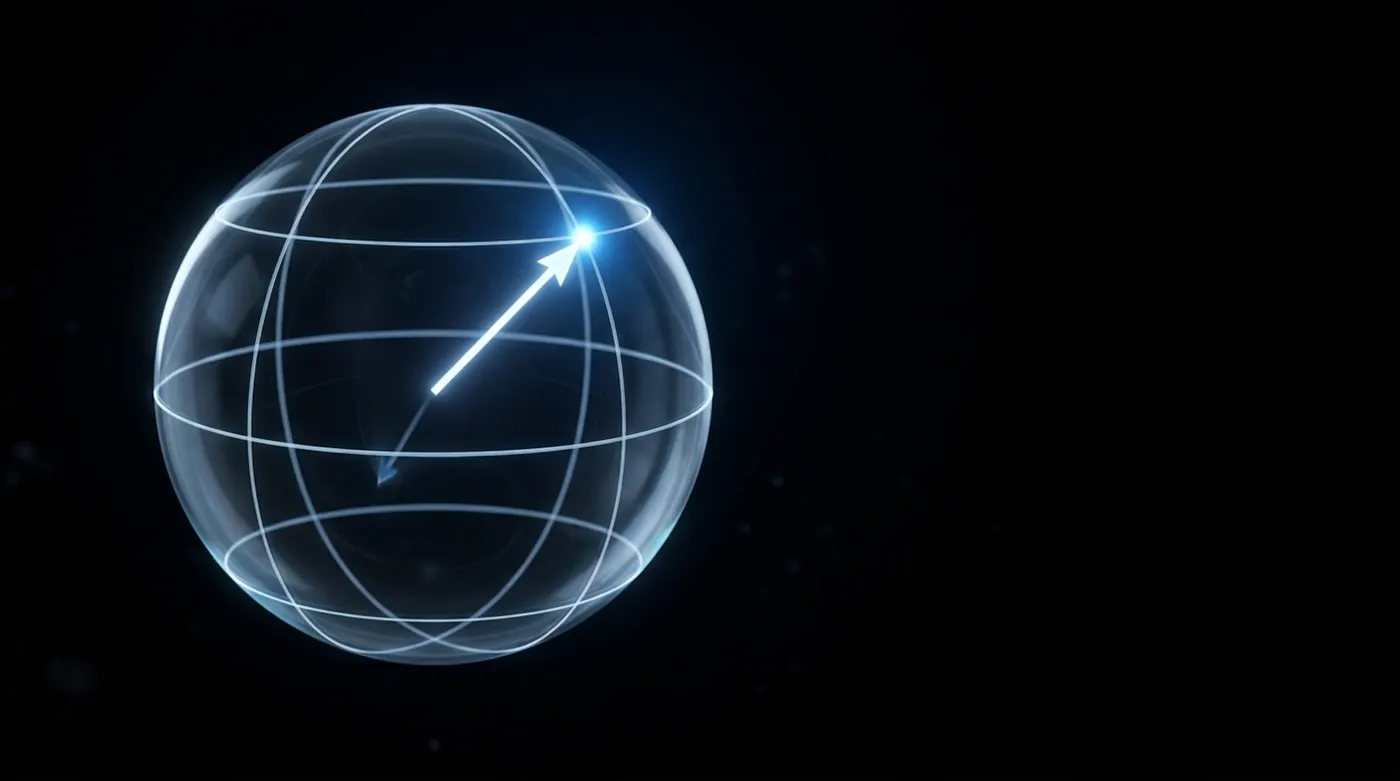
The name cat qubit references Schrodinger’s famous thought experiment, in which a cat is simultaneously alive and dead in a quantum superposition. In a cat qubit the logical and states are encoded as the superpositions and of two coherent states with amplitudes and in the phase space of a microwave resonator. Coherent states are the quantum states of the electromagnetic field that most closely resemble classical oscillations, and sets the mean photon number of the cavity. Because and are located on opposite sides of phase space, any physical process that would flip the qubit state would have to tunnel between two well-separated regions, a process that becomes exponentially suppressed as increases. This gives cat qubits an intrinsic hardware-level protection against bit-flip errors that does not require any active error correction.
The bias-preserving property is one of the most important characteristics of cat qubits. As the mean photon number is increased, the bit-flip error rate decreases exponentially while the phase-flip error rate increases only linearly. This asymmetry between the two error types is fundamentally different from the roughly equal error rates seen in transmon or flux qubits. A highly biased qubit, where bit-flip errors are orders of magnitude rarer than phase-flip errors, simplifies the overhead of error correction dramatically because the full-scale surface code can be replaced by a repetition code along the phase-flip axis, which has far fewer physical qubits per logical qubit. Theoretical analyses suggest cat qubit-based architectures could reach fault-tolerant thresholds with significantly fewer physical qubits than architectures built from unbiased qubits.
The remaining challenge for cat qubits is the linear growth of phase-flip errors with mean photon number. Phase flips arise from photon loss events in the cavity, which collapse the phase-space superposition. As is increased to suppress bit flips, each photon loss event becomes more likely to cause a distinguishable phase error. This means the two error channels cannot be simultaneously suppressed using only the cat encoding alone. The standard approach is to accept this trade-off: use a large to make bit-flip errors negligibly rare, then apply a one-dimensional repetition code to correct the remaining phase flips. The result is a two-level error correction hierarchy where the cat encoding handles bit flips and the repetition code handles phase flips, replacing the two-dimensional surface code with a simpler structure.
The leading experimental implementation comes from Alice & Bob, a French quantum hardware startup, whose superconducting cat qubit chips (the Boson series) stabilize cat states in a driven resonator. Their architecture uses a nonlinear superconducting resonator driven by a two-photon pump to stabilize the cat states, and they have demonstrated exponential suppression of bit-flip errors while maintaining coherent gate operation. The approach is sometimes called the hardware-efficient error correction strategy because it shifts error correction burden from software and qubit count to the physics of the oscillator mode, exploiting the large Hilbert space of a harmonic oscillator to encode robustness. Other groups at Yale, ENS Paris, and AWS have pursued related bosonic encoding strategies, and the broader class of bosonic codes, which includes GKP codes and binomial codes alongside cat codes, represents one of the most active research directions in the path toward fault-tolerant quantum computing.