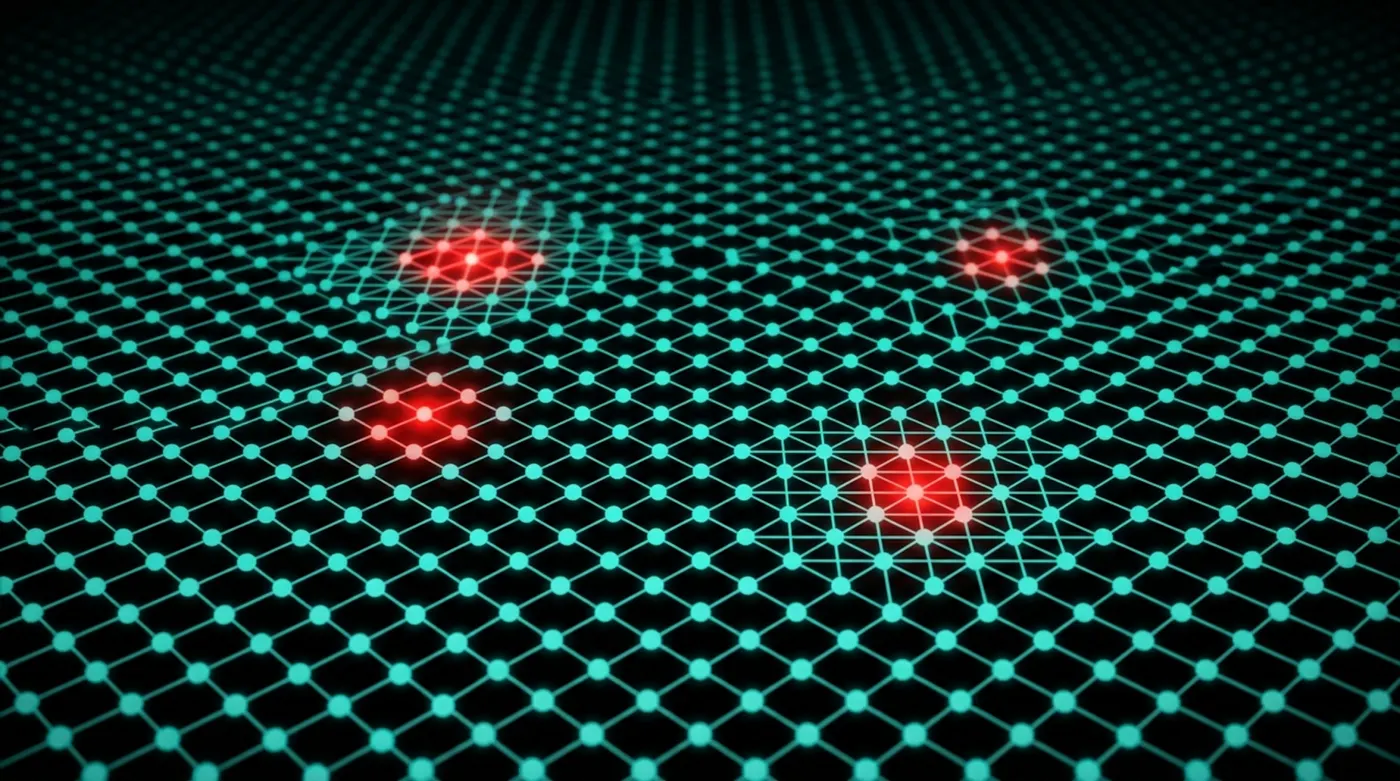
A deep dive into Germanium qubits - one of the most promising and fast-moving semiconductor qubit platforms. Germanium hole-spin qubits have attracted significant research attention since 2018 because they can be controlled faster than electron spin qubits in Silicon, are potentially compatible with existing CMOS infrastructure, and have demonstrated high-fidelity two-qubit gates.
This course is taught by the researchers actively building Germanium quantum devices at QuTech - giving you research-level insight rather than textbook summaries.
Part of the Quantum 301: Quantum Computing with Semiconductor Technology professional certificate.
What you’ll learn
- The physics of hole-spin qubits in Germanium: valence band structure, heavy-hole and light-hole states, and why spin-orbit coupling enables fast electrical qubit control
- How quantum dots are formed in Germanium structures using electrostatic gating
- The exchange interaction: how spin states on adjacent quantum dots can be coupled for two-qubit gate operations
- Pauli spin blockade: the mechanism that enables spin-to-charge conversion for single-shot qubit readout
- Fabrication processes for Germanium qubit devices: materials (Ge/SiGe heterostructures), ohmic contacts, gate metallisation, and the full cleanroom workflow
- The semiconductor industry landscape: which companies, research groups, and facilities are active in semiconductor quantum computing
- Machine learning for automated qubit tuning: why manual calibration does not scale and how ML replaces it
- Quantum error correction in Germanium systems: how syndrome measurement cycles would be implemented on a Ge qubit array
- Running quantum algorithms on semiconductor hardware: current state of the art and what benchmarks have been demonstrated
Course structure
The course runs for six weeks at six to seven hours per week. The opening module establishes the physics: Germanium’s band structure and why holes in Germanium differ advantageously from electrons in Silicon for qubit purposes.
The device physics module covers how gate voltages form quantum dots, how the charge occupancy is controlled, and how the exchange interaction enables two-qubit gates. You learn to interpret charge stability diagrams - the maps of quantum dot charge occupancy as a function of gate voltages that experimentalists use to find qubit operating points.
The fabrication module covers the complete device fabrication workflow: substrate preparation, Ge/SiGe heterostructure growth, mesa definition, gate metallisation, and bonding. The broader semiconductor industry context is included: who is doing what, with which facilities, and what the supply chain looks like.
The machine learning module addresses the auto-tuning problem: as more qubits are integrated, manual calibration becomes impossible. You learn how classification algorithms are applied to stability diagram images and how Bayesian optimisation searches for optimal operating points.
The course closes with quantum error correction and algorithm execution - how the physics translates into working quantum computation.
Who is this for?
- Semiconductor engineers and physicists transitioning into quantum hardware development
- Graduate students entering experimental quantum computing research on semiconductor platforms
- Researchers in solid-state physics or materials science interested in quantum device applications
- Anyone pursuing the Quantum 301 professional certificate from Delft University
Prerequisites
Prior completion of Fundamentals of Quantum Information and The Hardware of a Quantum Computer is strongly recommended. Some background in semiconductor physics (band gaps, doping, MOSFETs, quantum wells) is helpful - the course does not teach semiconductor fundamentals from scratch. Some familiarity with machine learning concepts is useful for the auto-tuning modules. This is a genuinely advanced course.
Hands-on practice
Exercises include:
- Analysing charge stability diagrams to identify qubit operating regimes
- Interpreting qubit characterisation data (T1, T2, gate fidelity) for Ge qubits
- Working through gate calibration sequences step by step
- Evaluating the impact of fabrication choices on expected device performance
- Applying machine learning classification to simulated stability diagram data
Problem sets are at research-adjacent difficulty with data drawn from real device characterisation workflows.
Why take this course?
Germanium qubits represent one of the most active frontiers in quantum hardware. Unlike superconducting qubits that dominate press coverage, semiconductor spin qubits offer a potentially cleaner path to fault-tolerant quantum computing at scale due to their compatibility with CMOS fabrication technology.
This course is taught by the QuTech group that has produced seminal Germanium qubit results. You get research-level insight, current experimental data, and direct access to the knowledge that would otherwise require joining the group as a graduate student. For anyone seriously interested in quantum hardware, this is as close to research immersion as any online course gets.
Topics covered
Enrol in this course
Development and Applications of Germanium Quantum Technologies is $185 on edX, at advanced level, and runs 6 weeks, 6-7 hours per week. A certificate is included.
Affiliate link. We may earn a commission at no extra cost to you.