The Problem
Before an energy company drills anything, it needs a picture of what lies underground. Seismic imaging builds that picture by sending acoustic waves into the earth and reconstructing subsurface structure from the reflections. Turning raw seismic data into a usable image means simulating wave propagation through complex rock at enormous scale, and it is one of the most computationally demanding tasks in the oil and gas sector.
The scaling is punishing. On classical computers, doubling the resolution of a seismic image can require up to double the computational resources. Higher resolution means finer grids, smaller time steps, and more memory, so image quality is ultimately rationed by compute budgets and energy consumption.
The bp and Quantinuum Collaboration
In May 2026, Quantinuum and bp announced a project to develop quantum-hybrid algorithms for subsurface seismic imaging, framed as an attack on fundamental wave physics challenges. The announcement builds on a successful pilot that demonstrated the feasibility of the approach; the partners are now scaling it to simulate more complex subsurface properties.
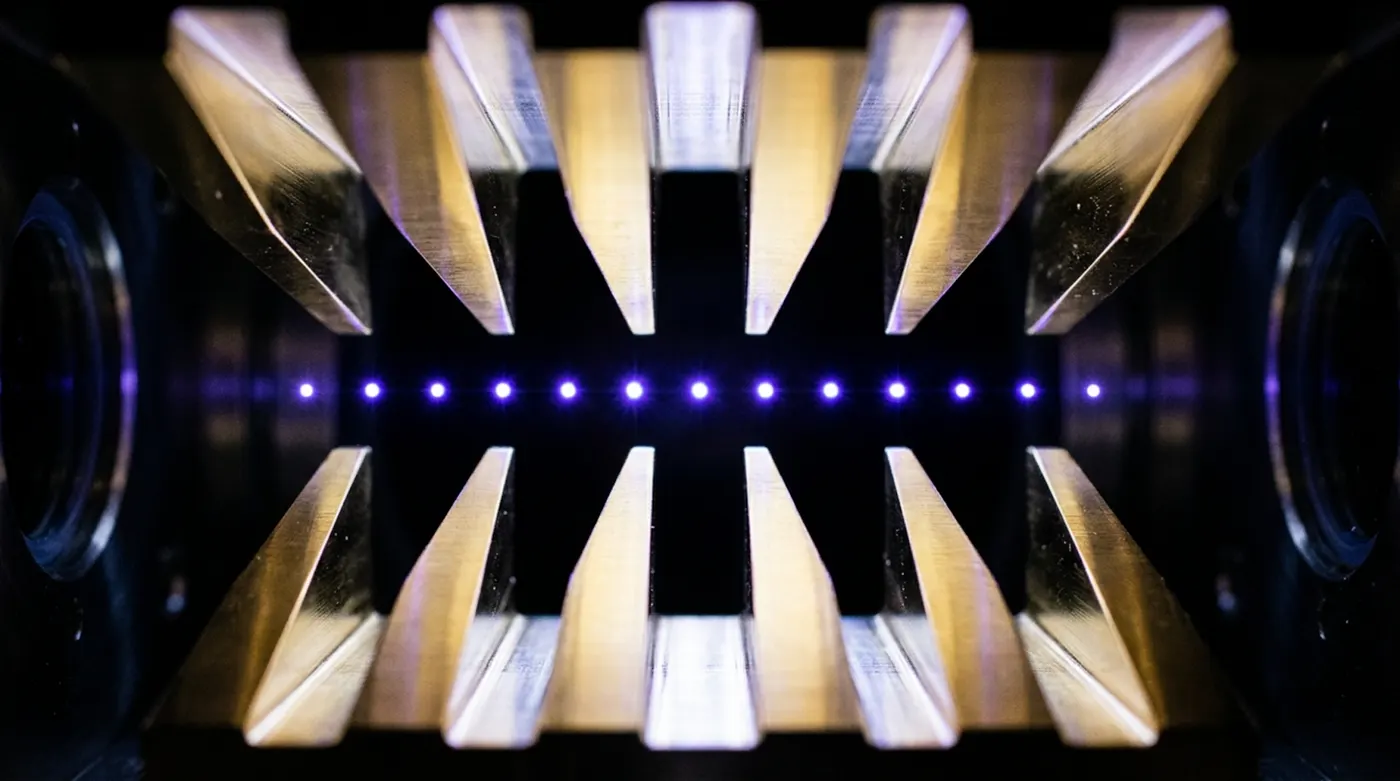
The architecture is explicitly hybrid. Quantinuum’s trapped-ion quantum processors handle the demanding high-dimensional wave propagation subroutines, while classical computing systems manage the surrounding data logic. Neither company claims that a quantum computer can run a full seismic imaging workflow today.
The motivating physics is a genuine structural advantage. The state space of a quantum computer doubles with each added qubit, so where a classical machine may need twice the resources to double seismic image resolution, a quantum computer could in theory achieve the same resolution gain by adding a single qubit. That could compress simulation timelines and reduce the energy cost of imaging. Dr. Rajeeb Hazra, Quantinuum’s President and CEO, said the work “has the potential to be a very important industrial use case for quantum computing.”
These are prospective claims about where the technology could go, not measured results. The public record contains no benchmark figures, fidelity numbers, or speedups from this collaboration.
bp’s Wider Quantum Program
The Quantinuum work is not bp’s first move in quantum computing. In February 2021, bp joined the IBM Quantum Network as an Industry Partner, gaining cloud access to IBM’s quantum systems, including what was then IBM’s largest universal quantum computer available to industry at 65 qubits. At the time, bp pointed to potential applications such as modeling the chemistry and build-up of clay types in hydrocarbon wells, analyzing the fluid dynamics of wind farms, and optimizing autonomous robotic facility inspection. bp framed the membership as supporting the digital transformation behind its net zero ambition.
Why Wave Physics Suits Quantum Computers
Wave propagation problems reduce, after discretization, to very large structured linear algebra. A subsurface model is divided into a grid, the wave equation is discretized over that grid, and the simulation becomes repeated application of large sparse operators. The size of these systems grows rapidly with resolution, which is exactly the regime where quantum encodings are interesting: n qubits can represent a state vector with 2^n entries.
As a simplified illustration of how such a problem can be formulated, here is the standard classical setup of a small 2D discretized operator of the kind that appears in wave and pressure simulations. This is a teaching example, not bp’s or Quantinuum’s code:
import numpy as np
from scipy.sparse import csr_matrix
from scipy.sparse.linalg import spsolve

# Simplified illustration: 4x4 grid, 5-point Laplacian stencil,
# the building block of discretized wave and pressure equations
n = 4
N = n * n
A = np.zeros((N, N))
for i in range(n):
    for j in range(n):
        idx = i * n + j
        A[idx, idx] = 4.0
        if i > 0: A[idx, idx - n] = -1.0
        if i < n - 1: A[idx, idx + n] = -1.0
        if j > 0: A[idx, idx - 1] = -1.0
        if j < n - 1: A[idx, idx + 1] = -1.0

b = np.zeros(N)
b[0], b[N - 1] = 1.0, -1.0  # source and sink terms
x = spsolve(csr_matrix(A), b)

# A quantum computer could encode this 16-dimensional field
# in just 4 qubits; doubling the grid resolution in each
# dimension adds 2 qubits rather than quadrupling the memory.
print(f"Classical solve, field at corners: {x[0]:.4f}, {x[N-1]:.4f}")
The honest caveats apply to any quantum approach in this space. Loading large classical datasets into a quantum state is expensive, reading a full solution back out requires many measurements, and algorithms for linear systems and quantum simulation carry overheads that depend on problem conditioning. These are open research questions, which is why the bp and Quantinuum work targets specific wave propagation subroutines inside a hybrid workflow rather than wholesale replacement of classical solvers.
Where This Stands
The collaboration is research, openly described as such. A feasibility pilot succeeded, the scaled-up phase is just beginning, and no quantum advantage for seismic imaging has been demonstrated. What bp gains now is a rigorous mapping of which parts of its imaging workloads could ever benefit from quantum hardware, and a working relationship with one of the leading trapped-ion hardware companies as that hardware matures.
Learn more: Quantinuum t|ket> Reference | NISQ Era Overview