Role Profile
Quantum Hardware Engineer
Quantum hardware engineers build the machines. They design and fabricate qubits, calibrate processors, operate the cryogenic and microwave systems that keep them coherent, and squeeze fidelity out of physical devices. This role sits at the intersection of experimental physics, electrical engineering, materials science, and cryogenics, and the talent pool is among the scarcest in all of technology.
What the role does day to day
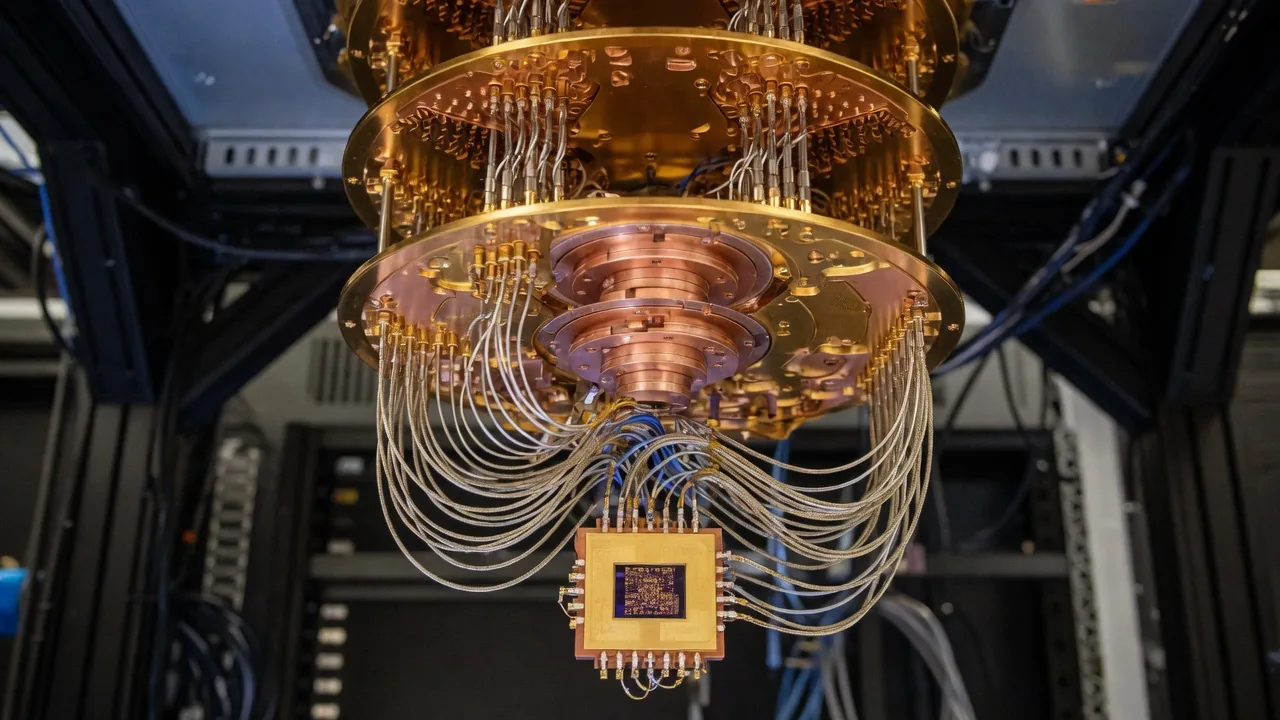
A quantum hardware engineer works in the lab as much as at a desk. A typical day might involve cooling a new chip in a dilution refrigerator, running calibration routines to find each qubit's frequency, then measuring coherence times and gate fidelities to see how the device performs. When something is off, and something is usually off, you debug across the whole stack: is it the qubit, the wiring, the microwave pulses, the readout chain, or stray crosstalk between neighbours? The work is deeply experimental, and progress comes from careful measurement and iteration rather than a single clever insight.
The exact work depends heavily on the qubit modality. Superconducting teams (IBM, Google, Rigetti) live in microwave engineering and cryogenics; trapped-ion teams (IonQ, Quantinuum) work with lasers, vacuum systems, and ion traps; neutral-atom teams (QuEra, Pasqal, Atom Computing) use optical tweezers and Rydberg states; photonic teams (PsiQuantum, Xanadu) build integrated optics. Across all of them, the central engineering challenge is the same: scaling from tens of qubits to thousands while holding error rates low enough for error correction to work.
Core responsibilities
- Design, fabricate, and assemble quantum processors and their supporting hardware: qubits, resonators, control lines, and packaging.
- Calibrate and characterize qubits, measuring coherence times (T1/T2), gate fidelities, readout errors, and crosstalk.
- Build and tune the control stack: microwave pulse sequences, arbitrary waveform generators, lasers, and timing electronics.
- Operate and maintain dilution refrigerators and cryogenic systems that hold processors near absolute zero.
- Run experiments in the lab, debug hardware faults, and iterate on device design with the fabrication team.
- Develop pulse-level control software and feedback loops, and work with the software team on the device gate set and connectivity.
- Improve yield, scalability, and reproducibility as processors grow from tens to thousands of qubits.
Skills and tools
Required skills
- Experimental physics or electrical engineering
- Cryogenics and dilution refrigerators
- Microwave engineering and RF design
- Lab instrumentation (AWGs, oscilloscopes, VNAs)
- Qubit characterization and calibration
- Signal processing and control theory
- Python and lab automation (instrument control)
- Quantum mechanics and qubit physics
Nice to have
Concepts and references to know
Salary by seniority
Often a fresh PhD or a masters with strong lab experience. Hands-on time with cryogenics and RF is the differentiator.
Owns device bring-up and calibration, runs experiments independently, and contributes to design decisions.
Leads processor architecture or a hardware subsystem; an extremely scarce talent pool that commands a premium.
Ranges are estimated US-centric base salaries for 2026 and exclude equity and bonuses. Because experienced quantum hardware engineers are so rare, senior compensation at well-funded startups can exceed these figures. Compensation varies by region: the UK, Germany, the Netherlands, Canada, Japan, and Australia typically pay 55 to 80 percent of US levels. National labs pay somewhat below industry but offer strong benefits and research freedom. See the full salary guide for details.
Demand and outlook
Demand is high and the supply of qualified people is genuinely scarce, because the role requires hands-on experience that takes years to build and is typically gained through a PhD in experimental quantum physics or a closely related engineering program. Every hardware company is racing to scale qubit counts and drive down error rates, and that work is fundamentally hardware engineering. As the field pushes toward fault-tolerant machines, the need for engineers who can scale fabrication, control, and cryogenic infrastructure grows rather than shrinks. Engineers who bridge hardware and software, for example those comfortable with both pulse-level control and circuit-level programming, are especially valuable.
Typical employers
Hardware-focused quantum companies, large technology firms with quantum divisions, semiconductor companies, and national laboratories are the main employers.
- IBM Quantum
- Google Quantum AI
- IonQ
- Quantinuum
- Rigetti
- PsiQuantum
- Atom Computing
- QuEra
- Pasqal
- Alice & Bob
- Oxford Quantum Circuits
- Nord Quantique
- Intel
- Microsoft Quantum
- National labs (Sandia, NIST, Oak Ridge)
Browse current openings on the quantum jobs board, which links directly to company application pages.
Want to be in line for roles like this? Join the talent pool and we will email you when a matching listing is posted.
How to become a quantum hardware engineer
This path runs through physics and engineering rather than pure software. The step-by-step guide covers quantum mechanics, the physical qubit modalities, decoherence and noise, pulse-level control, and error correction, and it is the right starting point.
Step-by-step guide How to Become a Quantum Engineer → A roadmap through qubit physics, control electronics, cryogenics, error correction, and getting hired on the hardware side.Related roles
Ready to start? Follow the quantum engineer guide, or compare it with the research scientist and quantum developer guides.