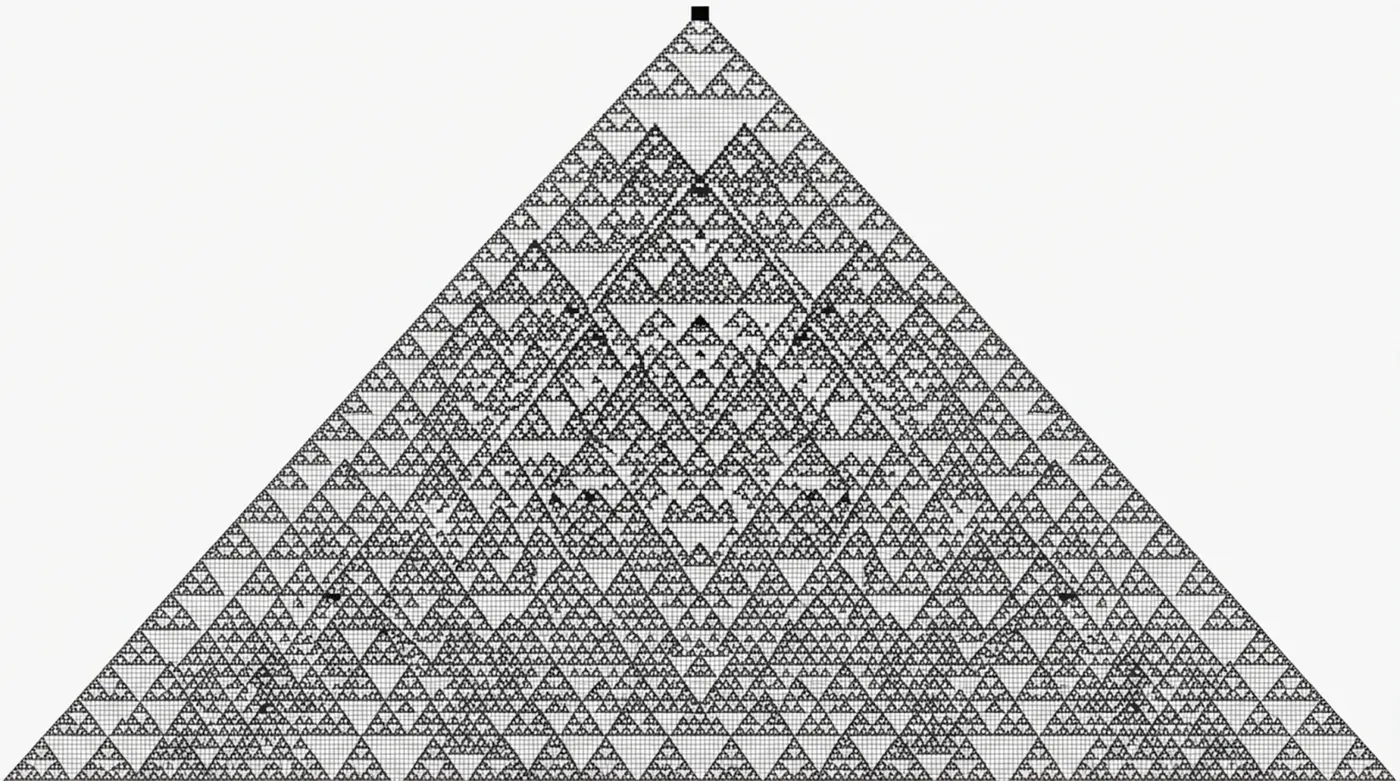
A quantum cellular automaton consists of a lattice of qudits (typically qubits), a local update rule that is a unitary operator acting on a finite neighborhood of each cell, and a requirement that the global evolution across all cells simultaneously be a well-defined unitary on the entire Hilbert space. The locality condition means each qubit’s update depends only on its neighbors within some fixed radius r, analogous to a classical cellular automaton rule. The translation invariance requirement that the same rule applies at every lattice site further constrains the structure and leads to rich algebraic characterizations. QCA were introduced as a discrete-time, spatially homogeneous alternative to the quantum circuit model, well-suited for describing quantum many-body dynamics and quantum field theories on a lattice.
One-dimensional Clifford QCA are the best-understood family. Their update rules are generated by Clifford operations on finite neighborhoods, meaning the evolution maps Pauli operators to Pauli operators and can be tracked efficiently with the stabilizer formalism. The Goldilocks QCA, defined by a particularly symmetric three-site Clifford rule, has been studied extensively because it produces fractal entanglement patterns and serves as a bridge between quantum chaos and classical reversible cellular automata. These examples demonstrate that even simple local rules can generate highly complex global dynamics, including volume-law entanglement growth from product state initial conditions.
The connection to quantum field theory and Feynman’s path integral arises because a QCA on a spacetime lattice defines a discrete approximation to a quantum field theory, with the local unitary rule playing the role of a short-time propagator. Feynman proposed a precursor of this idea when discussing quantum computers as simulators of physics, noting that a quantum system with local interactions could naturally simulate another local quantum system without exponential overhead. QCA formalize this intuition: a QCA whose local rule encodes the plaquette operators of a lattice gauge theory implements a Trotterized simulation of that gauge theory, unifying the QCA perspective with Hamiltonian simulation on quantum hardware.
QCA have become a productive framework for studying topological phases of matter and measurement-based quantum computation. Topological QCA, which cannot be built from finite-depth quantum circuits alone, correspond to nontrivial elements of a classification group that mirrors the K-theory classification of symmetry-protected topological phases. In measurement-based quantum computation, performing adaptive single-qubit measurements on a suitable entangled resource state drives an effective QCA that implements the target circuit, connecting two seemingly different computational models. The study of lattice gauge theory simulation on near-term quantum hardware increasingly draws on QCA design principles to construct efficient, hardware-native time-evolution circuits that preserve gauge invariance at every step.