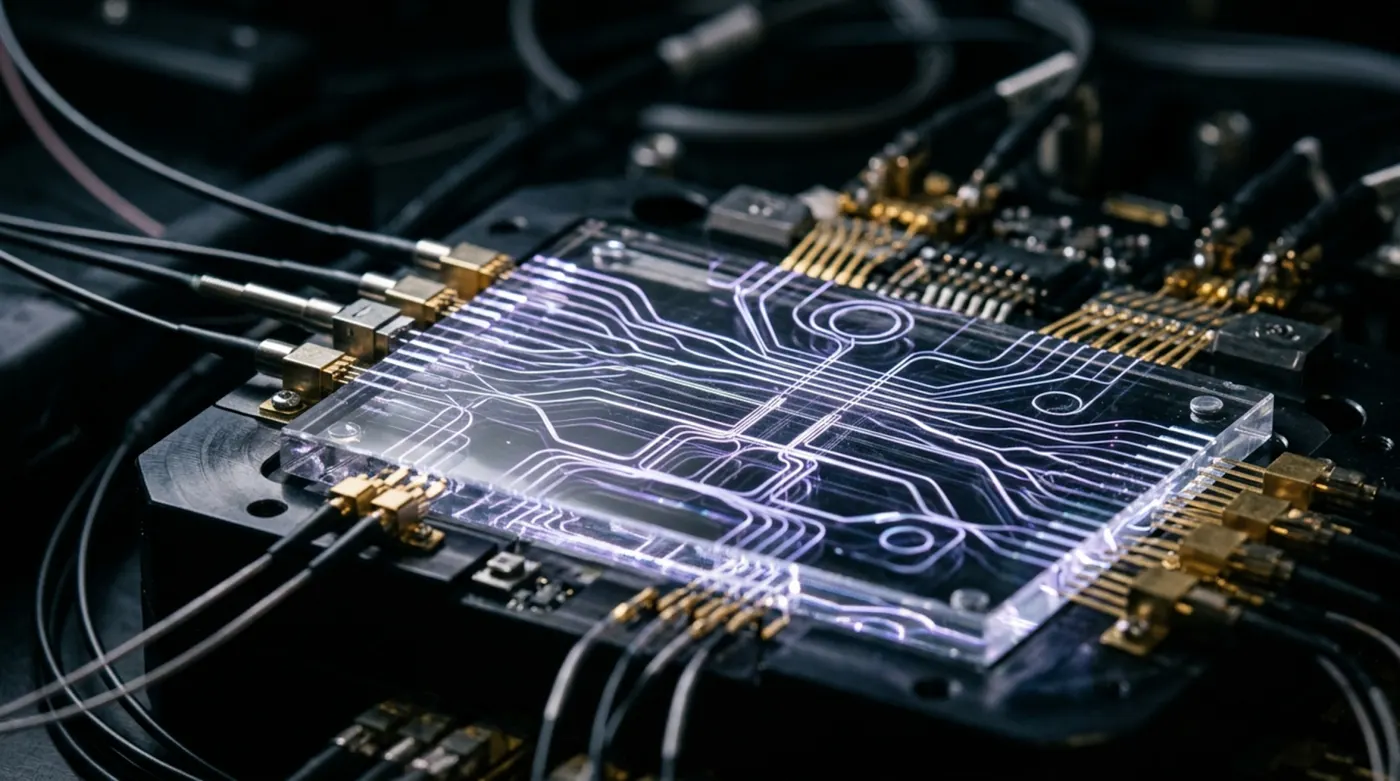
Just as a classical computer bus carries data between processors and memory, a quantum bus carries quantum information between qubits that would otherwise be too far apart to interact directly. The concept is most concrete in circuit quantum electrodynamics (circuit QED), where a superconducting coplanar waveguide resonator couples two or more transmon qubits. Each qubit is capacitively connected to the resonator, and when both qubits are detuned far from the resonator frequency (the dispersive limit) the resonator mediates an effective qubit-qubit interaction without becoming populated. The resonator acts as a shared electromagnetic field mode that shuttles virtual photons between the qubits, enabling entangling gates across a chip without requiring direct physical proximity.
Circuit QED and the Jaynes-Cummings model
The interaction between a single qubit and the resonator is described by the Jaynes-Cummings Hamiltonian: , where is the resonator frequency, is the qubit frequency, is the coupling strength, and / are photon annihilation/creation operators. In the dispersive regime, where the qubit-resonator detuning is large compared to , this Hamiltonian reduces to an effective qubit-qubit coupling of strength for two qubits. The resonator frequency also shifts by depending on the qubit state, which is the basis for qubit readout as well as the bus interaction. Typical coupling strengths range from 50 to 300 MHz for superconducting qubits, giving effective qubit-qubit couplings of a few MHz and two-qubit gate times of tens to hundreds of nanoseconds.
Phonon and photonic buses
Beyond microwave resonators, other physical systems serve as quantum buses. In trapped-ion processors, the shared motional modes of the ion crystal are the bus: when laser pulses are tuned to motional sidebands, they create an effective spin-spin interaction mediated by collective phonons, enabling the Molmer-Sorensen gate between any pair of ions in the chain. The entire ion chain acts as an always-connected bus, giving trapped-ion systems all-to-all connectivity at the cost of slower gates as the chain grows. Photonic quantum buses use optical fiber or free-space optical channels to connect physically separated modules, allowing entanglement distribution between cryostat modules or between different buildings. These photonic links underpin modular quantum computing architectures where individual superconducting or spin-based processors are networked together into a larger logical system.
Connectivity versus crosstalk trade-off
More buses mean more connectivity, but each coupling pathway also introduces a potential crosstalk channel. In superconducting processors, adding resonators to increase qubit-qubit connectivity brings additional ZZ interaction terms that contribute to spectator errors. Tunable coupling circuits address this by switching the effective coupling between a large value (gate active) and near zero (gate idle), but they add fabrication complexity and their own noise sources. Quantum bus design is therefore a central engineering trade-off: architects must balance the computational benefit of higher qubit-qubit connectivity against the error budget cost of residual always-on interactions introduced by each coupling element.