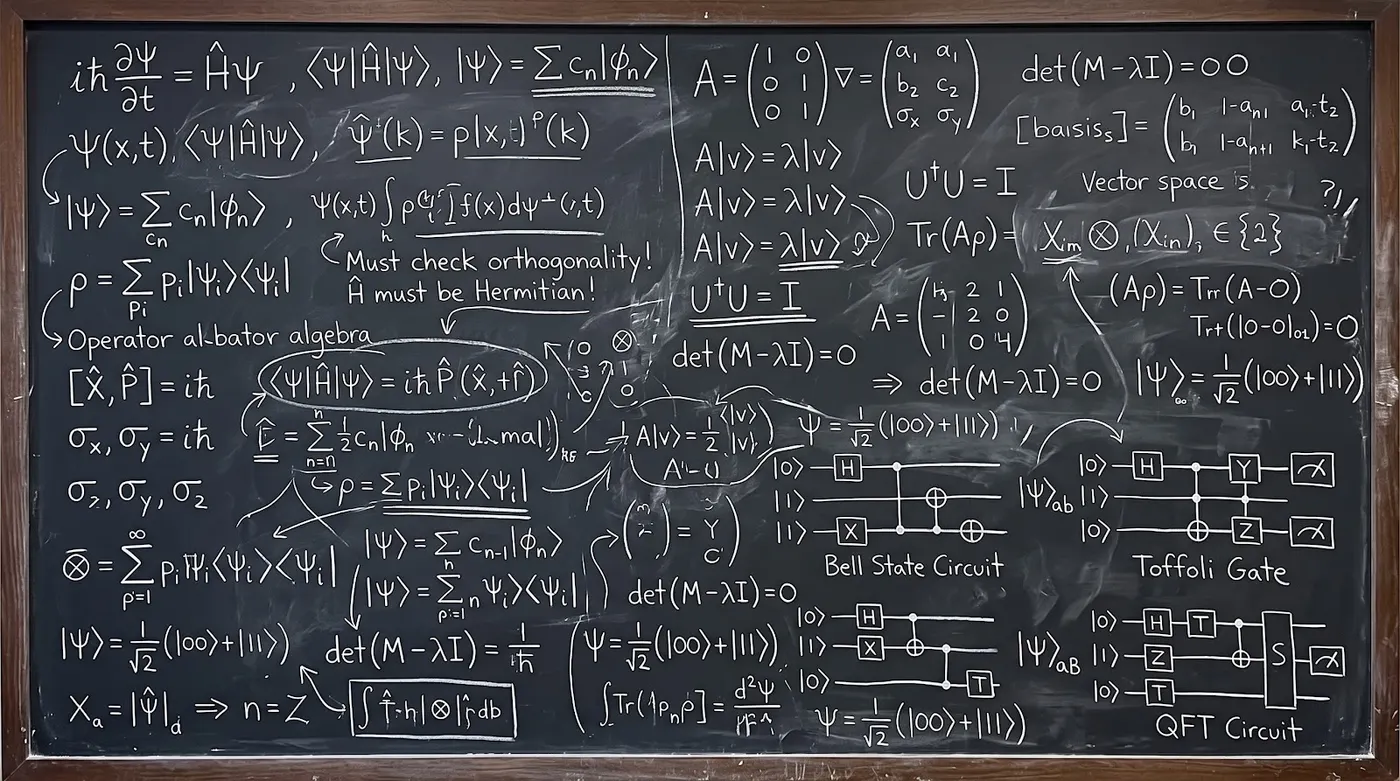
Clifford circuits are quantum circuits built from just three gate types: the Hadamard gate H, the phase gate S, and the CNOT gate. These circuits can create entanglement, produce superpositions, and look genuinely quantum in every operational respect. Yet they can be simulated exactly by a classical computer in time that scales polynomially with the number of qubits. This is the Gottesman-Knill theorem, and it draws a sharp line inside quantum computing: Clifford operations alone are not enough for a quantum speedup. To achieve universal quantum computation, you need at least one non-Clifford gate, most commonly the T gate.
The details
The Clifford group on qubits is the set of all unitary operators that map Pauli operators to Pauli operators under conjugation. More precisely, a unitary is a Clifford operation if for every -qubit Pauli operator :
where is also an -qubit Pauli operator (possibly with a phase). The generators of the -qubit Clifford group are H, S, and CNOT. Some examples of the conjugation action:
Because Clifford gates just permute and multiply Pauli operators, any Clifford circuit on qubits can be tracked as a list of Pauli operators (one per stabiliser generator), each of length . The state at every point is a stabiliser state described by bits rather than complex amplitudes. Updating this description through a Clifford gate takes time per qubit acted on.
The Gottesman-Knill theorem formalises this: any Clifford circuit on qubits with gates can be simulated classically in time. This remains true even with adaptive measurements (measuring qubits and using the results to choose later gates), which is the setting used in measurement-based quantum error correction.
# Stim: a fast classical Clifford circuit simulator
import stim

# Build a 5-qubit GHZ-like Clifford circuit
circuit = stim.Circuit("""
    H 0
    CNOT 0 1
    CNOT 0 2
    CNOT 0 3
    CNOT 0 4
    M 0 1 2 3 4
""")

# Sample 10000 measurement outcomes efficiently (no exponential blowup)
sampler = circuit.compile_sampler()
samples = sampler.sample(shots=10_000)
print(samples[:5])  # each row is one shot; expect 00000 and 11111 only
What Clifford circuits cannot do is provide a quantum computational speedup. They can produce maximally entangled states and implement all quantum error-correcting operations based on stabiliser codes. But the set of states reachable by Clifford circuits from the state (stabiliser states) is a set of measure zero in the full Hilbert space. The vast majority of quantum states, including those needed for Shor’s algorithm or Grover’s algorithm, require non-Clifford operations.
The T gate () is the most common non-Clifford gate added to achieve universality. T gate count is the key cost metric for fault-tolerant algorithms because T gates require expensive magic state distillation to implement fault-tolerantly, while Clifford gates can be applied transversally (directly on logical qubits without distillation) in most stabiliser codes.
The line between simulable and not
The Clifford/non-Clifford boundary is one of the most important conceptual divisions in all of quantum computing. It separates the classically simulable from the potentially hard, the cheap from the expensive on fault-tolerant hardware, and the efficiently error-correctable from the distillation-requiring.
Understanding Clifford circuits explains why stabiliser codes and fault-tolerant quantum computing work the way they do: error correction and detection operations are all Clifford, preserving the stabiliser structure of the code space. It also explains the economic reality of fault-tolerant computation: minimising T gate count in an algorithm is not an aesthetic choice but a direct reduction in hardware cost.
Common misconceptions
Misconception 1: Clifford circuits are trivial or uninteresting. Clifford circuits include all Bell state preparation, quantum teleportation, the encoding and decoding of all stabiliser error-correcting codes, and the entangling operations in superdense coding. They are some of the most practically important circuits in quantum computing, even though they are classically simulable.
Misconception 2: Any circuit with entanglement is hard to simulate classically. Clifford circuits produce highly entangled states (including maximally entangled Bell pairs and GHZ states) that are nonetheless efficiently simulable. Entanglement is necessary but not sufficient for classical intractability. What matters is whether the state is a stabiliser state, not whether it is entangled.
Misconception 3: Adding a single T gate to a Clifford circuit always makes it hard to simulate. One T gate does not immediately make a circuit exponentially hard. Classical simulation methods like the stabiliser rank formalism can handle circuits with small numbers of T gates efficiently, at cost roughly exponential in the T count. Simulation becomes genuinely hard only when the T count is large. This is why T count is a meaningful resource metric rather than a binary threshold.