The short version
- What it is
- A state vector in a two-dimensional complex vector space, written α|0⟩ + β|1⟩.
- The constraint
- |α|² + |β|² = 1. Those two numbers are the probabilities of measuring 0 or 1.
- On measurement
- The superposition is destroyed and you get one classical bit, not the amplitudes.
- Built from
- Superconducting circuits, trapped ions, photons, or neutral atoms.
- Judged on
- T1, T2, gate fidelity, and connectivity.
01 The classical bit vs the qubit
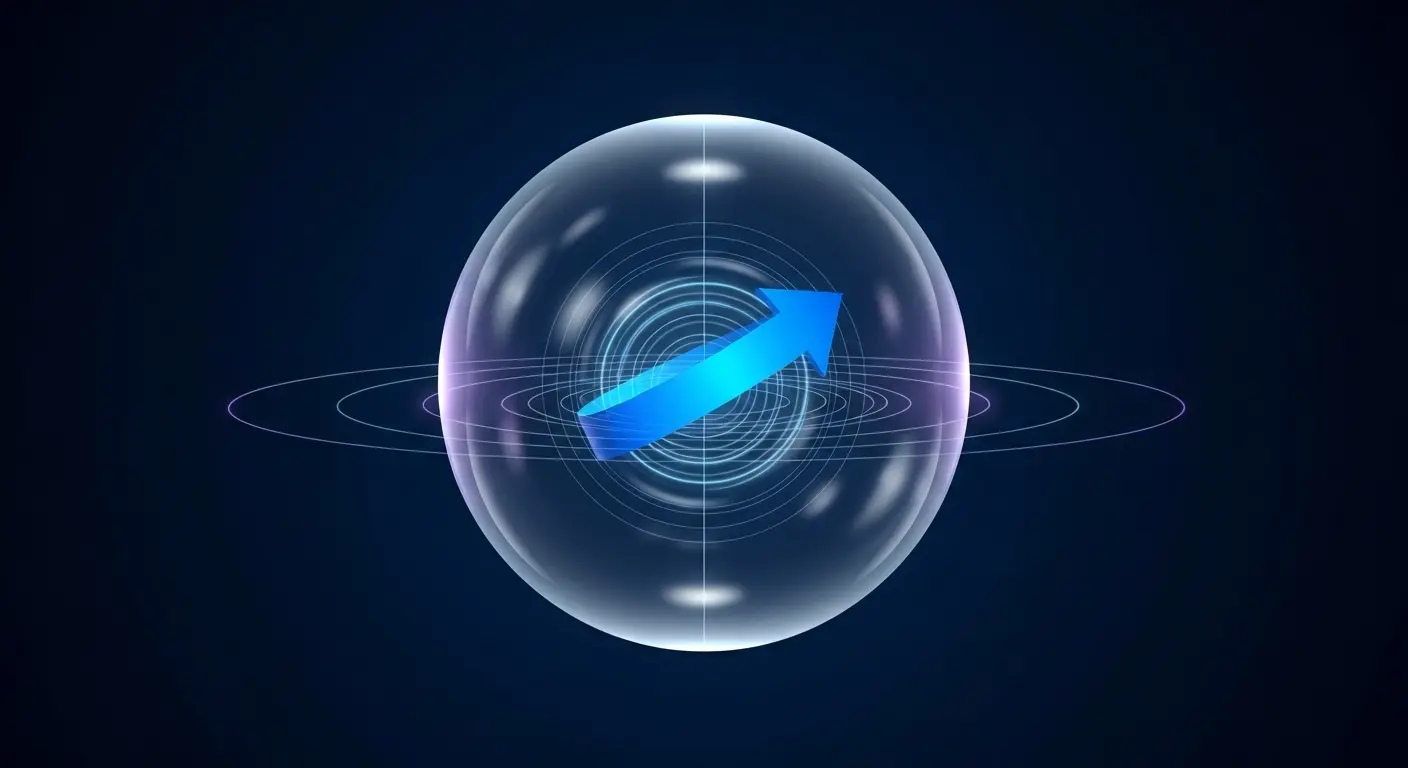
A classical bit is always in one of two states: 0 or 1. A qubit is described by a state vector in a two-dimensional complex vector space. Written in Dirac notation, the general state of a qubit is:
|ψ⟩ = α|0⟩ + β|1⟩ Here α and β are complex numbers (amplitudes) satisfying |α|² + |β|² = 1. The values |α|² and |β|² give the probabilities of measuring 0 or 1 respectively.
This is not the same as saying the qubit is "both 0 and 1 at the same time."
Superposition means the qubit genuinely has no definite value before measurement - it is in a quantum state that is neither 0 nor 1, but a combination that collapses to a specific outcome only when observed. The act of measurement itself forces the qubit into a definite state, and the superposition is destroyed.
This is why you cannot simply read out the amplitudes α and β directly. Each measurement gives only one bit of classical information: 0 or 1. Extracting useful information from quantum states requires careful circuit design and often many repeated measurements.
02 Physical implementations of qubits
A qubit is an abstract mathematical object. To build one in hardware, engineers need a two-level quantum system whose states can be prepared, manipulated with gates, and measured with high reliability. Several physical approaches are in active use today.
IBM, Google, Rigetti
Superconducting qubits
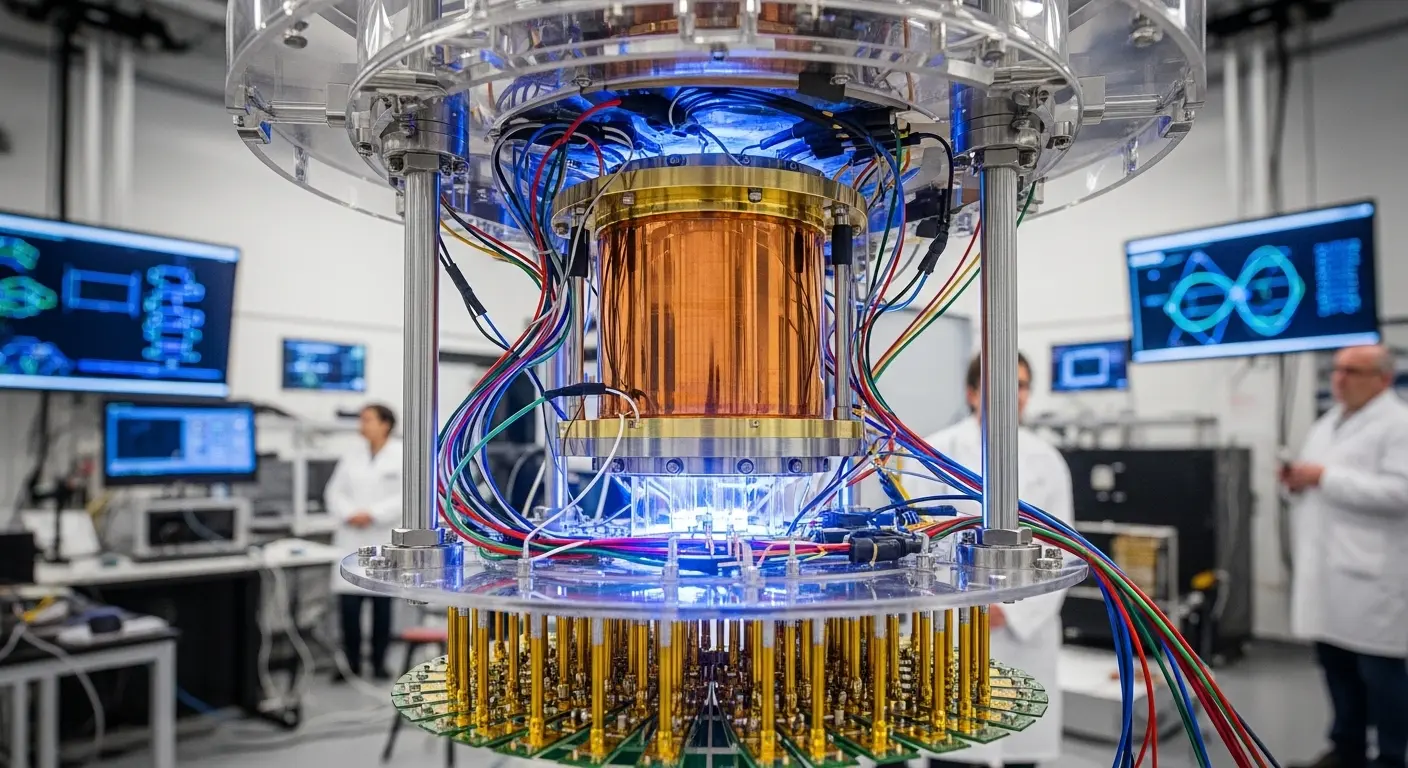
Superconducting qubits use tiny circuits of superconducting material cooled to temperatures near absolute zero (around 15 millikelvin). A non-linear inductor called a Josephson junction creates an anharmonic energy level structure, making it possible to isolate the lowest two energy levels as |0⟩ and |1⟩. Gate operations are applied with microwave pulses. They are fast (gate times in nanoseconds) and manufactured with semiconductor fabrication tools, but require extreme cooling and are sensitive to noise from their environment.
IonQ, Quantinuum
Trapped-ion qubits
Individual ions are trapped using electromagnetic fields and laser-cooled to near rest. The internal electronic energy levels of the ion serve as |0⟩ and |1⟩. Gate operations use laser pulses or microwave radiation. Trapped-ion qubits have some of the highest gate fidelities and longest coherence times of any platform, and any two qubits in the trap can interact directly. The main challenges are gate speed (microseconds rather than nanoseconds) and scaling to large numbers of ions in a single trap.
PsiQuantum, Xanadu
Photonic qubits
Photonic qubits encode quantum information in properties of single photons such as polarization or path. They can be transmitted over optical fiber and do not require cryogenic cooling, making them attractive for quantum networking and room-temperature operation. The fundamental challenge is that photons do not interact naturally with each other, making two-qubit gates difficult. Measurement-based approaches and specialized nonlinear elements are used to work around this limitation.
QuEra, Pasqual, Atom Computing
Neutral-atom qubits
Individual neutral atoms are held in place by tightly focused laser beams called optical tweezers. Qubit states are encoded in the hyperfine levels of the atom's ground state. Two-qubit gates exploit Rydberg interactions - when one atom is excited to a high-energy Rydberg state, it blockades neighboring atoms from being excited simultaneously, providing a controlled interaction. Neutral atoms offer long coherence times, reconfigurable connectivity, and the ability to arrange large 2D arrays of qubits.
03 Qubit properties that matter
When evaluating a quantum processor or comparing hardware platforms, four properties of qubits matter most in practice.
T1
Energy relaxation time
T1 measures how long a qubit initialized in the excited state |1⟩ takes to spontaneously decay back to |0⟩. This sets a hard upper limit on how long any computation can run. A T1 of 100 microseconds means you have roughly 100 microseconds of useful operation before the qubit has a significant chance of spontaneously flipping. Modern superconducting qubits typically achieve T1 values between 100 and 500 microseconds; trapped ions can reach seconds.
T2
Dephasing time
T2 measures how long a qubit maintains phase coherence in a superposition state. Dephasing is a subtler form of error than energy relaxation: the qubit's amplitude does not change, but the relative phase between |0⟩ and |1⟩ drifts randomly due to environmental noise. T2 is always less than or equal to 2*T1. For most algorithms, T2 is the more constraining timescale because many operations depend on phase relationships between qubits.
Accuracy
Gate fidelity
Gate fidelity is the probability that a gate operation produces the exact state it was intended to produce, averaged over all possible input states. A two-qubit gate fidelity of 99.5% sounds good, but compounding 100 such gates gives an overall success probability below 60%. High-fidelity gates are essential for running circuits with many operations, and they are harder to achieve for two-qubit gates than single-qubit gates. State-of-the-art systems reach 99.9% or above for single-qubit gates and 99-99.5% for two-qubit gates.
Layout
Connectivity and topology
Not every qubit can interact directly with every other qubit on most hardware. Superconducting processors typically connect each qubit to 2-5 neighbors in a fixed graph; trapped-ion systems offer all-to-all connectivity within the trap. When an algorithm requires a two-qubit gate between non-adjacent qubits, the compiler must insert SWAP gates to route the interaction through intermediate qubits. Extra SWAP gates add circuit depth, increase error, and consume coherence time, so hardware topology directly affects which algorithms run efficiently on a given machine.
04 Courses covering qubits and quantum fundamentals
Courses that teach qubit theory, quantum information, and the mathematical foundations of quantum computing.
-
Brilliant
Quantum Mechanics with Sabine
Brilliant / Sabine Hossenfelder
Brilliant's interactive quantum mechanics course presented with physicist Sabine Hossenfelder. Explains the machinery of quantum mechanics and its counterintuitive implications through hands-on simulations, using them to discover and reason about quantum states.
-
QUANTUM INFORMATION
Quantum Computation (Caltech PHYS 219)
Prof. John Preskill, Caltech
Prof. John Preskill's legendary Caltech quantum computation lecture notes. The most comprehensive freely available resource on quantum computing and quantum information.
-
QUBITS
Quantum Computing (University of Cambridge)
Dr Steven Herbert, University of Cambridge
University of Cambridge's undergraduate Quantum Computing course, with lecture notes publicly available, covering qubits, superposition, entanglement, core quantum algorithms, and quantum cryptography. Accessible at no cost.
-
edX
CertificateQuantum 101: Quantum Computing & Quantum Internet
Delft University of Technology (QuTech)
Begin your quantum journey with this professional certificate from Delft University of Technology. Covers qubits, quantum hardware, algorithms, error correction, and the quantum internet.
-
Brilliant
Quantum Computing (Interactive)
Brilliant's interactive quantum computing course, learn by doing with hands-on puzzles and visualisations. Subscription-based, covered by Brilliant's free trial.
-
edX
The Hardware of a Quantum Computer
Lieven Vandersypen and QuTech researchers (TU Delft)
Learn how a quantum computer could be physically built and controlled, covering superconducting qubits, trapped ions, and other hardware platforms from Delft University of Technology.
-
Google
Hands-On Quantum Error Correction with Google Quantum AI
Austin Fowler
Google Quantum AI's free-to-audit Coursera course on quantum error correction. Covers the surface code, stabilizer formalism, and the Stim and Crumble software tools used by Google researchers, with hands-on coding labs.
-
Coursera
SpecialisationThe Complete Quantum Computing Course for Beginners
Packt
A complete beginner's specialization covering quantum fundamentals, Qiskit programming, and real quantum algorithms, from high-school maths to running code on real quantum hardware.
05 Questions people ask
- What is a qubit in simple terms?
- A qubit is the fundamental unit of quantum information, analogous to the classical bit. Unlike a classical bit that is always either 0 or 1, a qubit can exist in a superposition of both states simultaneously until it is measured. At the moment of measurement the superposition collapses and the qubit returns a definite 0 or 1. The probabilities of each outcome are determined by the qubit's state vector. This ability to encode and process information in superposition is the source of quantum computing's potential advantage over classical machines.
- How many qubits do you need to do useful quantum computing?
- The honest answer is: many more than current hardware provides, once you account for error correction. Today's best systems have hundreds to thousands of physical qubits, but a fault-tolerant logical qubit requires roughly 1,000 or more physical qubits to protect against noise. Estimates for running Shor's algorithm against RSA-2048 at scale suggest millions of physical qubits. For near-term noisy devices (NISQ era), useful quantum advantage in narrow domains may be achievable with hundreds to a few thousand high-quality qubits, but this remains an active research question.
- What is qubit coherence?
- Coherence refers to the property that allows a qubit to remain in a quantum superposition without being disturbed by its environment. A qubit loses coherence through a process called decoherence, in which interactions with the surrounding environment cause the quantum information to leak away. Two key timescales characterize coherence: T1 (energy relaxation time) measures how long a qubit stays in its excited state before decaying to the ground state, and T2 (dephasing time) measures how long a qubit maintains phase information in a superposition. Longer T1 and T2 times mean more gate operations can be performed before errors accumulate.
- How is a qubit different from a classical bit?
- A classical bit is always in one of two definite states: 0 or 1. A qubit is described by a state vector with two complex amplitudes, allowing it to be in a continuous superposition of |0> and |1> until measured. Additionally, multiple qubits can be entangled, meaning the state of one is correlated with the state of another in ways that have no classical analog. This combination of superposition and entanglement gives quantum computers their distinctive computational character, though it also means quantum information cannot be copied (the no-cloning theorem) and is fragile against environmental noise.
- What are the most common physical qubit types?
- The leading physical implementations are superconducting qubits (used by IBM and Google), trapped-ion qubits (used by IonQ and Quantinuum), photonic qubits (used by PsiQuantum and Xanadu), and neutral-atom qubits (used by QuEra and Pasqal). Superconducting qubits are fast and compatible with semiconductor fabrication but require operation near absolute zero. Trapped ions offer very high gate fidelity and long coherence times but are slower and harder to scale. Photonic qubits operate at room temperature and travel at light speed but are difficult to make interact. Neutral atoms combine scalability with high fidelity through optical tweezer arrays.