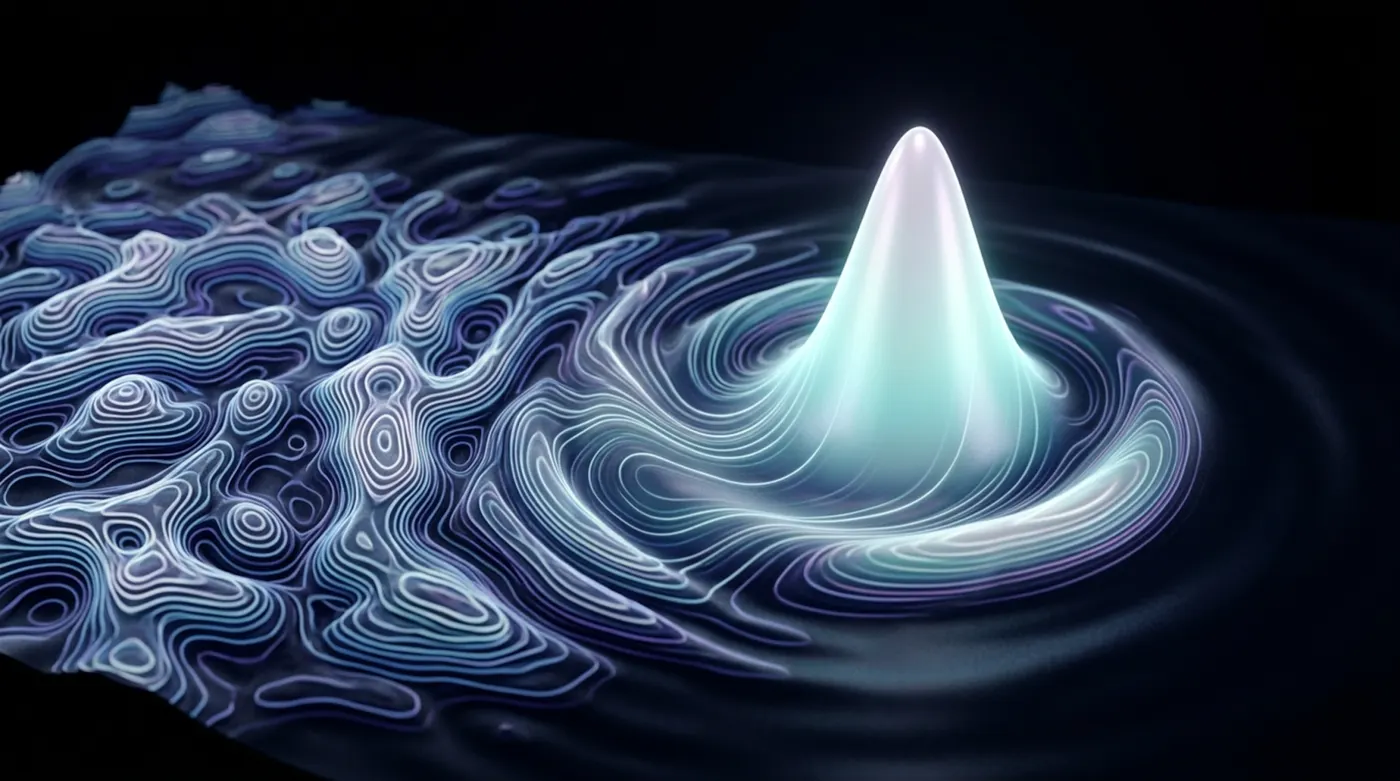
A quantum phase transition (QPT) is a phase transition that occurs at absolute zero temperature and is driven not by thermal fluctuations (which vanish at ) but by quantum fluctuations arising from Heisenberg’s uncertainty principle. As a non-thermal control parameter (such as pressure, magnetic field strength, or chemical composition) is varied past a critical value, the ground state of the system changes qualitatively and discontinuously.
Classical vs. Quantum Phase Transitions
Classical phase transitions (like water boiling or a magnet losing its magnetism at the Curie temperature) are driven by thermal fluctuations and occur at nonzero temperature. Quantum phase transitions occur at and are driven by quantum fluctuations that persist even when all thermal motion ceases.
The distinction is conceptually important: at a quantum critical point, the system’s ground state itself is singular, meaning no local perturbation theory can describe the crossover between phases. The quantum critical point can have observable effects at finite temperature through a “quantum critical fan”, a regime above the critical point where quantum fluctuations dominate the thermodynamics over a wide temperature range.
The Transverse Field Ising Model
The textbook example is the one-dimensional transverse field Ising model:
Here is the ferromagnetic coupling between neighboring spins and is the transverse magnetic field strength. At , the ground state is ferromagnetically ordered (all spins aligned). At large , quantum fluctuations induced by the transverse field destroy the ordering, and the ground state becomes paramagnetic. At the critical point , the system undergoes a quantum phase transition with diverging correlation length and specific scaling properties characteristic of the 2D classical Ising universality class.
Relevance to Quantum Computing
Quantum phase transitions are directly relevant to quantum computing in several ways.
Adiabatic quantum computing (and quantum annealing) relies on the adiabatic theorem: a system that starts in the ground state of an initial Hamiltonian and evolves slowly enough will end in the ground state of the final Hamiltonian. The critical difficulty arises at quantum phase transitions, where the energy gap between the ground state and the first excited state closes (or nearly closes). The adiabatic theorem requires the evolution to be slow compared to the inverse gap, so a closing gap demands exponentially slow evolution and destroys the speedup.
Quantum simulators (quantum devices programmed to emulate other quantum systems) are one of the most near-term promising applications of quantum hardware. Simulating quantum phase transitions in materials (exotic superconductors, topological insulators, frustrated magnets) requires exactly the kind of computation that is exponentially hard classically and polynomially feasible on a quantum device.
Barren plateaus in variational quantum algorithms have been linked to phase transition-like phenomena in the optimization landscape, where gradients vanish exponentially at a phase boundary in the parameter space.
Topological Quantum Phase Transitions
A subclass of QPTs involves changes in topological order rather than conventional symmetry breaking. The Kitaev chain model hosts a topological QPT between a trivial phase and a topological superconductor phase that supports Majorana zero modes at its endpoints. These Majorana modes are the proposed basis for topological qubits, which would be inherently protected from local noise by the gap of the topological phase.