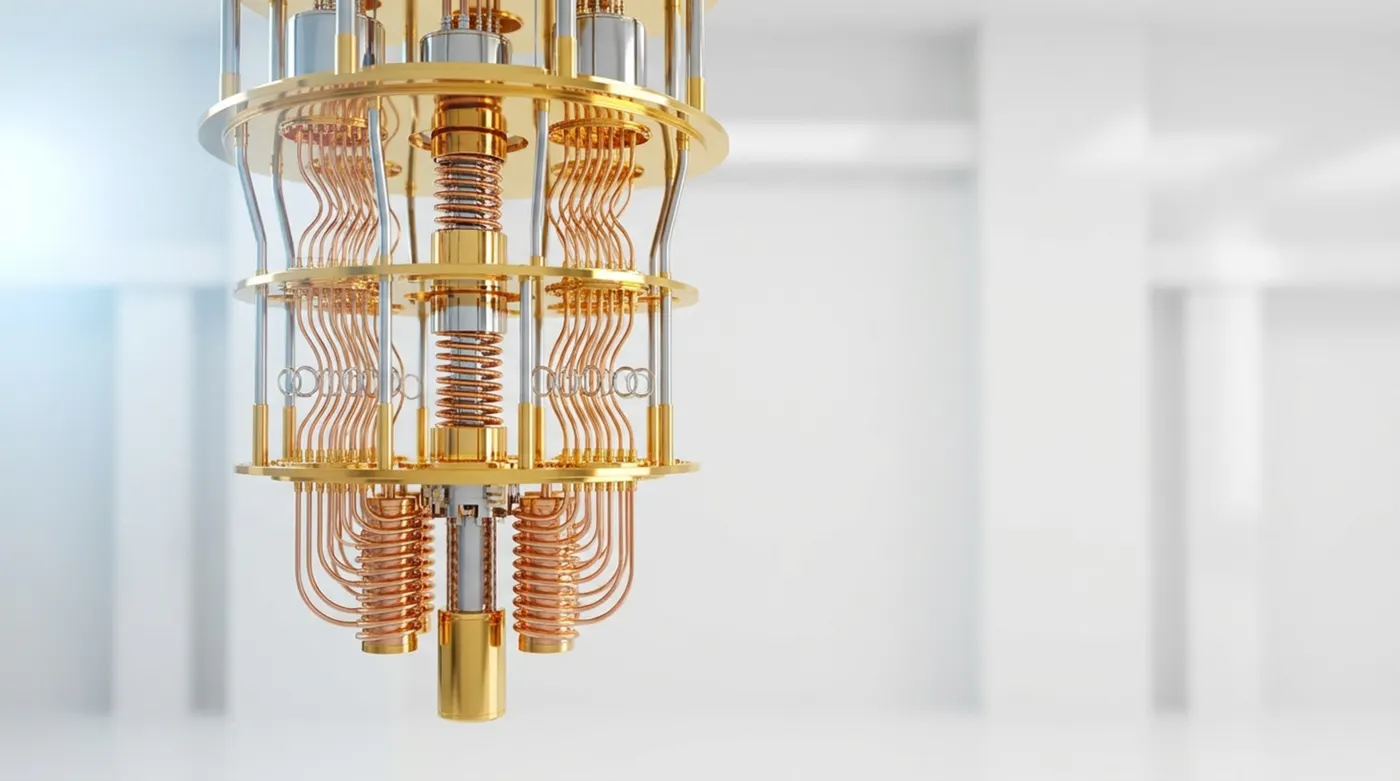
Adiabatic quantum computing treats computation as a physical process rather than a sequence of gate operations. You start by preparing a quantum system in the ground state of a simple Hamiltonian you can easily build, then slowly dial up a second Hamiltonian whose ground state encodes the answer to your problem. If the evolution is slow enough, the quantum adiabatic theorem guarantees the system never leaves its ground state, so at the end of the evolution you measure the solution. The slowness requirement is the central challenge: some problems demand exponentially slow evolution, erasing any quantum advantage.
The details
The adiabatic theorem states that a quantum system governed by a time-dependent Hamiltonian remains in its instantaneous ground state provided the evolution is slow compared to the inverse square of the spectral gap. Formally, if the Hamiltonian interpolates as:
then for the system to stay in the ground state throughout, the total evolution time must satisfy:
where is the minimum spectral gap (the smallest energy difference between the ground state and first excited state along the entire evolution path). When is small, the required time grows as , and for hard problem instances the gap can be exponentially small, requiring exponentially long evolution.
Adiabatic quantum computing is computationally universal. In 2004 Aharonov et al. proved that AQC is polynomially equivalent to gate-based quantum computing: any circuit-model computation can be encoded as an adiabatic evolution with at most polynomial overhead, and vice versa. This means AQC is not a fundamentally different computational model; it is a different physical implementation of the same computational power.
D-Wave Systems produces hardware inspired by adiabatic quantum computing, but their devices implement quantum annealing rather than ideal AQC. Quantum annealing uses a transverse-field Ising Hamiltonian, runs at finite temperature (rather than staying in the ground state), evolves faster than the adiabatic condition requires, and uses a fixed hardware graph rather than a programmable Hamiltonian. Whether D-Wave devices provide any quantum advantage over classical optimisers remains a genuinely open question after two decades of research.
QAOA can be understood as a discretised, finite-depth approximation to adiabatic evolution. With layers, QAOA samples a particular path through Hilbert space; as with appropriate angles it converges to the adiabatic limit.
The ideal AQC model has a natural advantage for certain problems: because the computation is continuous and analog, it is less sensitive to individual gate errors than circuit-based models. However, this does not make it fault-tolerant in the standard sense, and decoherence still disrupts real adiabatic hardware.
A simple illustration of the linear schedule:
H(s) at s=0: H_0 = -sum_i X_i   (easy ground state: all |+>)
H(s) at s=1: H_P = problem Ising Hamiltonian
Evolution: slowly ramp s from 0 to 1 over time T >> 1/Δ_min²
Measure: computational basis readout encodes the solution
Finding a good initial Hamiltonian whose ground state is easy to prepare and which connects well to via the interpolation path is itself a non-trivial design problem.
A different picture of speedup
Adiabatic quantum computing provides an alternative conceptual lens for understanding quantum speedup. Instead of thinking about quantum circuits and superposition, you think about energy landscapes and quantum tunnelling. The system can tunnel through classical energy barriers rather than climbing over them, which is the intuitive explanation for why it might outperform classical optimisation in some settings.
Understanding AQC also clarifies what D-Wave machines actually do, which is frequently misrepresented in press coverage. Knowing the gap between ideal AQC and real quantum annealing hardware is essential for critically evaluating claims of quantum advantage. The connection to VQE and QAOA shows how near-term variational algorithms inherit ideas from the adiabatic model.
Common misconceptions
Misconception 1: Adiabatic quantum computing is more powerful than gate-based quantum computing. AQC and gate-based quantum computing are polynomially equivalent models. Neither can solve problems the other cannot (assuming polynomial overhead is acceptable). AQC is a different physical approach, not a more powerful one.
Misconception 2: D-Wave computers are adiabatic quantum computers. D-Wave devices implement quantum annealing, which relaxes the strict adiabatic condition. They evolve too fast to guarantee staying in the ground state, operate at finite temperature, and use a fixed Ising hardware graph. They are inspired by adiabatic ideas but do not implement ideal AQC.
Misconception 3: A small spectral gap always means the algorithm fails. A small gap means the adiabatic algorithm requires long evolution time, but the system still finds the correct answer if given enough time. The practical problem is that real hardware has a finite coherence time, so exponentially long evolution cannot be realised. Classical algorithms face no such constraint, which is why a small gap erases the quantum advantage rather than simply making the algorithm slower.