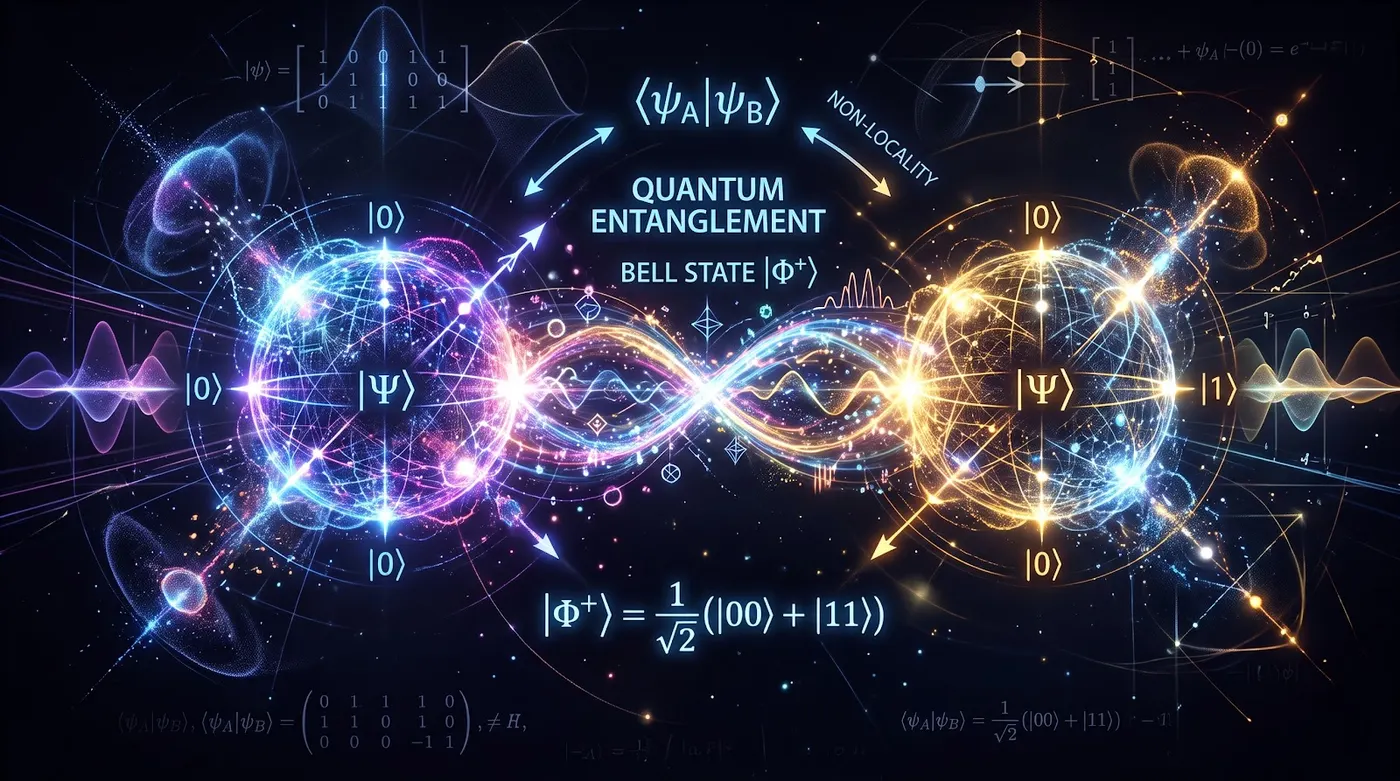
Transmitting entanglement over long distances is lossy. Optical fiber and free-space links introduce photon loss and depolarizing noise, so the Bell pairs that arrive after a long transmission are mixed states rather than pure, maximally entangled pairs. Entanglement distillation solves this by combining many low-fidelity pairs into fewer high-fidelity ones using only local quantum operations and classical communication (LOCC). The result is a smaller number of pairs that are much closer to the ideal Bell state.
The details
The simplest distillation protocol (the Bennett-Brassard-Popescu-Schumacher-Smolin-Wootters, or BBPSSW, scheme) works on pairs of noisy Bell pairs held between two parties, Alice and Bob. Each party applies a CNOT gate between their two qubits (one from each pair), using one pair as a control and the other as a target. Both parties then measure the target pair in the Z basis and communicate their outcomes classically. If the outcomes agree, the control pair is retained and its fidelity has increased; if they disagree, both pairs are discarded.
Iterating this procedure drives the fidelity toward 1, at the cost of consuming many initial pairs. Starting from noisy pairs with fidelity with respect to a Bell state, distillation can in principle produce arbitrarily high-fidelity pairs given enough raw input pairs and rounds.
The yield of a distillation protocol is bounded by the entanglement of formation of the initial state: you cannot extract more than ebits per input pair. For two-qubit Werner states with fidelity , distillation is possible if and only if .
In quantum networks, entanglement distillation is essential at every repeater node. A quantum repeater generates short-range entanglement across adjacent segments, then uses distillation to raise the fidelity of each segment’s pairs before performing entanglement swapping to extend the range. Without distillation, accumulated noise would render the end-to-end entanglement useless before it could span intercontinental distances.
Making a better pair out of several worse ones
Entanglement distillation is not just a theoretical tool. It is the central subroutine of the quantum repeater architecture that will eventually underpin global quantum internet infrastructure. The physical resource cost of distillation (how many noisy pairs are consumed per high-fidelity pair) directly determines how long a quantum repeater chain can be and how fast it can distribute entanglement.
Distillation also illuminates a fundamental asymmetry in quantum information: it is easy to degrade entanglement (just interact a qubit with its environment) but hard and resource-intensive to restore it. This asymmetry is precisely why quantum error correction and distillation protocols require substantial overhead.
Common misconceptions
Misconception 1: Entanglement distillation violates the no-cloning theorem. Distillation does not copy entanglement; it concentrates it. You start with many low-fidelity pairs and end with fewer high-fidelity pairs. The total entanglement never increases beyond what the input pairs contained.
Misconception 2: Classical communication is unnecessary for distillation. The classical comparison of measurement outcomes is essential. Without it, Alice and Bob cannot know which pairs to keep. The protocol uses LOCC (local operations and classical communication), not local operations alone.