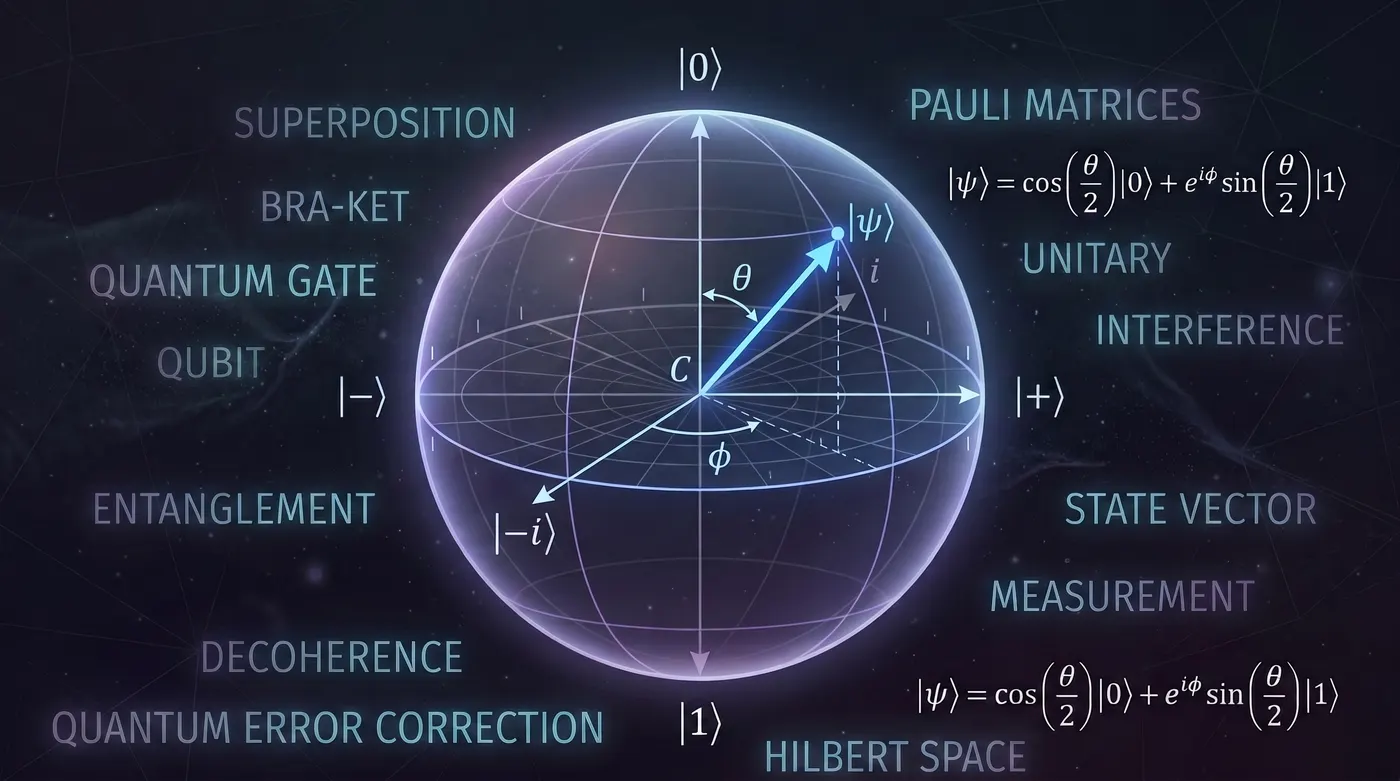
Building directly on Quantum 101, this programme consists of two advanced courses providing deeper mathematical and conceptual understanding of quantum computing and quantum communication. Where Quantum 101 builds foundations, Quantum 201 develops professional-level depth - the kind needed to work with real quantum algorithms and the error correction that makes fault-tolerant quantum computing possible.
Authored by researchers from the QuTech research centre at Delft University of Technology, where scientists and engineers drive quantum technology research.
What you’ll learn
- How to represent and manipulate single-qubit states, the elementary building blocks of quantum information, on the Bloch sphere
- Dirac notation, quantum circuit notation, and the standard single- and two-qubit gates
- How to create and quantify entanglement between multiple qubits
- Quantum information protocols built on entanglement, including quantum teleportation and superdense coding
- How to compile an algorithm on a real quantum computer based on electron spins, and determine and improve its coherence time
- Shor’s factoring algorithm: using quantum phase estimation and period finding to decompose integers into prime numbers
- Grover’s search and amplitude amplification as reusable algorithm techniques
- Why noise makes quantum error correction necessary, and how stabiliser codes and the surface code enable fault-tolerant quantum computing
- Recent breakthroughs in the quantum community and the most promising technologies for scalable quantum devices and the quantum internet
Course structure
Quantum 201 consists of two self-paced courses.
Course 1 - Fundamentals of Quantum Information Revisits qubits and quantum operations at a significantly higher mathematical level than Quantum 101. Dirac notation, state vectors, and tensor products become the primary tools. Single- and two-qubit gates are treated geometrically and algebraically, entanglement is characterised mathematically, and the course closes with quantum information protocols such as teleportation and superdense coding. Runs four weeks at six to eight hours per week.
Course 2 - Quantum Error Correction and Algorithms Covers quantum algorithms and the principles of quantum error correction for fault-tolerant quantum computing through a full-stack overview spanning hardware and software. Quantum phase estimation, Shor’s algorithm, and Grover’s search are worked through in detail, followed by stabiliser codes and the surface code. Runs four weeks at six to eight hours per week.
Both courses assume Quantum 101 content and linear algebra as prerequisites.
Who is this for?
- Quantum 101 graduates ready to develop depth in quantum information and algorithms
- Graduate students and researchers wanting formal treatment of advanced quantum topics
- Quantum software engineers who want to understand the mathematical foundations of the algorithms they implement
- Engineers who want to understand what fault-tolerant quantum computing demands in practice
- Anyone who wants to be able to read quantum information research papers with genuine comprehension
Prerequisites
Completion of Quantum 101 (or equivalent) is required. You must be comfortable with quantum circuits, Dirac notation, and entanglement at Quantum 101 level. Linear algebra at the level of eigenvalue decompositions and complex vector spaces is essential. Some familiarity with probability theory and modular arithmetic helps for the algorithms material.
Hands-on practice
Problem sets at Quantum 201 level require genuine mathematical work:
- Calculating quantum states after gate sequences by hand and verifying circuit equivalences algebraically
- Constructing circuits that prepare specific entangled states
- Verifying the quantum teleportation protocol step by step
- Working through Shor’s algorithm for small factoring examples
- Simulating error correction rounds and estimating logical error rates for stabiliser codes
The mathematical demands are comparable to a graduate quantum information science course - this is not a passive learning experience.
Why take this course?
Quantum 201 bridges the gap between accessible introductions and research-level material.
After completing it, you will be able to read quantum algorithm research papers and follow the mathematical arguments. You will understand why quantum error correction is essential and what it costs, with the precision needed to evaluate hardware claims critically. You will be equipped to contribute meaningfully to quantum software development at the algorithm layer.
QuTech’s researchers bring both mathematical rigor and practical clarity - a combination that is harder to find than it sounds in quantum computing education. This programme is the natural next step after Quantum 101 for anyone serious about the field.
Related tutorials
Practise the concepts from this course with these hands-on tutorials:
- Qiskit Hello World - Your first quantum circuit in Qiskit: Bell state, measurement, and histogram output
- Grover’s Algorithm Explained - Step-by-step implementation of Grover’s search algorithm in Qiskit
- Shor’s Algorithm Explained - How Shor’s factoring algorithm works and why it threatens current encryption
Topics covered
Enrol in this course
Quantum 201: Quantum Computing & Quantum Internet is $333 on edX, at advanced level, and runs 2 courses of 4 weeks, 6-8 hours per week. A certificate is included.
Affiliate link. We may earn a commission at no extra cost to you.