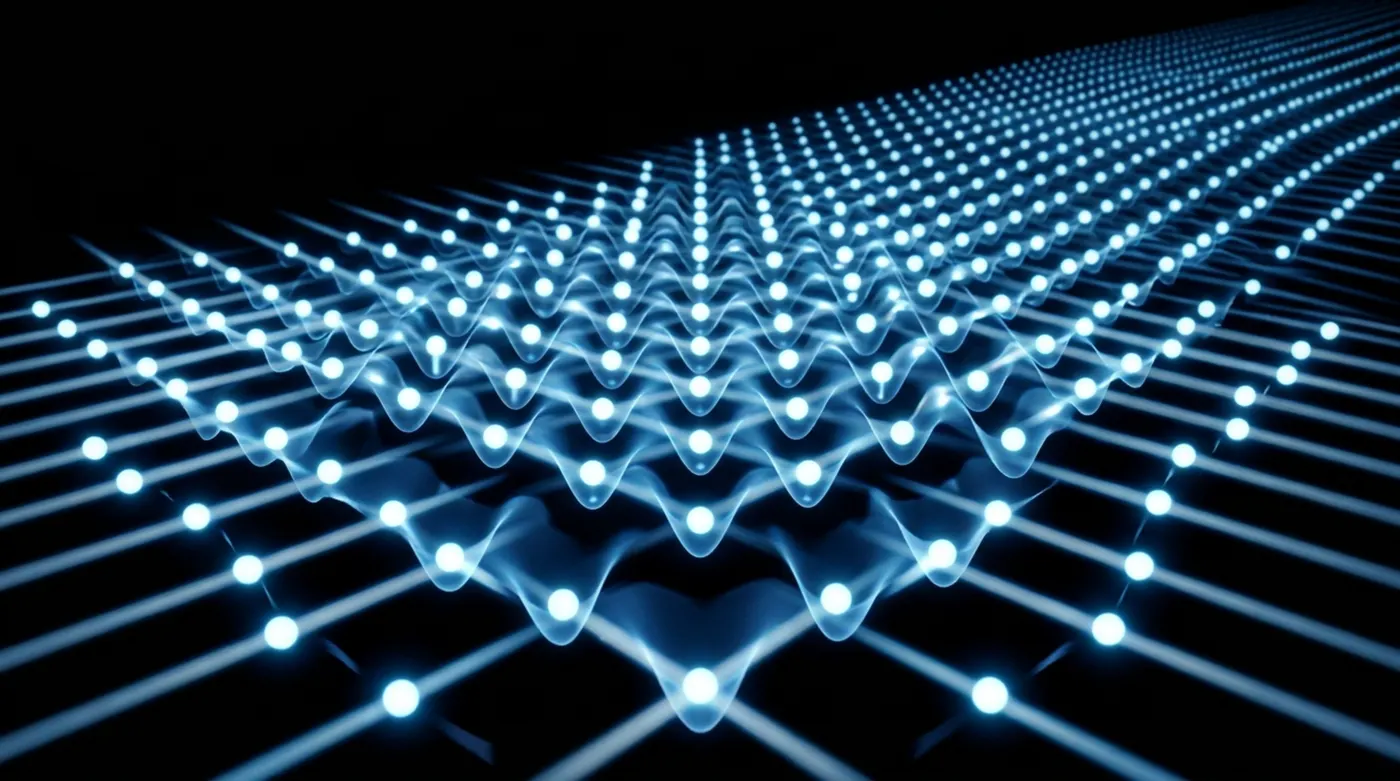
A quantum walk is the quantum mechanical counterpart of a classical random walk. In a classical random walk, a particle moves randomly at each step, and many important algorithms (including PageRank, Monte Carlo methods, and mixing algorithms for sampling) are based on classical random walks. Quantum walks replace classical probabilistic transitions with unitary quantum evolution, producing interference effects that dramatically change the walk’s spreading and mixing behavior.
Discrete vs. Continuous Quantum Walks
There are two main formulations. In a discrete-time quantum walk, a “coin” qubit is used to decide direction: a coin operator (such as the Hadamard gate) acts on the coin register, and then a conditional shift moves the walker based on the coin state. In a continuous-time quantum walk, the Hamiltonian of the system encodes the adjacency matrix of the graph, and the system evolves under Schrodinger’s equation without an explicit coin.
Both formulations spread quadratically faster than their classical counterparts on certain graph structures. A classical random walk on a line takes steps to spread a distance . A quantum walk spreads linearly in , covering the same distance in far fewer steps.
Algorithmic Applications
The Childs et al. (2003) exponential speedup result showed that quantum walks can traverse certain graph structures exponentially faster than any classical algorithm. This was the first demonstration of exponential quantum speedup for a black-box graph problem.
Element distinctness (determining whether all elements of an array are distinct) can be solved with queries using a quantum walk algorithm, compared to classically. This is a provable quantum speedup.
Ambainis’s quantum walk framework generalizes amplitude amplification and underlies several optimal quantum algorithms. The framework converts any Markov chain with certain spectral properties into a quantum walk subroutine that can quadratically accelerate the associated classical algorithm.
Grover’s Algorithm as a Quantum Walk
Grover’s search algorithm can be cast as a quantum walk on a complete graph, where the marked item is an absorbing state. The quadratic speedup of Grover’s algorithm ( vs. classical) corresponds exactly to the quadratic speedup of the quantum walk’s hitting time on this graph.
Physical Implementations
Quantum walks have been experimentally demonstrated in several platforms: photonic systems (where the walk happens on a lattice of beam splitters), trapped ions (with internal states serving as the coin), superconducting circuits, and neutral atom arrays. These experiments verify the interference patterns predicted by quantum walk theory and serve as benchmarks for quantum hardware.
Connection to Quantum Simulation
Quantum walks are closely related to quantum simulation. The continuous-time quantum walk on a lattice graph is equivalent to the evolution of a particle in a tight-binding lattice, which is a model studied in condensed matter physics. Quantum simulation of molecular and materials Hamiltonians often uses quantum walk-inspired Trotterization techniques to decompose the evolution into implementable circuit steps.