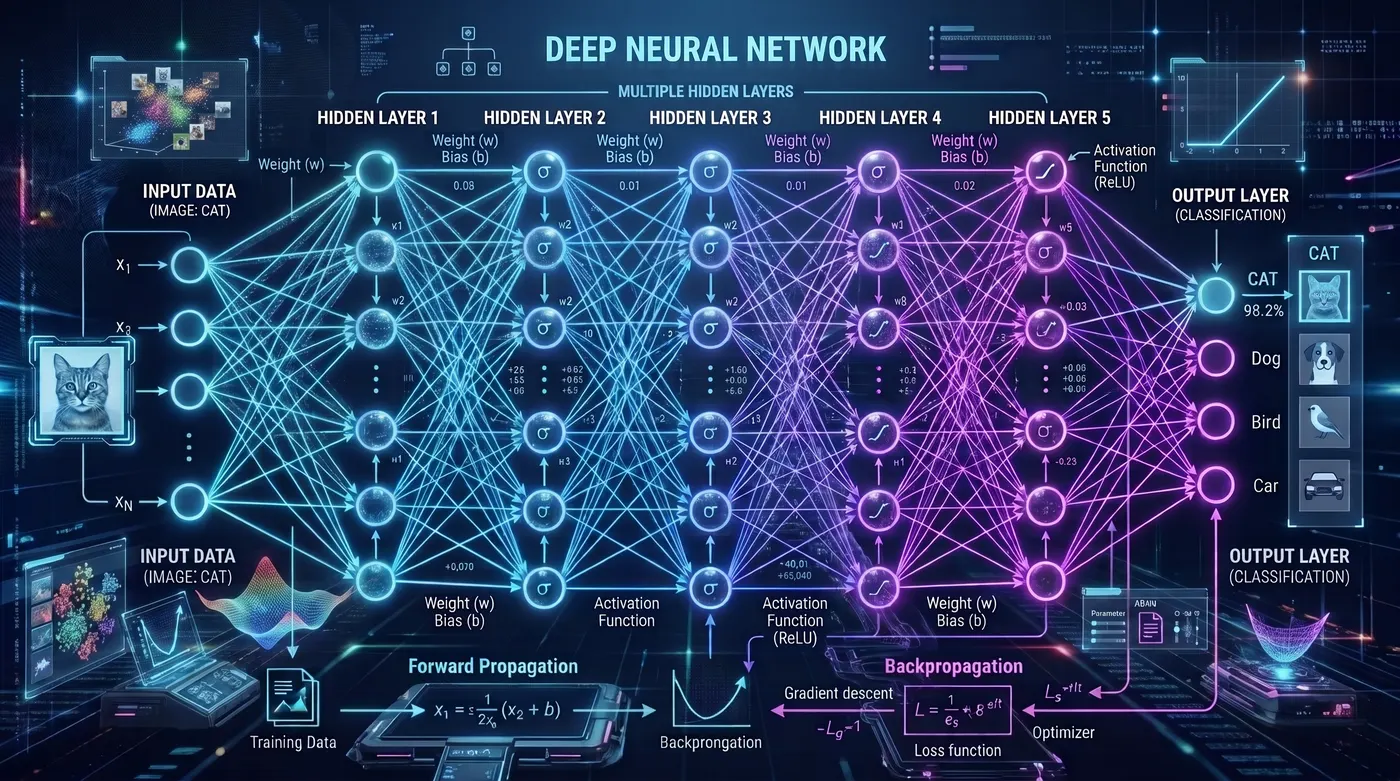
Quantum machine learning (QML) encompasses algorithms that use quantum computers to accelerate or enhance learning from data. The central question in the field is whether and when a quantum computer can solve a machine learning problem provably faster, more accurately, or with fewer samples than any classical algorithm. This question has proven far harder to answer than early enthusiasm suggested, but rigorous results have emerged that carve out specific regimes where quantum advantage is theoretically grounded.
Where advantage claims come from
Early QML proposals in the 2010s leveraged the HHL linear systems algorithm to claim exponential speedups for tasks like principal component analysis, support vector machine training, and least-squares regression. These algorithms operate on quantum-encoded data and produce quantum-encoded outputs, and their query complexity is exponentially smaller than the best known classical algorithms on the same inputs. The catch, identified by a series of classical dequantization results starting around 2018, is that if the classical algorithm is given access to sampling-based data structures (such as classical analogs of quantum RAM), it can match the quantum speedup on the same tasks. This substantially narrowed the landscape of legitimate QML advantage claims.
Quantum kernel methods
A more structurally motivated source of advantage is quantum kernel methods. A quantum kernel is a similarity measure between data points computed by running a quantum circuit: , where is a quantum feature map encoding a data point . The key insight is that the quantum feature maps can implement functions of the data that are hard for classical computers to evaluate, defining a kernel function in an exponentially large feature space that cannot be accessed directly by any efficient classical method.
Whether this leads to a learning advantage depends on whether the data has a structure that the quantum feature space captures well. Theoretical work has shown that for certain synthetic datasets, notably those generated by quantum processes or with correlations that mirror quantum circuit structure, quantum kernel methods can achieve provably lower generalization error than any efficient classical kernel. For generic classical datasets, no such guarantee exists. This is the central honesty constraint in QML: advantage is data-dependent, not universal.
Quantum neural networks and variational approaches
Quantum neural networks (QNNs) and variational quantum algorithms for machine learning train parameterized quantum circuits on classical data. They are analogous to classical neural networks in that a loss function is minimized by gradient descent, with gradients estimated using the parameter shift rule or direct measurement. The hope is that QNN expressibility (the range of functions a circuit can represent) combined with quantum interference produces models that generalize better than classical networks for certain problem classes.
In practice, QNNs face two serious obstacles: barren plateaus and noise. Barren plateaus are regions of the parameter landscape where gradients vanish exponentially in the number of qubits, making training infeasible for large circuits with random initialization. Noise from current hardware further degrades training signals and limits circuit depth. Active research into better initialization strategies, entanglement-aware architectures, and noise mitigation partially addresses these issues, but trainable large-scale QNNs remain an open engineering challenge.
Quantum generative models
Born machines and quantum circuit Born machines use the Born rule of quantum mechanics as a generative model: the probability of sampling an output string from a quantum circuit is where is the circuit’s output state. This gives a natural connection between quantum computation and probability distributions. Certain distributions (those requiring deep quantum circuits to generate) are conjectured to be hard to sample from classically (a conjecture related to boson sampling hardness), suggesting that quantum generative models can represent a richer class of distributions than efficient classical models.
Near-term and long-term outlook
Near-term QML advantage, on NISQ hardware without error correction, is unlikely for most practical machine learning tasks due to noise, limited qubit count, and barren plateau effects. The most plausible near-term case is learning about quantum data: characterizing quantum states, processes, or Hamiltonians from measurement outcomes, where the data itself has a quantum origin and quantum processing is therefore natural.
Long-term, fault-tolerant QML may deliver genuine advantages for specific structured datasets, particularly those arising from quantum physics, chemistry, or quantum communication, where the data encoding matches the natural structure of quantum circuits. The field’s direction has shifted from broad claims of exponential speedup to careful, task-specific analysis of when the structure of the data and the learning problem actually matches what quantum circuits do well.