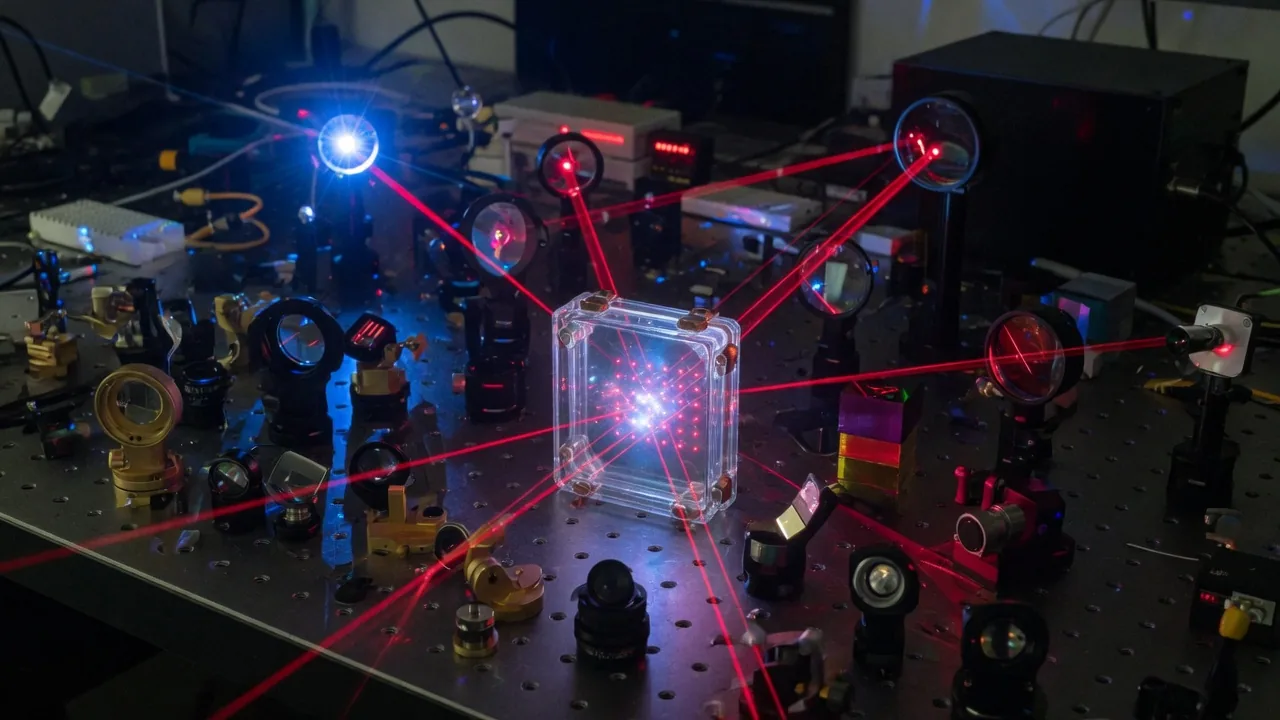
An optical tweezer exploits the interaction between an atom’s induced electric dipole moment and the gradient of a focused laser beam’s intensity profile. When a laser is focused to a diffraction-limited spot (typically by a high-numerical-aperture microscope objective), the intensity gradient near the focus creates a restoring force that pulls a polarizable atom toward the intensity maximum, trapping it in three dimensions. The trapping potential is proportional to the laser intensity and inversely proportional to the detuning from the atomic resonance; choosing a far-off-resonance trap (FORT) minimizes photon scattering, which would cause decoherence. Individual atoms are loaded stochastically from a laser-cooled cloud, and a real-time imaging and rearrangement protocol moves atoms with acousto-optic deflectors (AODs) to fill a target array pattern, typically achieving 95-99% site occupancy. Array sizes have grown rapidly: systems at Harvard, MIT, and companies like QuEra and Atom Computing now demonstrate programmable arrays of hundreds to over a thousand atoms.
Entangling gates between neutral atom qubits in optical tweezers are most commonly implemented via the Rydberg blockade mechanism. When two atoms within the blockade radius (typically a few micrometers) are both illuminated by a laser resonant with a transition from the ground state to a high-n Rydberg state, the strong dipole-dipole interaction between the Rydberg states shifts the doubly-excited energy level out of resonance. This blockade prevents both atoms from being simultaneously excited: if atom A is in the Rydberg state, atom B cannot be excited. A sequence of three pulses (excite control, rotate target conditionally, de-excite control) implements a controlled-Z or controlled-NOT gate with fidelities now reaching 99.5% on the best systems. The gate time is typically 100-500 nanoseconds, limited by the Rydberg lifetime and the Rabi frequency of the drive laser.
A major architectural advantage of optical tweezer arrays over fixed-topology superconducting chips is reconfigurability. Atoms can be physically shuttled between sites mid-circuit using AODs or spatial light modulators, enabling any-to-any connectivity and mid-circuit measurement followed by atom reloading to reset ancilla qubits without disturbing the data register. This flexibility makes neutral atom platforms particularly attractive for implementing quantum error-correcting codes, which require non-local connectivity patterns, and for zoned architectures where storage zones, entanglement zones, and readout zones are physically separated. The main challenges are atom loss (an atom that escapes its tweezer is lost from the computation), slower clock speeds compared to superconducting qubits (microseconds per gate vs. nanoseconds), and the difficulty of scaling laser infrastructure to address thousands of qubits independently.